+86 13816508465
Pump Knowledge
Nov. 20, 2026
Choose a single-stage centrifugal pump when its verified performance curve meets the required flow and total dynamic head (TDH) with a suitable operating margin. Consider a multistage pump when higher head is required at the same duty flow, or when a compact pressure-boosting arrangement is needed. Neither design is automatically more efficient or reliable: the operating point, liquid, suction conditions, installation and lifecycle costs determine the better choice.
For water pump buyers, the most useful comparison is not the number of impellers alone. It is whether a specific model can deliver the required flow and head together.
A single-stage centrifugal pump uses one impeller to add energy to the liquid. A multistage centrifugal pump uses two or more impellers arranged in series; each stage contributes to the total developed head. The water generally passes through successive stages at approximately the same flow rate.
Multistage construction is often useful for higher-head duties, but a properly selected single-stage pump can also provide substantial head. Pump type alone does not establish efficiency, noise level or suitability.
| Selection factor | Single-stage | Multistage |
|---|---|---|
| Hydraulic arrangement | One impeller | Two or more impellers in series |
| Head requirement | Practical when a model meets the duty head | Often selected for higher-head duties |
| Flow capability | Model- and curve-dependent | Model- and curve-dependent; stages do not simply multiply flow |
| Maintenance | Often fewer hydraulic components | More internal stages to inspect; service design varies |
| Installation format | Many conventional surface configurations | Horizontal and vertical formats available |
| Energy consumption | Depends on duty-point efficiency | Depends on duty-point efficiency; not automatically lower |
To shortlist suitable pumps, provide the required flow rate (Q) and total dynamic head (H). TDH includes the elevation difference, required delivery pressure and estimated friction losses, adjusted for the actual inlet conditions.
Consider a clean-water transfer system with these hypothetical requirements:
| Required flow rate | 60 L/min (3.6 m³/h) |
| Elevation rise | 12 m |
| Required delivery pressure head | 25 m |
| Estimated pipe and fitting losses | 8 m |
| Illustrative total head | 45 m at 60 L/min |
Assumption: the reference supply pressure is approximately zero gauge and the selected elevations and friction loss are applicable to the same operating flow. This is a teaching example, not an installation survey or a Stream pump test.
Decision: Compare each candidate's Q–H curve at 60 L/min and 45 m. A single-stage model is acceptable if it reaches the duty point within its permitted operating range. Otherwise, check a properly sized multistage model. Do not compare a pump's maximum flow with its maximum head as though both occur simultaneously.
| Stream series | Design | Published range / example | Selection use |
|---|---|---|---|
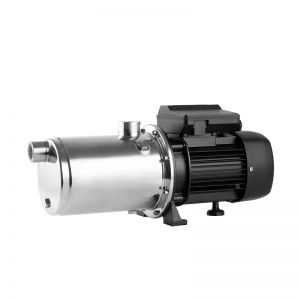
| SCPM | Conventional single-stage centrifugal | SCPM146: max flow 90 L/min; max head 25 m | Clean-water transfer, garden irrigation, moderate-pressure duties |
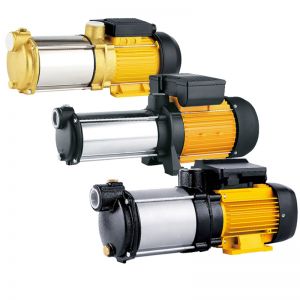
| MH | Horizontal multistage | Series maximum-flow coverage 60–365 L/min; maximum-head coverage 22–137 m | Higher-head water transfer and boosting where horizontal installation suits |
| MV | Vertical multistage | Series maximum-flow coverage up to 365 L/min; maximum-head coverage 22–130 m | Higher-head water boosting where vertical layout is preferred |
Source: Stream public product pages. Series values cover different models; listed maxima are not guaranteed together at one duty point. Consult the performance curve for the exact model before purchasing.
For an explanation of horizontal versus vertical multistage layouts, see Stream MH vs MV: Horizontal and Vertical Pump Guide.
| Application | Initial direction | Confirm before ordering |
|---|---|---|
| Short-distance clean-water transfer | Single-stage may be sufficient | Q–H duty point, suction conditions |
| High-pressure sprinkler irrigation | Compare multistage and suitably rated single-stage models | Sprinkler pressure at design flow, pipe losses |
| Multi-floor water boosting | Consider multistage models | Peak demand, inlet pressure, control method |
| Limited floor space in a plant room | Consider vertical multistage layout | Clearance, maintenance access, pipe layout |
| Abrasive or chemically aggressive liquid | Neither type without checking compatibility | Materials, seals, solids and temperature |
What flow rate is required at the design operating point?
What total dynamic head is required, including outlet pressure and friction losses?
What liquid will be pumped, and what are its temperature and quality?
What are the inlet level, suction lift and available inlet pressure?
Is horizontal or vertical installation preferred, and what maintenance clearance is available?
What voltage, frequency, control method and daily operating schedule are required?
Send these details when asking Stream to compare SCPM single-stage and MH/MV multistage options.
No. Efficiency depends on the specific pump curve and operating point. Compare input power and hydraulic efficiency for models that meet the same required flow and head.
Stages arranged in series mainly add head. They do not multiply the flow through the pump.
Possibly. It must meet the required flow and pressure at the actual duty point, with suitable suction conditions and controls. Building height alone does not determine pump type.
Choose the pump that meets the design flow and head at an acceptable operating point—not simply the pump with more stages. A single-stage model can be the practical choice for moderate duties; multistage models broaden higher-head options and offer different installation layouts. Verify the exact Q–H curve, inlet conditions and total operating cost before purchase.
For additional background, see Stream's earlier single-stage vs multistage overview. To compare models for your project, send Stream your duty-point requirements.
Technical references
Product ranges and examples: Stream SCPM, Stream MH and Stream MV. General multistage hydraulic principles: Hydraulic Institute Pump FAQs. Pump efficiency and product classifications: European Commission Water Pumps. No independent Stream comparative test is claimed.
Address
No.17 XeDa Jimei Ind. Park, Xiqing Economic Development Area, Tianjin, China
Telephone
+86 13816508465
QUICK LINKS