+86 13816508465
Pump Introductions
Sep. 10, 2026
Water-supply systems often need more pressure than a conventional single-stage centrifugal pump can provide.
A long irrigation line, several sprinklers, a multi-story home or a small commercial booster system may require both useful water flow and substantially higher pressure.
This is where multistage centrifugal pumps become particularly useful.
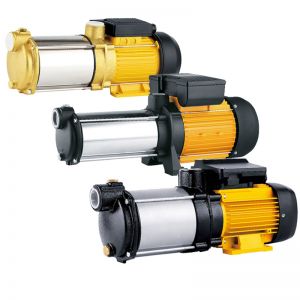
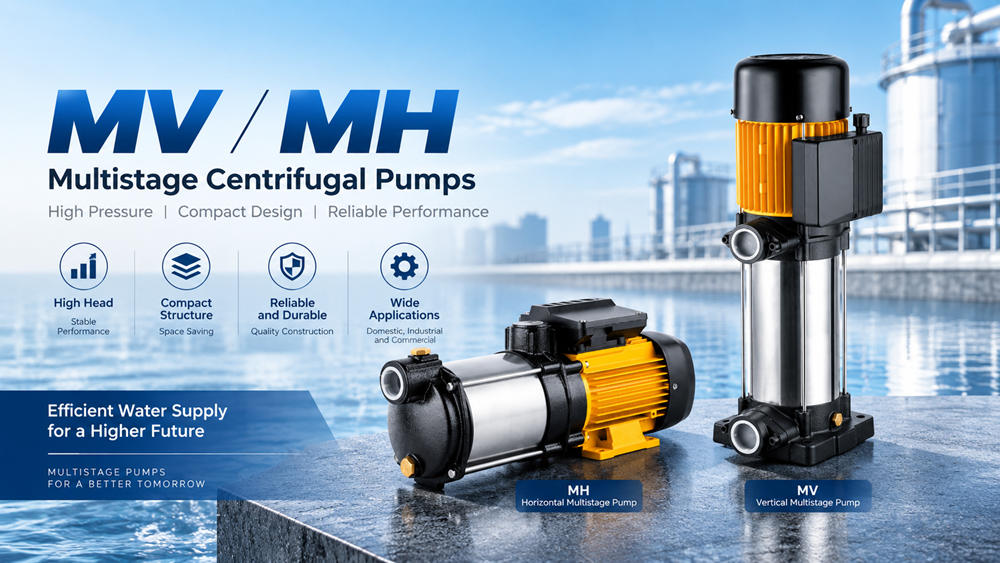
The Stream MH and MV series are compact multistage centrifugal pumps designed for clean-water transfer, pressure boosting, sprinkler irrigation, drip irrigation and domestic or light commercial water-supply systems.
The two pump families share very similar hydraulic concepts and application ranges.
Their most obvious difference is installation orientation:
MH — horizontal multistage centrifugal pump
MV — vertical multistage centrifugal pump
This gives users two installation formats for similar water-supply requirements.
Where horizontal space and easy conventional access are preferred, the MH can be a practical choice.
Where floor space is limited, the upright MV configuration can make better use of the available installation area.
This guide explains how multistage centrifugal pumps work, the similarities and differences between the Stream MH and MV series, and how to choose between horizontal and vertical installation.
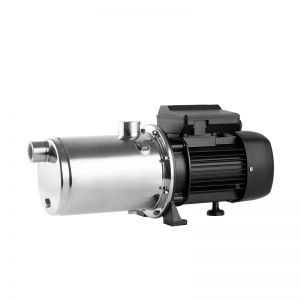
The Stream MH and MV are surface-mounted centrifugal pumps using multiple impellers arranged in series.
Each hydraulic stage adds energy to the pumped water.
Instead of asking one large impeller to generate the complete pressure increase, several smaller impellers progressively build head as the water moves through the pump.
This allows a compact pump to produce significantly higher pressure than many conventional single-stage domestic water pumps.
Both ranges are primarily intended for clean-water applications.
The Stream MH is the horizontal configuration of this compact multistage pump platform.
The motor and hydraulic stages are arranged horizontally along a common axis.
Stream specifies the MH series with maximum flow coverage from approximately 60 to 365 L/min and maximum head coverage from approximately 22 to 137 m across the range.
Different models are available for different combinations of flow, head and application requirements.
Its main applications include:
Domestic water boosting
Booster pump sets
Water transfer
Sprinkler irrigation
Drip irrigation
Garden water supply
Light commercial water systems
The Stream MV uses the same general multistage pumping principle but arranges the hydraulic section vertically.
Its upright configuration reduces the amount of floor space required around the pump.
The MV series provides capacity up to approximately 365 L/min and maximum head coverage up to approximately 130 m across the available models.
Its intended applications are very similar to the MH:
Domestic pressure boosting
Water transfer
Sprinkler systems
Drip irrigation
Booster systems
General clean-water supply
| Feature | Stream MH | Stream MV |
|---|---|---|
| Configuration | Horizontal | Vertical |
| Pump Type | Multistage centrifugal pump | Multistage centrifugal pump |
| Maximum Series Flow | Up to approximately 365 L/min | Up to approximately 365 L/min |
| Maximum Series Head | Up to approximately 137 m depending on model | Up to approximately 130 m depending on model |
| Floor Space | Requires more horizontal installation length | Smaller floor footprint |
| Typical Application | Water supply, irrigation and boosting | Water supply, irrigation and boosting |
The ranges are therefore very similar in application, but individual models should still be selected according to their specific pump curves rather than assuming that every MH and MV model has identical performance.
A multistage centrifugal pump contains several impellers positioned one after another.
Water enters the suction side and reaches the first impeller.
As the impeller rotates, mechanical energy from the electric motor is transferred to the water.
The water then passes through a diffuser or hydraulic channel that directs it toward the next impeller.
The second impeller adds additional hydraulic energy.
This process continues through the remaining stages until the water reaches the discharge.
The result is progressively increased head across the pump.
The main advantage of arranging centrifugal stages in series is that the head produced by each stage is added together.
In simplified form:
Total Head ≈ Stage 1 Head + Stage 2 Head + Stage 3 Head + Additional Stages
This makes multistage pumps particularly useful where relatively high pressure is required without using an extremely large single impeller.
| Feature | Multistage Pump | Single-Stage Pump |
|---|---|---|
| Number of Impellers | Multiple | One |
| Typical Strength | Higher pressure/head | Simple construction and useful general flow |
| Typical Application | Boosting, irrigation and pressurized water supply | Transfer and general water pumping |
Large industrial multistage pumps are commonly associated with very high-pressure processes and large mechanical rooms.
However, many domestic, agricultural and light-commercial applications need the hydraulic advantages of multiple stages without requiring a large industrial pump.
Compact multistage pumps such as the MH and MV meet this market requirement.
They provide useful combinations of:
High head
Moderate to high flow
Compact dimensions
Low-noise operation
Simple surface installation
Multiple material configurations
When two pumps use similar hydraulic designs, orientation mainly changes how the equipment fits into the installation.
The water does not become more pressurized simply because the pump is vertical.
Likewise, a horizontal pump is not automatically more efficient simply because the shaft is horizontal.
The actual pump curve, hydraulic stages, impeller design and motor determine performance.
Orientation primarily affects:
Floor footprint
Overall height
Pipe arrangement
Maintenance access
Mechanical-room layout
A horizontal multistage pump can be particularly convenient where sufficient floor space is available.
Typical reasons to choose the MH include:
Existing horizontal pump installation
Low ceiling height
Easy side access for inspection
Traditional domestic booster layout
Simple connection to horizontally arranged piping
Horizontal pumps are particularly familiar to installers because they resemble conventional household centrifugal and self-priming pump layouts.
The main advantage of a vertical configuration is reduced floor-space requirement.
The hydraulic stages extend upward instead of horizontally across the pump room.
This can be useful where:
Floor area is limited
The pump is installed inside a compact equipment room
Several pumps must be installed side by side
A narrow booster-system footprint is preferred
Vertical equipment arrangement better fits the project
No.
A common misconception is that a vertical multistage pump must automatically produce more pressure because its impellers are stacked vertically.
Pressure is created by the hydraulic stages, not by the physical direction in which they are arranged.
A horizontal multistage pump using a similar number and design of stages can produce comparable head.
This is clearly demonstrated by the Stream MH and MV ranges, which cover very similar hydraulic performance envelopes despite using different orientations.
Again, not necessarily.
Flow capability depends primarily on hydraulic passage size, impeller geometry and rotational speed.
Both Stream families reach approximately 365 L/min at the upper end of their respective product ranges.
The most practical orientation choice often comes down to available space.
| Installation Constraint | Often Better Choice |
|---|---|
| Limited floor area | MV Vertical |
| Limited installation height | MH Horizontal |
| Horizontal existing piping | MH may simplify layout |
| Several pumps installed closely together | MV can reduce required floor footprint |
One of the primary applications of both the MH and MV is domestic water boosting.
Homes and small buildings can experience insufficient pressure because of:
Low municipal supply pressure
Multiple floors
Long pipe runs
Multiple simultaneous outlets
Water supplied from storage tanks
A multistage pump can provide additional pressure while maintaining useful water flow.
Both pump families can be incorporated into automatic booster systems.
A basic system may combine:
MH or MV pump
Pressure tank
Pressure switch or electronic controller
Pressure gauge
Check valve
More advanced systems can use variable-speed control to maintain constant pressure according to demand.
For larger buildings, several multistage pumps can be installed in parallel.
One pump may operate during low demand.
As water demand increases, additional pumps can start automatically.
This arrangement can provide better flexibility than operating one oversized pump continuously.
Both Stream MH and MV are suitable for garden and irrigation water supply.
A multistage pump is particularly useful when irrigation equipment requires meaningful operating pressure.
Applications include:
Garden hoses
Sprinklers
Drip irrigation
Greenhouses
Small farms
Landscape irrigation
A sprinkler needs more than simply water flow.
Water must leave the nozzle at sufficient pressure to produce the intended spray pattern and coverage.
If available head is too low, spray radius decreases and irrigation becomes uneven.
Multistage pumps are well suited to this type of pressure-dependent application.
Drip systems normally operate at lower pressure than many sprinklers but may include long pipe runs, filters, valves and many emitters.
The pump must therefore provide sufficient pressure to overcome the complete system resistance.
Pressure regulation may be required to match pump output to the drip system.
The MH and MV can also transfer clean water between tanks, reservoirs and suitable water systems.
A multistage pump becomes particularly attractive when water must travel:
Over long distances
Up significant elevation
Through relatively long pipelines
Through filters or other pressure-consuming equipment
Although compact compared with large industrial pumps, the upper end of the MH and MV ranges provides meaningful hydraulic capacity.
Suitable models can therefore be considered for light commercial applications such as:
Small hotels
Restaurants
Shops
Apartment buildings
Small commercial booster systems
Water-treatment equipment
Noise is an important consideration when a booster pump is installed near occupied spaces.
Stream positions both MH and MV as low-noise multistage pump families.
The multistage hydraulic arrangement allows pressure to be developed progressively across several impellers, contributing to smoother hydraulic operation when the pump is correctly selected and installed.
Actual sound levels depend on model, installation and operating point.
Even a quiet pump can become noisy if it is installed incorrectly.
Possible causes include:
Rigid pipe vibration
Cavitation
Poor foundation
Air in the suction pipe
Operating far from the correct duty point
Correct hydraulic selection and pipe installation are therefore essential for achieving low-noise operation.
Stream specifies self-priming capability up to approximately 6 meters for the MH and MV series under suitable installation conditions.
This can simplify applications where the water source is located below the pump.
Actual suction performance depends on several factors including water temperature, pipe diameter, suction-line sealing and installation elevation.
A conventional centrifugal pump normally requires the pump body and suction pipe to be filled with water before startup.
A self-priming design is capable of evacuating a limited amount of air from the suction line after initial filling and establishing water flow.
This makes installation more convenient in tank and irrigation systems where the water source is below pump level.
A nominal self-priming value should not be treated as a guaranteed suction depth in every installation.
Practical suction lift decreases when:
Water temperature rises
Installation altitude increases
Suction piping is too narrow
The suction pipe is too long
Air leaks exist in fittings
For best performance, keep the suction pipe as short and direct as practical.
Both Stream MH and MV use stainless steel pump-body construction.
For clean-water pumping, stainless steel offers several advantages:
Good corrosion resistance
Clean water-contact surface
Durable external appearance
Suitable construction for domestic and commercial clean-water systems
Stream specifies PPO material for the diffuser components.
Engineering plastics such as PPO allow manufacturers to produce accurate hydraulic passages while keeping the pump compact and controlling overall weight.
The MH and MV ranges are available with different impeller-material configurations depending on the selected model.
Stream lists PPO and stainless steel as available impeller materials.
This provides flexibility between economical engineered-plastic hydraulics and more metal-intensive configurations.
Impeller material should be selected according to:
Water quality
Required durability
Budget
Operating frequency
Application requirements
The correct configuration should be confirmed from the specific model technical data.
Stream specifies dry-run protection for applicable single-phase MH and MV configurations.
Dry running occurs when the pump continues operating without sufficient water.
This can cause rapid heating and damage the mechanical seal and hydraulic components.
Integrated protection can provide an additional safeguard, although correct system installation remains essential.
| Parameter | MH | MV |
|---|---|---|
| Pump Type | Horizontal multistage centrifugal | Vertical multistage centrifugal |
| Maximum Series Flow | Up to 365 L/min | Up to 365 L/min |
| Maximum Series Head | Up to approximately 137 m depending on model | Up to approximately 130 m depending on model |
| Maximum Ambient Temperature | 40°C | 40°C |
| Maximum Fluid Temperature | 80°C | 80°C |
| Maximum Working Pressure | Refer to individual model; standard working condition listed up to 10 bar | Up to 10 bar under stated working conditions |
| Pump Body | Stainless steel | Stainless steel |
| Diffuser | PPO | PPO |
| Impeller | PPO / Stainless steel | PPO / Stainless steel |
| Insulation | Class B / F | Class B / F |
| Duty | Continuous rated | Continuous rated |
The first question when choosing between MH and MV should not be whether the pump looks better horizontally or vertically.
The first two questions should be:
How much water do I need?
How much head does the system require?
Once the hydraulic duty is known, users can select suitable models from the MH or MV range and then choose the installation format that fits the available space.
Required flow depends on the application.
For a household booster system, calculate the expected simultaneous water demand.
For irrigation, add the flow requirements of sprinklers or drip zones operating at the same time.
For water transfer, consider how quickly the tank or reservoir needs to be filled.
Total dynamic head can include:
Vertical elevation
Required outlet pressure
Pipe friction
Valve resistance
Filter pressure loss
Sprinkler pressure requirement
A simplified relationship is:
Total Dynamic Head = Static Elevation + Required Pressure + Friction Losses
Maximum pump head normally occurs when flow approaches zero.
A working water system requires both flow and pressure at the same time.
The correct operating point is therefore found on the pump performance curve.
Do not select MH or MV simply because the maximum head printed in the catalogue exceeds the required value.
Maximum flow is typically measured at relatively low head.
As the system requires more pressure, available flow decreases.
The pump curve should therefore be checked at the actual required head.
Every centrifugal pump has an operating region where hydraulic efficiency is best.
Selecting a pump reasonably close to this region can contribute to:
Lower energy consumption
Lower hydraulic vibration
Reduced mechanical stress
Longer seal and bearing life
A larger pump does not automatically create a better water system.
If the pump produces much more pressure than required, installers may need to throttle the discharge valve.
This wastes hydraulic energy and can increase electricity consumption.
Excessive pressure can also place unnecessary stress on pipes and fittings.
An undersized pump may provide acceptable pressure when only one outlet is open but lose pressure rapidly when several users operate simultaneously.
In irrigation, insufficient pressure can reduce sprinkler radius and create uneven watering.
The correct model should therefore satisfy both required flow and required head.
Jet pumps and multistage pumps can both be used for domestic boosting and irrigation.
However, they emphasize different strengths.
| Feature | MH / MV Multistage | Typical Jet Pump |
|---|---|---|
| Hydraulic Principle | Multiple centrifugal stages | Jet / venturi-assisted self-priming |
| Pressure Generation | Progressive across several stages | Single hydraulic system |
| Typical Strength | Smooth high-pressure water supply | Strong suction and conventional self-priming applications |
The Stream MH and MV should also be distinguished from much larger industrial vertical multistage pumps.
MH and MV are compact surface pumps aimed mainly at domestic, agricultural and light-commercial clean-water applications.
Industrial vertical multistage pumps may use larger flange connections, higher-pressure ratings, industrial-standard motors and different materials for demanding building and process applications.
The correct pump family should therefore be selected according to the scale of the installation rather than simply because both products use several impellers.
Both MH and MV can be suitable.
If hydraulic performance is similar, the decision can primarily be based on installation space and piping arrangement.
A traditional pump room with sufficient floor space may favor MH.
A compact equipment cabinet or narrow pump room may favor MV.
Again, neither orientation is automatically better.
The correct model is the one that provides the required flow and pressure at the intended irrigation duty point.
After hydraulic requirements are satisfied, select the orientation that best fits the site.
Vertical pumps can make it easier to arrange several pumps within a compact skid because they use less floor length.
Horizontal pumps can provide convenient service access and are familiar to many installers.
Both can therefore be incorporated into suitable booster-system designs.
Install the pump on a stable surface to reduce vibration.
Long suction pipes increase friction and reduce available suction performance.
Even a small suction-side air leak can interfere with priming and reduce pump performance.
Restrictive suction piping can increase hydraulic losses and contribute to cavitation.
Valves can simplify maintenance and pump replacement.
Follow the pump instructions before initial operation, even where self-priming capability is provided.
Cavitation occurs when local pressure in the pump falls low enough for vapor bubbles to form.
When these bubbles collapse inside higher-pressure areas, they can create noise, vibration and hydraulic damage.
Possible causes include:
Excessive suction lift
Blocked suction line
Undersized suction pipe
High water temperature
Excessive pump flow
Both MH and MV use closed, externally ventilated motors and mechanical seals.
Routine attention should include:
Checking for seal leakage
Monitoring motor noise
Inspecting pipe connections
Checking suction filters
Keeping motor ventilation clear
Monitoring pressure and flow
MH is Stream's horizontal multistage centrifugal pump range for clean-water transfer, irrigation and pressure-boosting applications.
MV is the vertical version of Stream's compact multistage centrifugal pump concept, designed for similar clean-water and pressure-boosting applications with a smaller floor footprint.
The main practical difference is installation orientation. MH is horizontal, while MV is vertical. Their application and hydraulic ranges are broadly similar, although individual model performance is not necessarily identical.
The MV vertical configuration generally requires less floor area because its hydraulic stages extend upward.
A horizontal MH can be more convenient where installation height is limited.
No. Pump pressure is created by the hydraulic stages, not by whether the pump is mounted vertically or horizontally.
Both ranges include models capable of approximately 365 L/min at the upper end of the series, depending on model and operating point.
The MH product family reaches approximately 137 m maximum head on selected configurations, while the MV range reaches approximately 130 m depending on model.
Stream specifies self-priming capability up to approximately 6 m under suitable conditions.
Yes. Sprinkler irrigation is one of the intended applications for both series.
Yes. Both product pages list drip irrigation among the intended applications.
Yes. Domestic water boosting and booster systems are core applications of both pump families.
Stream specifies a maximum pumped-fluid temperature of 80°C under the stated working conditions.
The specified maximum ambient temperature is 40°C.
The Stream product specifications list a stainless steel pump body.
PPO and stainless steel impeller configurations are available depending on the selected model.
Stream lists both MH and MV for continuous-rated duty under the specified operating conditions.
First determine the required flow and head. If suitable models are available in both ranges, then choose according to floor space, installation height, piping arrangement and maintenance preference.
The Stream MH and MV demonstrate why pump orientation does not need to dictate application.
Both are compact multistage centrifugal pump families designed to provide high-pressure clean-water pumping for domestic supply, irrigation, water transfer and booster systems.
Both use multiple hydraulic stages to progressively increase water pressure, and both are available across broad flow and head ranges for different project requirements.
Their primary difference is how that hydraulic system is packaged.
The MH arranges the pump horizontally, providing a familiar installation layout with relatively low overall height.
The MV arranges the hydraulic section vertically, reducing floor-space requirements and making it attractive for compact pump rooms and booster installations.
With stainless steel pump bodies, multiple impeller-material options, low-noise operation, self-priming capability and applications ranging from garden irrigation to domestic and light-commercial pressure boosting, the two series provide users with flexibility without requiring completely different pumping technologies.
The best selection principle is therefore straightforward:
Choose the required flow and head first. Choose horizontal or vertical installation second.
For systems where floor area is available and conventional horizontal installation is preferred, the Stream MH provides a practical solution.
For systems where compact floor footprint is a priority, the Stream MV provides similar multistage performance in an upright format.
Address
No.17 XeDa Jimei Ind. Park, Xiqing Economic Development Area, Tianjin, China
Telephone
+86 13816508465
QUICK LINKS