+86 13816508465
Pump Knowledge
Oct. 26, 2026
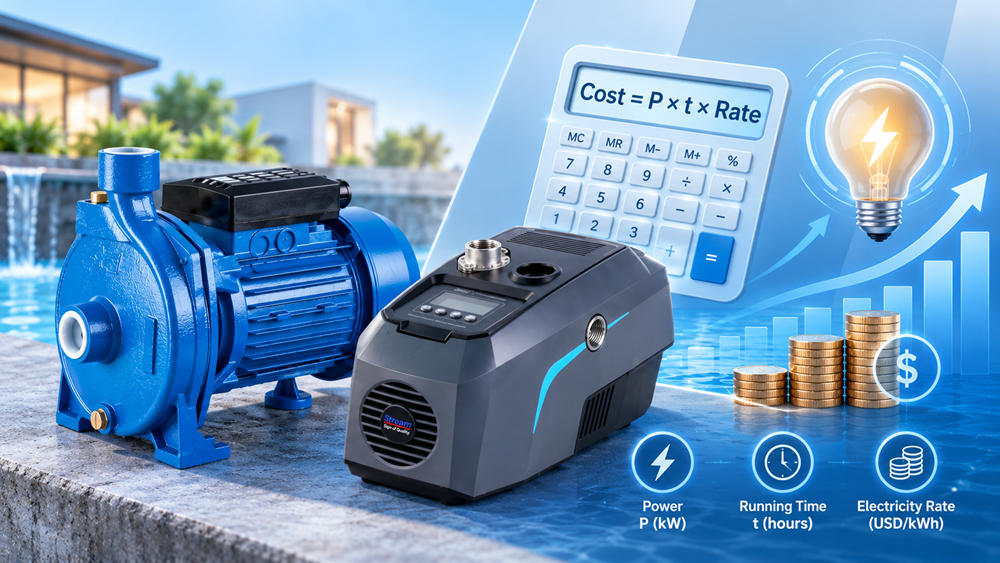
BLUF: To estimate a water pump's electricity cost, multiply its average electrical input power (kW) by the hours it runs and your electricity tariff per kWh. The motor's rated output power and the pump's maximum flow or head do not tell you its exact electricity consumption. For purchasing decisions, compare pumps at the same required flow and head, then include operating hours, installation, maintenance and purchase price.
Quick formula
Energy (kWh) = Input power (kW) × Operating hours (h)
Electricity cost = Energy (kWh) × Tariff (currency/kWh)
| Input | What to collect | Why it matters |
|---|---|---|
| Electrical input power | Measured or reliably specified kW at the operating duty | Determines energy consumption |
| Running time | Hours/day and operating days/year | Converts power to annual energy |
| Electricity tariff | Your local price per kWh | Converts energy into cost |
| Pump duty point | Required flow (Q) and total head (H) | Makes comparisons technically meaningful |
If power varies across the day, calculate each operating period separately and add the kWh. For variable-speed pumps, do not estimate annual consumption from maximum motor power alone.
Suppose a water-transfer pump has a hypothetical average electrical input of 0.80 kW, runs five hours per day for 300 days per year, and electricity costs 0.20 currency units per kWh.
| Annual running time | 5 × 300 = 1,500 hours |
| Annual electricity use | 0.80 × 1,500 = 1,200 kWh |
| Annual electricity cost | 1,200 × 0.20 = 240 currency units |
Illustrative calculation only. The 0.80 kW input, operating schedule and electricity tariff are assumptions, not Stream product test results. Currency is deliberately unspecified so buyers can apply local tariffs.
A catalogue may show the motor's rated power, which can refer to mechanical output rather than measured electricity drawn from the supply. Electrical input also depends on motor efficiency and actual loading. For a pump-and-motor assembly, use a measured wattage, input-power curve or verified supplier information at the specified duty point.
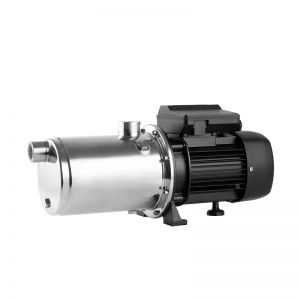
For example, the Stream SCPM146 centrifugal pump lists 550 W, maximum flow of 90 L/min and maximum head of 25 m. These are published catalogue specifications; they do not establish the unit's measured electrical input at every working point. Maximum flow and maximum head are also not simultaneous operating values.
For details on matching flow and head, refer to the pump performance curve guidance or consult the manufacturer's Q–H curve directly.
Imagine two suitable pumps that meet the same flow and head. Their verified average electrical input differs, while operating hours and tariffs remain equal. Here is a transparent example for comparing annual and five-year electricity use:
| Illustrative metric | Pump A | Pump B |
|---|---|---|
| Average electrical input | 0.80 kW | 0.62 kW |
| Annual running hours | 1,500 | 1,500 |
| Annual energy | 1,200 kWh | 930 kWh |
| Annual cost at 0.20/kWh | 240 | 186 |
| Five-year electricity cost | 1,200 | 930 |
Result: Pump B saves 54 currency units per year, or 270 over five years at an unchanged tariff and operating schedule. If Pump B costs 200 more to buy, its simple electricity-only payback is approximately 3.7 years (200 ÷ 54). This excludes finance charges, maintenance differences, installation costs and changes in usage.
Both pumps and power figures in this comparison are hypothetical. It is not a performance comparison between two Stream models.
Select the duty point correctly. Match the pump to required flow and total head rather than choosing by motor watts alone.
Reduce avoidable pipe losses. Check undersized pipes, clogged strainers, unnecessary restrictions and poor layout.
Review operating hours. Automatic stop controls may reduce unnecessary running when the application permits.
Assess variable-speed control where demand changes. Potential savings depend on the system curve, static head and baseline control method—not a universal percentage.
Compare whole-life costs. Consider installation, electricity, servicing, downtime and replacement parts alongside the purchase price.
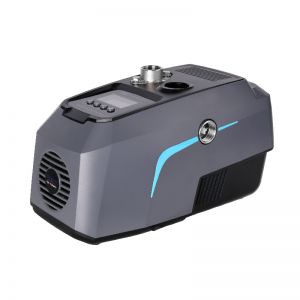
The Stream Hydrobox 900 is an example of a variable-frequency constant-pressure booster system. Its suitability and potential electricity savings must be assessed for the actual supply system; this article does not claim a measured savings rate for Hydrobox 900.
Ask suppliers for the following information before comparing running costs:
Required flow rate (m³/h or L/min) and total dynamic head (m)
Expected operating schedule: hours/day, days/year and peak periods
Pumped liquid, temperature and installation location
Applicable voltage and frequency
Input power or power curve at the intended operating point
Motor and pump efficiency information, where available
Control method: fixed speed, on/off or variable speed
Purchase price, service requirements and expected replacement parts
Review the Stream pump range and contact Stream Pumps with your required duty point, working hours and local electricity tariff to discuss suitable product options.
If 750 W is the actual electrical input maintained for one hour, consumption is 0.75 kWh. If 750 W is only the rated motor output, actual electrical consumption may differ.
No. Electricity use depends on actual input power and operating time. A pump that completes the same duty efficiently in less time may have a different total energy cost than its nameplate rating suggests.
No. Variable-speed control can help where demand changes, but savings depend on system hydraulics, existing controls and operating patterns. Evaluate the application rather than assuming a fixed percentage.
Use verified electrical input, operating hours and local tariff to estimate electricity costs. For a fair purchasing comparison, verify that pumps meet the same required flow and head, then compare whole-life cost—not simply rated watts or purchase price.
Technical references and methodology
Pump model specifications: Stream SCPM Series and Stream Hydrobox 900.
Independent background: Australian Government — Motors and Variable Speed Drives; European Commission — Water Pumps.
All cost comparisons above are transparent teaching calculations, not laboratory results, product efficiency certifications or guaranteed electricity savings.
Previous: None
Address
No.17 XeDa Jimei Ind. Park, Xiqing Economic Development Area, Tianjin, China
Telephone
+86 13816508465
QUICK LINKS