Pump Buying Guide / Distributor Procurement
How to Calculate the Total Cost of Ownership of a Water Pump
Quick answer (BLUF): Calculate a pump's total cost of ownership (TCO) by adding its purchase and installation costs to the energy, operation, preventive maintenance, repair, downtime and end-of-life costs expected over the same service period. Compare candidates only after confirming that they can deliver the same required flow and head. A cheaper pump may cost more over five years if its measured electrical input or servicing needs are higher.
1. What belongs in a water pump's total cost?
A practical TCO assessment covers more than the initial purchase price. Include the pump, motor, controls and accessories actually needed for the specified duty. Account for transport and installation, input electricity, routine servicing, parts, corrective repairs, the expected cost of interruptions, and disposal where material. The life-cycle-cost approach is described in the Hydraulic Institute/Europump Pump Life Cycle Costs guide.
| Cost component | What the buyer should record | Commonly missed item |
|---|---|---|
| Acquisition | Quoted pump, motor, controller, accessories and freight | Different equipment scopes across suppliers |
| Installation | Pipework changes, electrical installation, commissioning | Controls, cables, foundations or local labor |
| Energy | Input kW at real operating conditions × hours × tariff | Part-load consumption, demand charges, changing tariffs |
| Routine maintenance | Planned inspections, seals, bearings, labor and consumables | Scheduled access and technician travel |
| Repairs and downtime | Expected replacement parts, emergency work and interrupted service | Backup pumping and lost production |
| End of life | Removal, disposal and any residual/salvage value | Costs that differ across designs |
2. How to calculate five-year electricity cost
Use measured or credible estimated electrical input power, not the nominal motor rating as if it were always the electricity drawn. Record representative power at each significant duty point, especially for variable-speed pumps with changing demand.
Annual electricity cost = Input power (kW) × Operating hours per year × Electricity tariff (US$/kWh)
For several operating conditions, calculate electricity use for each load segment and add the results. When pumps do not run the same number of hours, compare the energy needed to deliver the same annual water volume at the same service pressure rather than assuming equal hours.
Original worked example: two equally capable pumping solutions
The table assumes both candidate packages meet the same hydraulic duty and operate 2,500 hours per year. Their 1.50 kW and 1.15 kW electrical input figures are hypothetical operating-point values, not a comparison of actual Stream models.
| Assumption | Pump A | Pump B |
|---|---|---|
| Purchase price | US$900 | US$1,250 |
| Installation and commissioning | US$300 | US$300 |
| Average input electricity at representative duty | 1.50 kW | 1.15 kW |
| Operating hours per year | 2,500 h | 2,500 h |
| Electricity price | US$0.16/kWh | US$0.16/kWh |
| Annual electricity consumption | 3,750 kWh | 2,875 kWh |
| Annual electricity cost | US$600 | US$460 |
| Annual routine maintenance budget | US$130 | US$100 |
| Five-year corrective repairs allowance | US$250 | US$150 |
| End-of-life allowance | US$50 | US$50 |
3. Five-year TCO comparison: itemized result
| Five-year cost | Pump A | Pump B |
|---|---|---|
| Purchase | US$900 | US$1,250 |
| Installation | US$300 | US$300 |
| Electricity (five years) | US$3,000 | US$2,300 |
| Planned maintenance (five years) | US$650 | US$500 |
| Corrective repairs allowance | US$250 | US$150 |
| Disposal allowance | US$50 | US$50 |
| Five-year TCO | US$5,150 | US$4,550 |
Assumption limits: Prices, energy use, maintenance and repair allowances are invented for a reproducible illustration. No actual pump models are being compared. The example excludes inflation, changing energy tariffs, tax, unplanned downtime, financing and time value of money. For a major or long-life project, use discounted cash flow (net present value), justified replacement schedules and a sensitivity analysis.
4. Sensitivity check: operating hours can change the decision
Using the same assumed input-power difference of 0.35 kW, a US$0.16/kWh electricity tariff gives US$0.056 in energy savings for every hour operated. That is US$56 per year at 1,000 hours, US$140 at 2,500 hours, or US$224 at 4,000 hours. The economic value of efficiency increases with use, provided both solutions deliver equivalent service.
| Annual operating hours | Annual energy saving for B | Five-year energy saving |
|---|---|---|
| 1,000 | US$56 | US$280 |
| 2,500 | US$140 | US$700 |
| 4,000 | US$224 | US$1,120 |
A buyer should also check sensitivity to electricity prices, load profiles and the likelihood of costly failures. Do not insert a standard energy-savings percentage merely because a package includes variable-speed control. The actual operating point and demand profile matter.
5. Which pump data should buyers request?
Ask every supplier to quote a complete package and document the same application: design flow and total dynamic head, inlet pressure and suction conditions, liquid properties, power supply, operating schedule, performance curve, electrical input or relevant efficiency information, control philosophy, maintenance access and replaceable components. Check that both quotations cover the same accessories and commissioning obligations.
For pump performance, the European Commission's water-pump information provides useful context for hydraulic efficiency and the scope of EU ecodesign requirements; those rules apply to the products and markets within their defined scope and are not universal import rules.
6. Stream Pumps examples: compare configurations, not marketing percentages
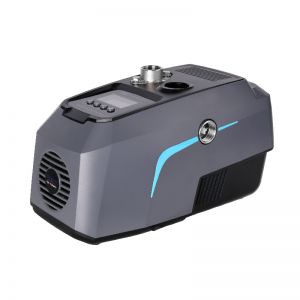
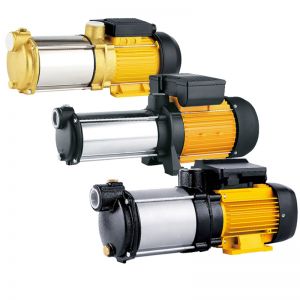
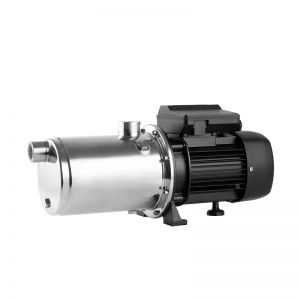
Stream offers different configurations that buyers may evaluate for an appropriate duty. The Hydrobox 900 VFD booster system uses variable-speed pressure control for suitable clean-water boosting applications. Its published maximum flow is 5.2 m³/h and maximum head 50 m; these are separate published limits, not a simultaneous duty point. The MH horizontal multistage range and MV vertical multistage range illustrate alternative mechanical layouts for clean-water transfer and pressure boosting.
These product links are selection references only. Published product descriptions do not demonstrate that one Stream series uses the hypothetical 1.50 kW or 1.15 kW above, nor do they prove a particular five-year saving. For the distinction between input electricity and nameplate power, read Stream's electricity cost calculation guide. For variable-speed savings claims and limitations, see when a VFD pump actually saves energy.
Stream's customer support information describes pre-sale and after-sale assistance, but buyers should confirm the exact warranty scope, spare-parts availability, lead times and service terms for each order. No fixed warranty period or guaranteed stock is assumed here.
7. Distributor's pump TCO request-for-quotation checklist
Duty: required flow (m³/h), total dynamic head (m), suction conditions and water quality.
Operating profile: hours/year, low/normal/peak demand proportions and planned years of service.
Energy: measured or documented input power at relevant operating points, local tariff and control losses.
Scope: pump, motor, VFD/controller, sensors, pressure tank, valves, cables and spares included.
Commercial terms: quoted unit price, currency, Incoterm and named place, freight, tax, installation and commissioning.
Maintenance: scheduled tasks, spare-part numbers, replacement intervals as applicable and labor assumptions.
Risk: expected downtime consequence, backup needs, repair arrangements and service response terms.
Documentation: Q-H curve, relevant performance data, electrical specifications and applicable conformity documents.
Contract: written warranty coverage, exclusions, spare-part ordering procedures and support contacts.
Analysis: five-year cost table, sensitivity to operating hours and tariffs, and optional discounted cash flow.
Frequently asked questions
Is the lowest-priced water pump always the lowest-cost choice?
No. A low purchase price can be outweighed by higher electricity, maintenance, installation or interruption costs. Compare packages for equivalent delivered water service.
Should I use motor-rated kW to calculate electricity cost?
Use representative electrical input kW wherever possible. Rated motor output and actual electrical input are not interchangeable, and variable-demand operation can change consumption over time.
Does a variable-frequency-drive pump always have a lower TCO?
No. Benefits depend on demand variation, static head, operating schedule, pump selection, controller cost and real system power use. A suitable fixed-speed pump may be competitive for stable duty.
Should maintenance and downtime be treated as guaranteed annual costs?
No. These are planning estimates based on maintenance schedules, reliability records and application risk. For key installations, show both the base case and a higher-risk scenario.
What information should a distributor send Stream before requesting a TCO comparison?
Provide the application, duty-point flow and head, supply voltage and frequency, annual operating hours, control requirements, target market, water quality and relevant commercial constraints. Ask for model-specific curves and electrical data before estimating operating costs.
Conclusion
The best pump purchase decision is based on the cost of delivering the required water service over time—not only the invoice price. Verify flow and head first, use credible input-power data for the actual demand profile, and document maintenance, failure risk and support assumptions. Then calculate the five-year total for every candidate on the same basis.
Technical basis and disclosure
Hydraulic Institute / Europump — Pump Life Cycle Costs (second edition) (life-cycle-cost methodology; trade-association guide, not a product endorsement).
European Commission — Water Pumps (scope and product efficiency information for relevant EU markets).
Stream Hydrobox 900; Stream Customer Support (product and service descriptions; not test results for the example).
Transparency: All financial amounts, runtime values, electrical input values and maintenance allowances used in the calculations above are original illustrative assumptions; they are not Stream quotations, published energy measurements, warranty terms or case-study outcomes. Published manufacturer specifications must be checked against the selected model and duty point.