+86 13816508465
Pump Knowledge
Oct. 20, 2026
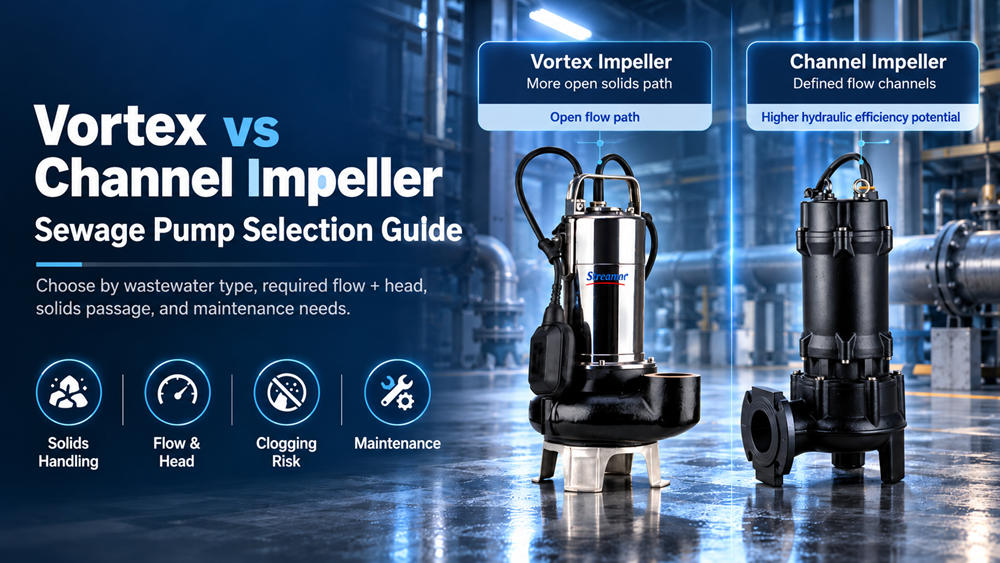
Bottom line: Neither a vortex impeller nor a channel impeller is always the better sewage-pump choice. A vortex design uses a recessed impeller and a relatively open flow path, while a channel design moves more of the liquid through defined passages between the blades. Select by wastewater composition, required flow and head, clogging exposure, and life-cycle costs—not impeller name alone.
For buyers comparing submersible sewage pumps, the most useful starting point is the duty point and the type of solids involved. The sections below explain the trade-offs and show how to evaluate two actual Stream pump series.
A vortex pump typically has an impeller recessed from the main solids passage. The impeller transfers energy to the liquid and generates a swirling flow that transports wastewater and compatible suspended matter. This arrangement can reduce direct interaction between some solids and the impeller blades, but it does not eliminate the possibility of blockage.
A channel impeller uses one or more broad passages formed by the blades. The liquid and passable solids travel through those passages. Single-channel and double-channel designs are commonly used in wastewater service. Their hydraulic performance and clogging behaviour depend on the specific geometry and duty point.
| Selection factor | Vortex impeller | Channel impeller |
|---|---|---|
| Flow path | Recessed impeller; relatively open solids path | Defined passage(s) through the impeller |
| Solids handling | Often selected where suspended soft solids are expected; check actual passage rating | Can handle compatible solids within its specified passages; check actual passage rating |
| Fibres and wipes | Not clog-proof; fibres may still accumulate | Not clog-proof; fibres can collect around blades or other hydraulic features |
| Hydraulic efficiency | May involve an efficiency trade-off for a more open passage | Can offer favourable hydraulic efficiency in some designs; verify actual curve |
| Best purchasing criterion | Wastewater composition + manufacturer curve + maintenance access | Wastewater composition + manufacturer curve + maintenance access |
Important: Solids passage diameter does not, by itself, predict how a pump will handle long fibres, wipes or rags. Published wastewater-pump research shows that clogging behaviour depends on material characteristics, geometry and operating conditions.
The following are published product-family specifications, not results from a controlled head-to-head test. The pumps serve different application and performance ranges, so the table must not be interpreted as a ranking.
| Published specification | Stream SVX | Stream SWQ |
|---|---|---|
| Impeller design | Vortex impeller | Double-channel impeller |
| Maximum specified solids passage | Up to 35 mm | Up to 45 mm |
| Published liquid temperature | 0–40°C | 0–40°C |
| Published pH range | 6.5–8.5 | 6.5–8.5 |
| Published maximum immersion depth | 5 m | 5 m |
| Product information | SVX product page | SWQ product page |
What these numbers mean: The SWQ family lists a larger maximum solid passage than SVX, but that does not prove SWQ will resist fibrous clogging better in every installation. The values are upper limits stated for the respective product series; check the exact model before ordering.
Begin with a sewage pump designed for the expected liquid and solids. A vortex model such as Stream SVX or SVQ may be worth considering where the published application and hydraulic range fit. Check the expected concentration and type of suspended material rather than assuming “dirty water” describes the entire duty.
A double-channel model such as Stream SWQ may be relevant when the required flow/head and allowable solids match its published operating range. Compare the Q–H performance curves of the actual models at the same duty point instead of selecting by motor power or impeller shape alone.
Neither conventional vortex nor channel hydraulics guarantees blockage-free service with these materials. Ask the supplier about the exact impeller design, past application suitability and any need for upstream screening or an appropriate cutting system. Do not rely solely on the maximum spherical-solids passage figure.
What are the required flow rate (m³/h) and total dynamic head (m) at the same operating point?
Is the wastewater primarily soft suspended solids, grit, sludge, fibres or wipes?
What are the largest expected particles, and are there long or stringy materials?
What are the liquid temperature, pH and any chemical compatibility concerns?
How long will the pump run, and how accessible will it be for inspection?
What pipe diameter, discharge layout, available voltage and frequency will be used?
Can the supplier provide the model-specific Q–H curve, solids-passage information and operating limits?
Procurement tip: Request both the hydraulic duty point and the wastewater composition in writing. Two pumps with the same motor power or maximum solids-passage figure can behave very differently in service.
No. Its open flow arrangement can help with some solids-handling duties, but fibres, wipes and actual operating conditions can still cause clogging. Model-specific evidence matters more than a general impeller label.
Not necessarily. Some channel configurations achieve favourable hydraulic efficiency, but the comparison must use specific models at the same flow and head. Total operating cost also depends on maintenance and downtime.
No. A nominal passage figure is not a guarantee for irregular, fibrous, abrasive or hard objects. Confirm allowable material and liquid conditions with the supplier.
Vortex and channel impellers solve wastewater-handling problems differently. The right buying decision starts with the actual liquid, required flow and head, expected solids, and the manufacturer’s model-specific data. For Stream products, compare the SVX vortex sewage pump with the SWQ double-channel sewage pump, or review the sewage pump range to narrow the options.
Have a wastewater application to specify? Send Stream your flow, head, liquid and solids information for a model-matching discussion.
Stream model specifications: SVX and SWQ. Technical context: Development of Sewage Pumps with Numerical and Experimental Support (peer-reviewed open-access research) and Study on Fiber Clogging Mechanism in Sewage Pump Based on CFD–DEM Simulation.
This article is a buyer-oriented comparison. It does not report original Stream laboratory tests or a measured efficiency comparison between SVX and SWQ.
Address
No.17 XeDa Jimei Ind. Park, Xiqing Economic Development Area, Tianjin, China
Telephone
+86 13816508465
QUICK LINKS