+86 13816508465
Pump Knowledge
Oct. 20, 2026
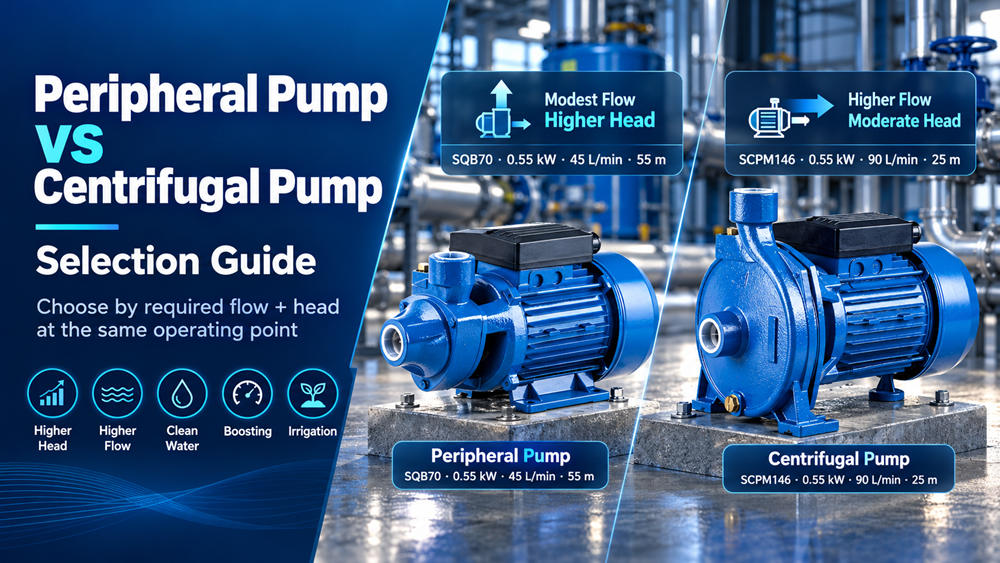
Quick answer: Choose a peripheral pump when the application requires relatively modest flow and higher head from a compact clean-water pump. Choose a conventional single-stage centrifugal pump when the priority is generally greater water volume at a suitable system head. Neither type is universally better: check the required flow and head at the same operating point on the manufacturer's performance curve before ordering.
A peripheral pump (also called a regenerative turbine or peripheral-impeller pump in many domestic pump catalogs) uses a bladed impeller and peripheral flow passage to repeatedly transfer energy to the liquid. This arrangement can develop comparatively high head at modest flow in a small pump.
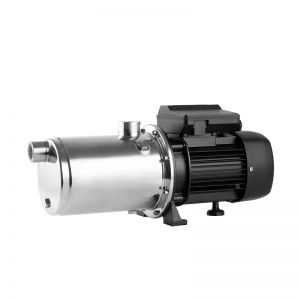
A conventional centrifugal pump transfers energy through a rotating impeller and volute or diffuser. Its hydraulic design can support a broad range of flow and head duties; the domestic single-stage models compared here typically prioritize higher flow than similarly powered peripheral models.
These descriptions are general tendencies, not universal performance limits. Both are dynamic pumps, and a peripheral pump is itself a type of rotodynamic pump.
| Selection factor | Peripheral pump | Conventional centrifugal pump |
|---|---|---|
| Typical duty | Lower flow, relatively higher head | Often higher flow at moderate head |
| Water quality | Clean, particle-free water is important | Clean water for the domestic SCPM range; other designs vary |
| Common applications | Small pressure systems, local boosting, wash points | Water transfer, distribution, larger irrigation demand |
| Efficiency | Often lower hydraulic efficiency than suitable conventional centrifugal designs | Can offer better efficiency for appropriate duties; verify actual curves |
| What to verify | Operating-point flow, suction conditions, clean-water limits | Operating-point head, efficiency, motor loading, suction conditions |
The following are published catalog maximums for two 550 W models, not measured performance at one common duty point.
| Model | Power | Max. flow | Max. head |
|---|---|---|---|
| SQB70 peripheral pump | 0.55 kW | 45 L/min | 55 m |
| SCPM146 centrifugal pump | 0.55 kW | 90 L/min | 25 m |
What the data tells buyers: At the same listed motor power, SQB70 is configured for a higher maximum head, while SCPM146 offers a higher maximum flow. It does not mean SQB70 delivers 45 L/min at 55 m, or SCPM146 delivers 90 L/min at 25 m. Maximum head and maximum flow normally occur at different points on the curve.
To evaluate a specific duty, compare the two published Q-H curves at the same required flow and head. If neither curve meets the duty reliably, choose a different size or pump design.
| Buyer requirement | Starting point | Important check |
|---|---|---|
| Compact clean-water pressure boosting, modest consumption | Peripheral model may fit | Actual flow at required pressure and control arrangement |
| Multiple garden outlets or higher-volume irrigation | Centrifugal model may fit | Total simultaneous flow, sprinkler pressure, pipe friction |
| Transfer between water tanks | Compare both curves | Elevation change and required filling time |
| Sandy, abrasive or sewage water | Neither SQB nor SCPM by default | Choose a pump explicitly rated for the liquid |
Flow: How many litres per minute or cubic metres per hour are required during normal use?
Head: What is the total dynamic head, including elevation, pressure at the outlet and pipeline losses?
Liquid: Is the water clean and free from sand, solids and chemically aggressive substances?
Installation: What are the suction lift, pipe diameter, priming arrangement and available electrical supply?
Duty: Will the pump run intermittently or continuously, and is automatic pressure control needed?
Quick selection example: A buyer asks for 30 L/min at 30 m of total dynamic head. This is a required duty point, not proof that either example model can meet it. Check whether (30 L/min, 30 m) lies on an acceptable part of each manufacturer's performance curve. The published maximums alone are insufficient to approve either model.
Not necessarily. Motor power alone does not show how much water a pump delivers at the required head. Compare the Q-H curve and efficiency at the actual operating point.
For a small, higher-pressure outlet, a suitable peripheral pump may work. For more simultaneous sprinklers or higher flow, a conventional centrifugal pump may be preferable. The irrigation layout determines the answer.
The Stream SQB and SCPM examples are intended for clean, non-aggressive liquids. Do not use them for abrasive or sewage service without model-specific approval.
Peripheral pumps and conventional centrifugal pumps serve overlapping but different clean-water requirements. Start with the required flow, head and liquid conditions; then verify the duty point against the relevant performance curve. Compare the Stream peripheral pump range and Stream centrifugal pump range before requesting a model recommendation.
Need help comparing pump models? Send the required flow, total dynamic head, liquid details and electrical supply through the Stream Pumps contact page.
Product specifications: Stream SQB and Stream SCPM.
Selection guidance: Flow, head and duty-point explanations are general engineering principles. For model selection, use the Q-H performance curves and operating limits provided in the relevant Stream product documentation.
Model maximums are supplier-published catalog specifications, not independently measured values. Application recommendations are general selection guidance and must be confirmed against the actual duty and model documentation.
Address
No.17 XeDa Jimei Ind. Park, Xiqing Economic Development Area, Tianjin, China
Telephone
+86 13816508465
QUICK LINKS