+86 13816508465
Pump Knowledge
Oct. 20, 2026
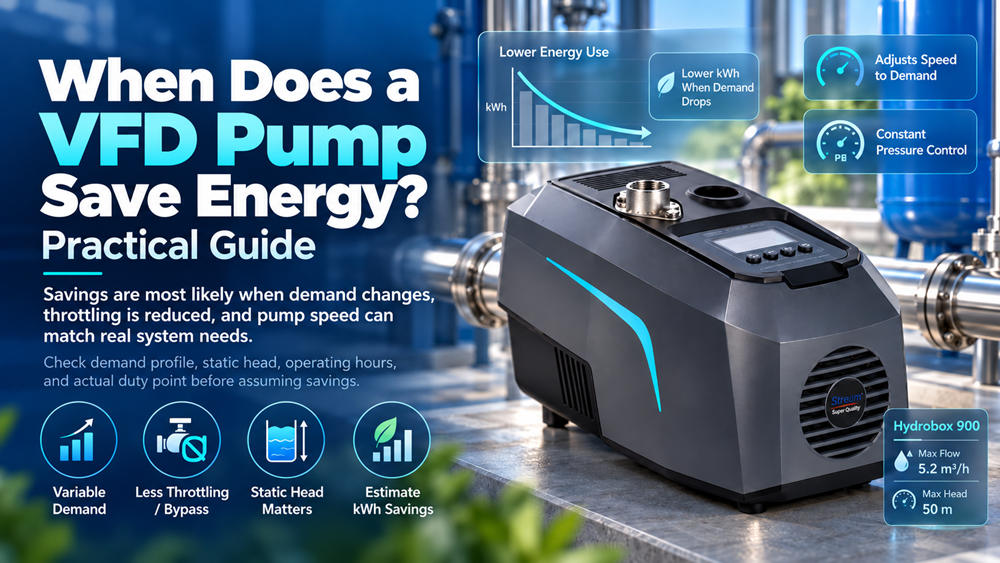
Bottom line: A variable frequency drive (VFD) can save electricity when pump demand changes over time and reducing speed avoids unnecessary flow or pressure. Savings are often more promising where a fixed-speed pump would otherwise throttle or recirculate water. They can be limited when most of the required head is static, the pump already runs near its efficient duty point, or demand rarely changes. No single savings percentage applies to every pump installation.
For buyers of domestic and light-commercial booster systems, the practical question is not simply whether the pump has a VFD. It is whether its control method, pump curve and daily water demand suit variable-speed operation.
A VFD adjusts motor frequency and speed as water demand changes. In a constant-pressure boosting system, a pressure sensor and controller can increase speed when more outlets open and reduce speed when demand falls. This may avoid running a pump at unnecessary speed during part-load operation.
For an idealized centrifugal pump operating under comparable conditions, the pump affinity laws relate speed to flow, head and power:
Flow: Q2/Q1 ≈ N2/N1
Head: H2/H1 ≈ (N2/N1)2
Power: P2/P1 ≈ (N2/N1)3
Important limitation: These are approximate pump relationships, not a guarantee of electrical savings. The actual operating point depends on the system curve, static head, hydraulic efficiency, motor and drive losses, and control strategy. A 20% speed reduction does not automatically mean a fixed percentage reduction in electricity consumption.
| System condition | Energy-saving potential | Why it matters |
|---|---|---|
| Large changes in daily flow demand | Often favorable | Pump speed can follow lower-demand periods. |
| Existing throttling or bypass recirculation | Often favorable | Speed control may reduce avoidable hydraulic losses. |
| High friction-head share | Potentially favorable | Required system head falls as flow falls. |
| Mostly static lift | More limited / case-dependent | Minimum lifting head remains even at reduced flow. |
| Nearly constant demand, well-matched fixed-speed pump | May be small | Little scope to reduce speed; drive losses still exist. |
Total dynamic head can be considered as static head + friction losses + any required outlet pressure head, using a consistent system boundary. Friction loss changes with flow, while static elevation head does not. Where a pump must continually lift water to an elevated tank, slowing it too far may leave insufficient head to deliver water at all.
In contrast, a booster serving several taps with fluctuating demand may have opportunities to reduce pump speed while maintaining its required delivery pressure. The savings must still be checked against the actual pump and system curves.
For a practical estimate, calculate the electrical input power during each operating period:
Daily energy (kWh) = Σ [electrical input power (kW) × operating hours (h)]
Annual savings (kWh) = (baseline daily kWh − proposed daily kWh) × operating days per year
Annual cost savings = annual kWh savings × local electricity tariff
Suppose a fixed-speed installation consumes 0.8 kW for eight hours per day. For a proposed variable-speed arrangement, assume the total measured or reliably predicted electrical input would be 0.5 kW for six hours and 0.8 kW for two hours, while providing the same required water service.
| Scenario | Calculation | Energy/day |
|---|---|---|
| Fixed speed | 0.8 kW × 8 h | 6.4 kWh |
| Variable speed | (0.5 kW × 6 h) + (0.8 kW × 2 h) | 4.6 kWh |
| Difference | 1.8 kWh/day × 365 days | 657 kWh/year |
In this hypothetical example, calculated electricity use is approximately 28% lower. This is not a general VFD saving, a promise of performance, or a Hydrobox 900 test result. Real estimates need the demand profile, measured input power or credible equipment efficiency data, and the same delivered flow and pressure service in both cases.
Demand is nearly constant: a correctly selected fixed-speed pump may already operate efficiently.
Static head dominates: the required lifting head limits useful speed reduction.
The existing pump is oversized or inefficient: first examine pump resizing or system improvements; adding a drive alone may not be the best solution.
Operating hours are low: potential annual electricity savings may not recover the additional equipment cost quickly.
Control or installation is unsuitable: poor pressure settings, minimum-flow limitations or insufficient inlet conditions can offset expected benefits.
For a payback comparison, include drive or system purchase cost, installation and commissioning, electricity savings, maintenance differences and local energy prices. Also consider whether constant pressure, noise or comfort benefits matter independently of electricity savings.
| Required information | Why the supplier needs it |
|---|---|
| Minimum / typical / peak flow | Defines demand variation and sizing. |
| Required outlet pressure or head | Checks available pressure at the required flow. |
| Source water level / inlet pressure | Determines suction and inlet constraints. |
| Pipe length, fittings and elevation | Supports the system-head estimate. |
| Hours at different demand levels | Needed for meaningful energy calculations. |
| Voltage, liquid temperature, installation | Checks product operating limits. |
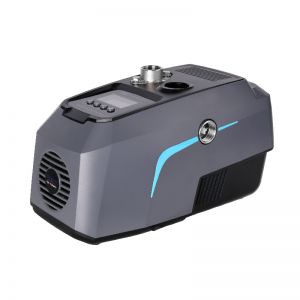
The Stream Hydrobox 900 intelligent VFD booster system adjusts motor speed in response to water-pressure demand. It is intended for suitable residential water-pressure boosting, tanks and related clean-water applications.
| Maximum flow | 5.2 m³/h |
| Maximum head | 50 m |
| Speed range | 1,500–3,000 rpm |
| Supply voltage range | 160–250 V |
| Maximum liquid temperature | 55°C |
Selection note: Maximum flow and maximum head are separate points on a pump curve; they must not be treated as simultaneous duty-point values. These published specifications do not establish a specific energy-saving percentage for Hydrobox 900. Check the full product data and performance curve against the installation requirements. For features and control details, see the Hydrobox 900 product introduction.
No. Savings depend on the load profile, static and friction head, existing control method and motor-drive efficiency. Some installations may see little financial benefit.
A properly sized and configured VFD booster can adjust speed to maintain a pressure setpoint across a useful demand range. It still cannot exceed its available pump head and flow capacity.
Compare electrical input energy under equivalent water demand and pressure requirements, ideally using representative operating data before and after installation.
A VFD is most useful when it solves a real variable-demand control problem. Before purchasing, check the demand profile, required duty point, static head, operating hours and total project cost. Use energy savings as an engineering calculation, not a fixed marketing percentage.
For a suitable residential application, explore the Stream HydroSmart range or send your system requirements to Stream Pumps for product matching.
Technical basis and transparency
General variable-speed drive principles and the need to consider operating load and motor-drive efficiency are supported by the Australian Government's Motors and Variable Speed Drives guidance. Hydrobox 900 specifications are taken from Stream's published product page.
The calculation in Section 4 is an illustrative buyer-education example, not independent product testing or a guaranteed reduction for any Stream model.
Previous: None
Next: Rainwater Harvesting Pump Selection Guide | Stream Pumps
Address
No.17 XeDa Jimei Ind. Park, Xiqing Economic Development Area, Tianjin, China
Telephone
+86 13816508465
QUICK LINKS