+86 13816508465
Pump Knowledge
Oct. 20, 2026
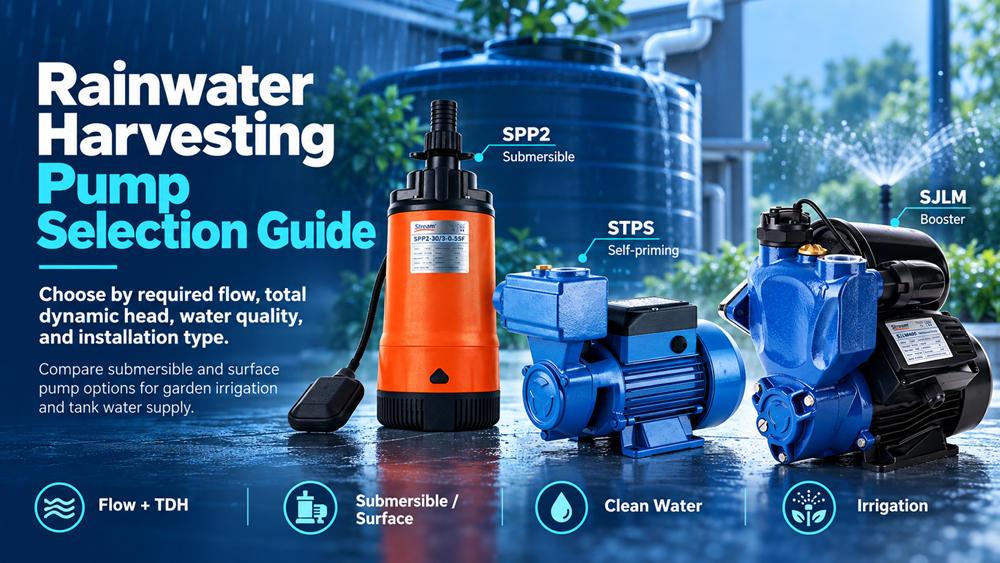
Choose a rainwater harvesting pump by matching the required irrigation flow and total dynamic head (TDH) to a pump performance curve—not by motor wattage or maximum head alone. A submersible multistage pump often suits a clean-water storage tank, while a suitably primed surface pump may work better when easy maintenance access is important. Water quality, dry-run protection and irrigation controls also affect the decision.
The practical approach is to identify the outlets operating together, their required pressure, the elevation from tank water level to outlet, and friction losses in the pipework. The example below shows how to turn those inputs into a pump enquiry.
| Selection factor | Submersible multistage pump | Surface self-priming pump |
|---|---|---|
| Location | Installed inside a suitable water tank | Installed outside, close to the water source |
| Suction arrangements | Normally avoids an external suction lift and long suction pipe | Requires a correctly designed, airtight suction line and initial priming per manufacturer instructions |
| Maintenance access | Usually requires lifting the pump out of the tank | More accessible for routine inspection |
| Common fit | Covered tank with limited space around it | Accessible tank where a protected, dry equipment location is available |
| Key constraint | Tank opening, immersion limit and low-water protection | Suction lift, air leakage, weather protection and priming |
A self-priming pump is not designed to run dry. Both options need clean enough water for their stated operating conditions.
For sprinklers, use the flow required at their intended operating pressure. Do not simply add every irrigation outlet if the system is divided into separate zones.
TDH ≈ elevation difference + required pressure head at the outlet + friction and component losses. Use the lowest normal tank water level when assessing the demanding operating condition. For water, 1 bar is approximately 10.2 m of pressure head.
| Input | Assumed value | How it is used |
|---|---|---|
| Two sprinklers operate together | 8 L/min each | Required total flow = 16 L/min (0.96 m³/h) |
| Height from minimum tank water level to sprinkler | 4 m | Elevation head = 4 m |
| Sprinkler pressure requirement | 2.0 bar | Outlet pressure head ≈ 20.4 m |
| Pipe, fittings and filter losses at 16 L/min | 6 m (illustrative estimate) | Friction and component losses = 6 m |
| Preliminary duty point | 16 L/min at about 30.4 m | Confirm actual losses and check the pump curve |
Important: This is an educational calculation, not a Stream product performance test or a confirmed recommendation for a particular model. Friction loss must be recalculated for the actual pipe diameter, length, fittings and filters. A pump is suitable only when its published Q–H curve supports the required duty point.
| Application | What to confirm before choosing |
|---|---|
| Single garden hose | Desired flow at the nozzle, hose diameter and length, elevation |
| Pop-up or rotating sprinklers | Minimum operating pressure and flow per sprinkler; number working together |
| Drip irrigation | Emitter flow, low-pressure regulator requirements, filtration and zone control |
| Several irrigation zones | Largest simultaneous-demand zone, not the sum of all separately operated zones |
| Tank also supplying utility outlets | Additional simultaneous demand, pressure-control arrangements and local plumbing requirements |
Sprinklers may need relatively high outlet pressure. Drip systems often need filtration and pressure regulation. Selecting a pump solely for maximum head can result in an unsuitable actual operating point.
Screen roof gutters and tank inlets to reduce leaves and larger debris.
Allow sediment management within the tank; avoid placing a clean-water pump inlet directly in settled sludge.
Use filtration appropriate for sprinklers or drip emitters and allow for filter pressure losses.
Confirm that the pump materials and working conditions are suitable for the actual water quality.
Provide low-water protection and check that float switches or sensors can operate without obstruction.
Rainwater is not automatically free from sand, sediment or organic debris. Pumps specified for clear water should not be treated as sewage or dirty-water pumps.
| Stream product | Where it may fit | What must still be checked |
|---|---|---|
| SPP2-30/3-0.55F multistage submersible booster pump | Tank-installed clean-water supply, garden rainwater use and irrigation; 0.55 kW motor and automatic float switch | Published Q–H curve at the required flow; tank depth and 5 m maximum immersion limit; clean-water conditions |
| STPS self-priming peripheral pump | Surface-installed tank-water extraction, domestic supply and suitable garden irrigation | Model-specific flow/head curve; suction arrangements; clean-water requirement; initial priming |
| SJLM self-priming booster pump | Applications where automatic boosting may be relevant | Controller suitability, actual system pressure range, suction and demand conditions |
The SPP2 product page specifies a maximum immersion depth of 5 m, liquid temperature of 0–40°C and pH 6.5–8.5. The STPS80 introduction gives maximum flow up to 46 L/min and maximum head up to 65 m, but these maxima are not simultaneous operating values. Neither number substitutes for checking the complete model curve.
| Information to provide | Example / notes |
|---|---|
| Water source and tank installation | Above-ground or underground tank; tank dimensions and access opening |
| Minimum and maximum tank water levels | Give expected water level relative to pump and outlets |
| Required flow | L/min or m³/h at maximum simultaneous demand |
| Outlet pressure requirement | bar or kPa for hose, sprinkler or drip system |
| Elevation difference | Metres from lowest operating water level to highest required outlet |
| Pipework | Internal diameter, approximate length, fittings and filter type |
| Water quality | Clear water, possible sediment, leaf contamination and temperature |
| Power supply | Voltage, frequency, phase and plug/cable requirements |
| Installation preference | Submersible or surface-mounted; available maintenance access |
| Controls | Float protection, pressure switch, pressure tank, regulator or zone timer |
| Purchase details | Quantity, destination market and documentation requirements |
A clear RFQ lets a supplier check duty-point suitability and configuration instead of making a recommendation based on wattage alone.
Buying by motor power: wattage cannot confirm flow and pressure at the required outlet.
Combining maximum flow and maximum head: they occur at different points on most pump curves.
Ignoring narrow hoses: long small-diameter pipes can create substantial friction loss.
Assuming self-priming means dry-running: proper priming and suction conditions remain necessary.
Forgetting controls: automatic irrigation may require separate pressure and demand control, not just a tank float.
Ignoring tank sediment: clean-water hydraulic stages and drip emitters may be damaged or blocked.
A multistage submersible pump is often practical when it can be installed inside a suitable clean-water tank. A surface pump can be suitable when there is convenient installation space and acceptable suction conditions. Final selection depends on the required flow and head.
Yes, when the pump curve supplies the combined flow and outlet pressure required by the operating sprinkler zone after allowing for elevation and pipe losses.
Possibly, but drip systems often need pressure regulation and fine filtration. Check emitter requirements and controller compatibility.
No. Maximum head generally does not represent the head available at useful irrigation flow. Check the pump performance curve at the actual duty point.
Specify flow and total dynamic head first, then choose the installation type and check water quality and controls. For suitable clean-water rainwater tanks, Stream’s SPP2 multistage submersible range is one option; for externally mounted arrangements, STPS and other surface pumps may fit. Compare models only at the real operating point.
For a product match, send your tank layout, required flow, outlet pressure, pipe size and power supply to Stream Pumps.
Product applications and limits: Stream SPP2 product specifications; Stream STPS product introduction. General selection principles: Australian Government — YourHome: Rainwater; NSW Government — Selecting an Irrigation Pump. The worked example is illustrative and does not claim independent Stream testing.
Address
No.17 XeDa Jimei Ind. Park, Xiqing Economic Development Area, Tianjin, China
Telephone
+86 13816508465
QUICK LINKS