+86 13816508465
Pump Knowledge
Oct. 19, 2026
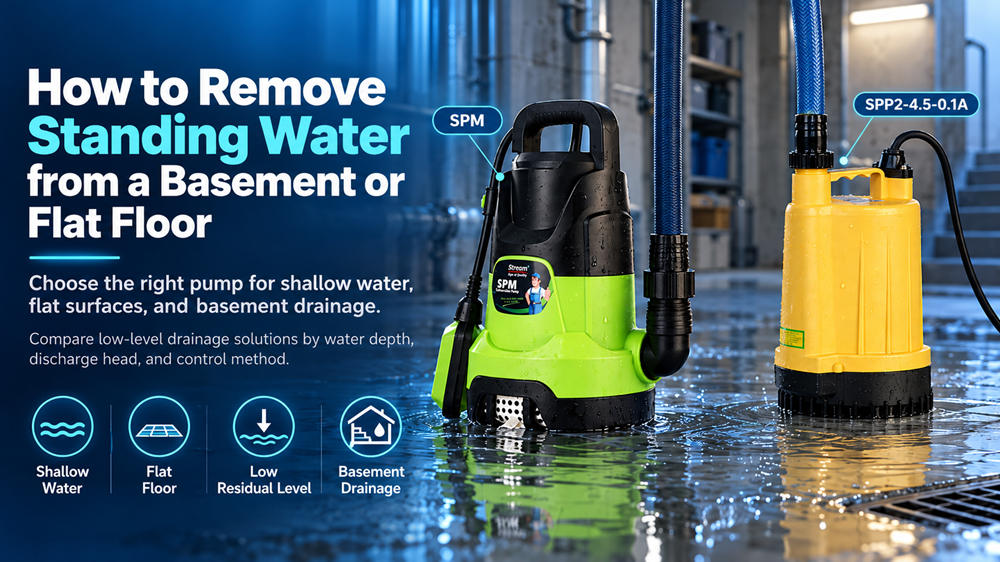
The fastest practical way to remove shallow standing water is to use a pump suited to the water depth and condition, then finish with a wet vacuum or manual drying. For clean or slightly dirty water left on a flat surface, a low-level puddle pump may remove more of the remaining water than an ordinary drainage pump. The critical specifications are minimum operating water depth, residual water level, allowable particles, discharge head and control method—not motor power alone.
| Situation | Practical option | What to check |
|---|---|---|
| Deep, relatively clean standing water | Standard submersible drainage pump | Starting depth, flow at required head, solids allowance |
| Shallow clean-water film on a flat floor | Low-level puddle pump | Residual level and operating instructions |
| Small puddles, corners or final water layer | Wet vacuum, squeegee and absorbent materials | Equipment suitable for wet use |
| Water with sludge, sewage or large debris | Appropriately rated dirty-water or sewage pump | Solids passage and liquid compatibility |
Do not use a clean-water puddle pump for unknown contaminated wastewater simply because the water layer is shallow. If water may be electrically hazardous or contaminated, isolate the area and have a qualified professional assess the conditions before pumping.
A conventional drainage pump may stop taking in water while a visible layer remains because its inlet sits above the floor, its float switch stops the motor at a higher level, or the remaining water no longer covers the intake sufficiently. A low-level pump is designed to draw water closer to the surface—but the stated residual water level is not necessarily the automatic float-switch stop level.
For example, a pump advertised as capable of reaching a 2 mm residual level may require a specific installation, starting water depth or supervised operating procedure. Check the model instructions before assuming it can start or stop automatically at that level.
Even a thin film can represent a significant amount of water over a large floor. For a reasonably level area, a useful illustrative calculation is:
Residual water (litres) = Floor area (m²) × Water depth (mm)
| Uniform water depth | Water remaining over 20 m² |
|---|---|
| 10 mm | 200 L |
| 5 mm | 100 L |
| 2 mm | 40 L |
Calculation note: This is a geometric example, not a pump test or a guaranteed drainage result. Floor slopes, uneven surfaces, trapped pockets and operating conditions change the actual volume.
| Buyer consideration | SPP2-4.5-0.1 | SSM |
|---|---|---|
| Published low-water figure | 2 mm | 5 mm |
| Suitable water | Clean and slightly dirty water within specification | Clean water; particles within published limit |
| Published maximum immersion depth | 5 m | 7 m |
| Temperature limit | 0–40°C | Up to 35°C |
| Level control | Float switch | Float switch with fixing device |
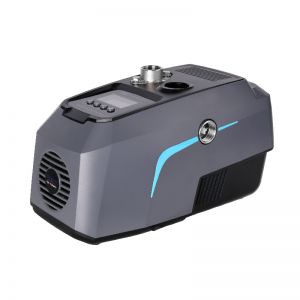
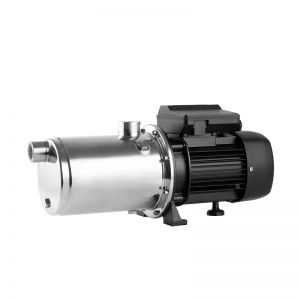
Review the official Stream SPP2-4.5-0.1 puddle pump and Stream SSM low-level pump pages for model-specific specifications and performance information. These two published low-water figures should not be interpreted as independently verified head-to-head test results.
Assess safety first. Do not enter water if electrical circuits, submerged sockets, unstable structures or contaminated liquids may create a hazard. Obtain qualified assistance where needed.
Identify the water. Check whether it is clean, slightly dirty or contains sediment and waste. Choose equipment with appropriate liquid and particle ratings.
Confirm the discharge route. Measure the vertical lift and consider hose length, diameter and bends. Water must be discharged to a permitted, safe location.
Read the pump instructions. Confirm minimum starting depth, float-switch clearance, allowed operating mode and electrical requirements for the local market.
Pump the accessible water. Keep the inlet clear and monitor performance, especially if working at low water levels.
Remove the final residue. Use a wet vacuum or other suitable tools, then clean and dry the affected surface. Pumping alone does not guarantee a dry floor.
What are the area size, current water depth and required residual depth?
Is the liquid clean, slightly dirty or heavily contaminated?
What is the required discharge height and hose diameter?
Will the pump operate automatically or under supervision?
What are the local voltage, frequency, plug and electrical protection requirements?
Does the selected pump's performance curve meet the required duty point?
For a broader range of portable drainage products, see Stream utility pumps. Buyers should share their water condition, discharge head and installation details before choosing a model.
No. Low-level pumps can reduce residual water, but actual results depend on floor shape, pump position and operating conditions. Final drying normally requires additional work.
Not necessarily. Residual water capability, minimum start level and float-switch operating level are different specifications. Always consult the product instructions.
Only if the liquid and particle content are within the particular pump's published limits. For sludge, sewage or larger debris, choose a pump designed for those conditions.
Choose the drainage method by water quality, depth and discharge requirements—not by a low-water number alone. Low-level puddle pumps can reduce the manual work remaining after pumping shallow, relatively clean water, but residual level and automatic operation must be checked separately. For product selection, compare the SPP2 and SSM specifications against the actual job.
Product data and reference: Technical figures above are drawn from the linked Stream Pumps product pages. The 20 m² water-volume example is a transparent mathematical illustration. Site safety guidance is general advice, not a substitute for applicable local electrical and flood-safety requirements or the manufacturer's instructions.
Previous: None
Next: How to Evaluate a Water Pump Supplier in China | B2B Guide
Address
No.17 XeDa Jimei Ind. Park, Xiqing Economic Development Area, Tianjin, China
Telephone
+86 13816508465
QUICK LINKS