+86 13816508465
Pump Knowledge
Oct. 19, 2026
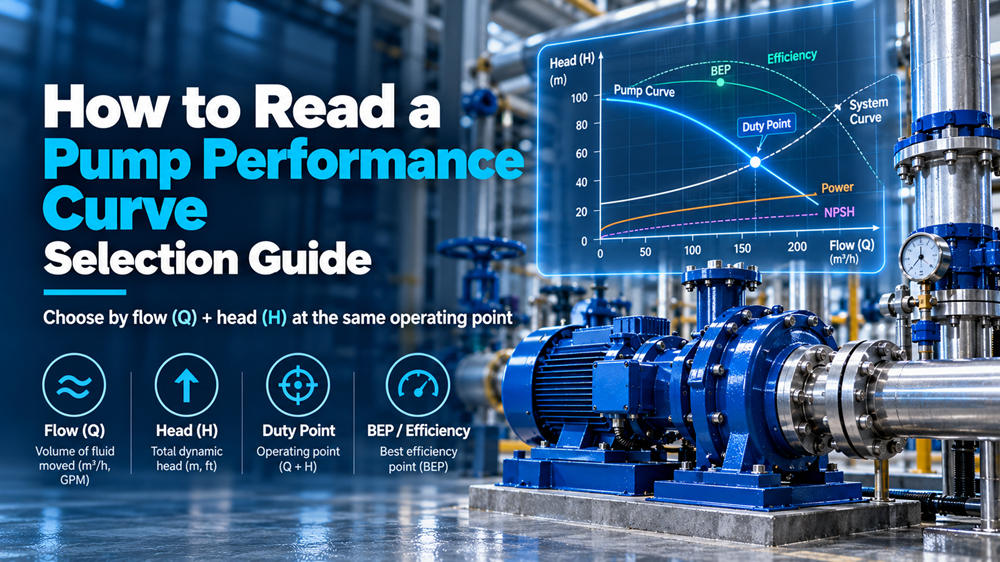
Bottom line: Choose a water pump by its required flow rate (Q) and total dynamic head (H) at the same operating point—not by its advertised maximum flow, maximum head, or motor power alone. The actual operating point occurs where the pump's performance curve intersects the system curve. Check efficiency, power, suction conditions, and the manufacturer’s recommended operating range before ordering.
This guide shows purchasing teams how to interpret published pump curves and what information to send a supplier for a reliable model recommendation.
A pump performance curve represents how a particular pump performs at a stated speed and impeller configuration. Common chart elements include:
Q (flow): the volume delivered per unit time, such as L/min or m³/h, usually on the horizontal axis.
H (head): energy added to the liquid, expressed as metres or feet of liquid, usually on the vertical axis.
Efficiency (η): the ratio of hydraulic output power to pump shaft input power.
Power: the input required by the pump across its operating range; check whether a chart shows shaft or electrical power.
NPSH requirement (where published): helps assess suction-side conditions and cavitation risk.
Not every small domestic pump catalogue contains every curve. Where efficiency or NPSH information is missing, request it from the supplier if important to the application.
Specify the flow the system must deliver during normal operation. For example, 40 L/min is equal to 2.4 m³/h. Avoid using an unspecified “high flow” requirement.
Account for elevation, required delivery pressure, friction losses and relevant velocity or suction conditions. A simple open-tank-to-open-tank preliminary model is required head ≈ static elevation difference + pipe and fitting losses. Pressurised systems also need the pressure difference included. Use the actual hydraulic arrangement for final design.
Locate the intersection: that is the predicted operating point at the specified speed. Then verify that the point lies within the manufacturer's permitted operating range and that motor power, NPSH margin and material compatibility are satisfactory.
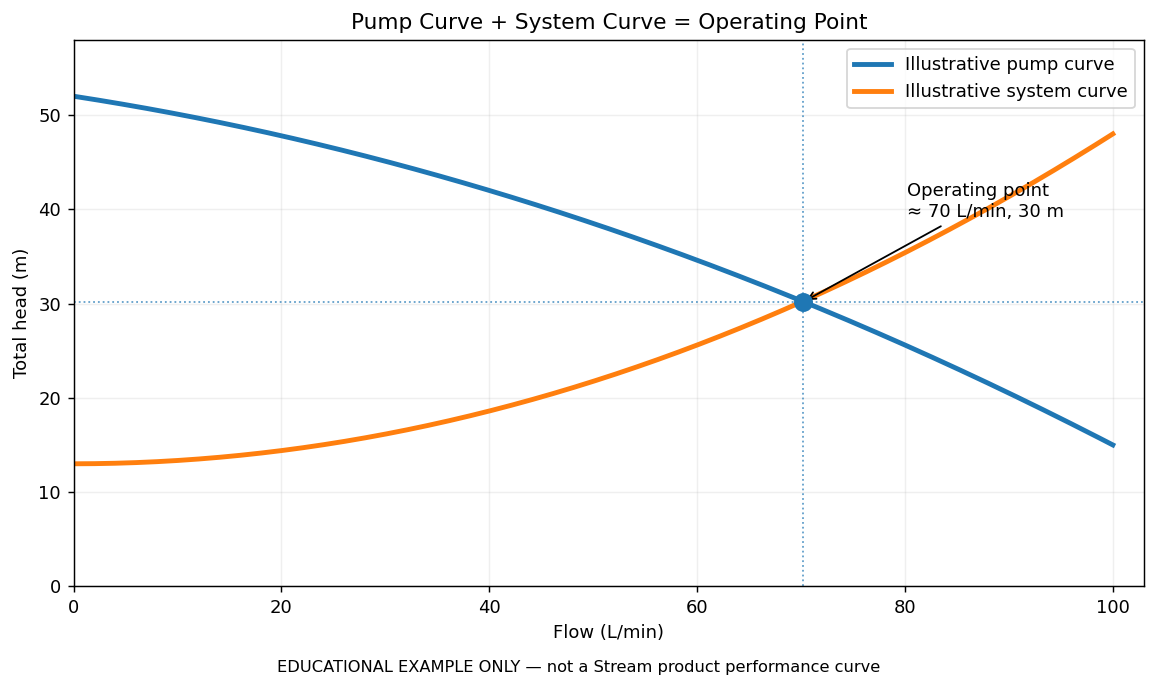
Original educational illustration. Both curves are hypothetical, not measured or published Stream pump data. Upload the companion PNG to your CMS if it removes embedded images.
For many centrifugal and peripheral pump curves, maximum head occurs near zero flow, while maximum flow occurs at much lower head. Therefore, a label such as “Q max 90 L/min; H max 25 m” does not mean the pump can deliver 90 L/min at 25 m.
Consider the following published catalogue endpoints for Stream models. They are useful for narrowing the range, but do not establish an actual duty point:
| Stream model | Rated motor power | Published Q max | Published H max |
|---|---|---|---|
| SCPM146 | 550 W | 90 L/min | 25 m |
| SQB70 | 550 W | 45 L/min | 55 m |
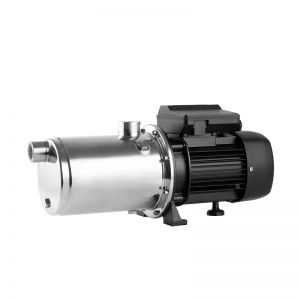
See the full published curve and technical data for the Stream SCPM centrifugal pump and the Stream SQB peripheral pump. These models serve different flow/head requirements; choose from their actual curves rather than headline numbers.
Illustrative buyer requirement: clean-water delivery of 40 L/min at an estimated total dynamic head of 20 m, on a compatible power supply.
Convert flow if necessary: 40 L/min = 2.4 m³/h.
Mark the required point: Q = 40 L/min, H = 20 m.
Read the manufacturer’s Q–H curve at 40 L/min and check whether the available head meets the requirement.
Confirm efficiency, input power, allowable operating range, suction conditions and the liquid’s compatibility.
Important: Neither the SCPM146 nor the SQB70 can be confirmed suitable for this 40 L/min at 20 m duty based on published maximum values alone. The actual performance curve or supplier-confirmed operating data is required. This is the distinction between preliminary shortlisting and a defensible selection.
The best efficiency point (BEP) is where the pump reaches peak hydraulic efficiency at the specified speed and impeller diameter. Operating far from the recommended range may increase vibration, hydraulic loading or energy use. The acceptable range depends on the pump design and manufacturer guidance; do not assume every model has the same BEP or allowable operating region.
For suction-lift applications, also verify NPSH available versus required, with an appropriate margin. Pump curve interpretation is not a substitute for confirming cavitation risk or installation conditions.
Treating Q max and H max as one attainable operating point.
Comparing two pumps by motor wattage without checking hydraulic output.
Ignoring pipe losses or required outlet pressure when defining total head.
Using a curve for a different frequency, speed or impeller configuration.
Overlooking efficiency, motor loading and minimum operating constraints.
Assuming performance in a viscous or solids-laden liquid matches a clean-water curve.
| Before you request a model | What to confirm |
|---|---|
| Required duty point | Flow and total head at the same condition |
| Curve basis | Model, speed, frequency and impeller size |
| Operating suitability | Efficiency, recommended range and power |
| Site conditions | Suction arrangement, losses, liquid and voltage |
| Evidence | Manufacturer curve or written duty-point confirmation |
If your team is preparing a quotation request, include the full application details as well as the flow/head requirement. Explore Stream pump categories and request performance information for a specific model before final selection.
No. A pump with a higher shutoff or maximum head may deliver less flow at the actual operating head. Compare pumps at the same duty point.
No. Motor power is not a substitute for a head–flow curve. Pumps of the same rated power can have substantially different hydraulic characteristics.
Ask the supplier for the published curve or a written performance confirmation at your duty point, including applicable speed and electrical frequency.
General curve interpretation follows the Hydraulic Institute — Combined Pump & System Curves and Hydraulic Institute — Pump FAQs. Stream product endpoints are from the linked SCPM and SQB official product pages. The teaching illustration and worked requirement are examples, not product test results.
Address
No.17 XeDa Jimei Ind. Park, Xiqing Economic Development Area, Tianjin, China
Telephone
+86 13816508465
QUICK LINKS