+86 13816508465
Pump Knowledge
Oct. 19, 2026
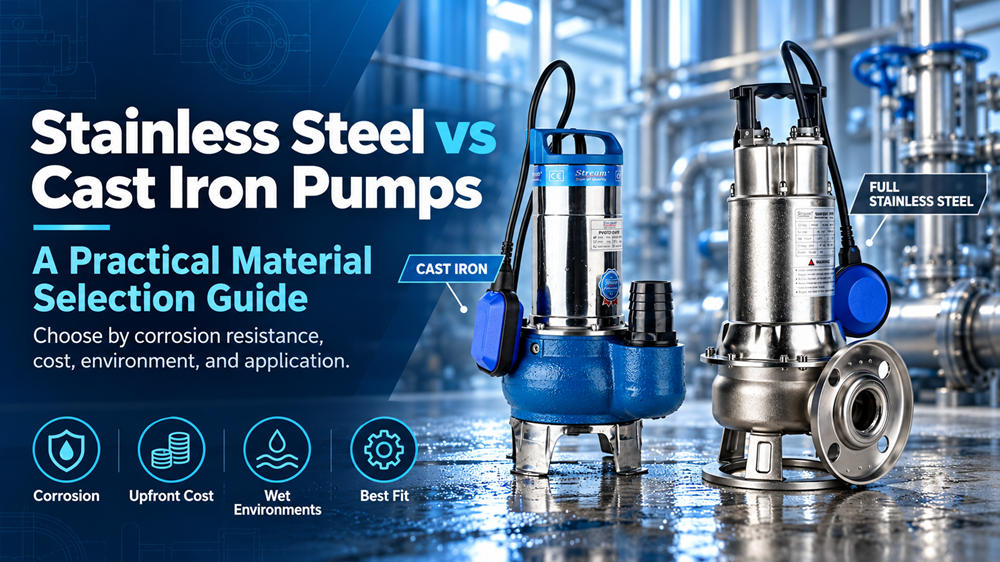
Bottom line: Stainless steel is often worth considering when corrosion exposure or long-term surface condition is a priority; cast iron remains a practical, economical option for many compatible clean-water and wastewater duties. Neither material is universally better. Buyers should verify the actual alloy or casting grade, pumped-liquid chemistry, hydraulic duty, coating, seals, and operating conditions before choosing.
This guide compares the two material options from a pump buyer's perspective and uses published Stream PVS/PVX and SWK specifications as concrete examples. These are supplier-published product specifications, not independent laboratory test results.
| Selection factor | Stainless steel | Cast iron |
|---|---|---|
| Corrosion | Good in compatible media; depends on grade and chemistry | Often relies on coatings and appropriate water conditions |
| Upfront cost | Typically higher, depending on construction | Often lower |
| Mechanical construction | Properties vary with alloy and design | Rigid, established casing material |
| Wet environments | Often chosen to limit external rust | Coating condition needs attention |
| Typical buying question | Which stainless grade and which wetted parts? | Which casting grade and protective coating? |
Important: Material alone does not determine hydraulic efficiency, solids-handling capacity, or pump lifetime. Those depend on the complete pump design and actual duty.
Stainless steel forms a protective passive surface, but some grades can suffer pitting or crevice corrosion in chloride-containing water. Even common 316 stainless steel should not be treated as automatically suitable for continuous seawater exposure. The British Stainless Steel Association explains why chloride level, temperature, oxygen, flow and crevices matter.
For cast iron, corrosion protection depends on the water and the coating system. Damage to coatings or exposure to aggressive liquid may increase maintenance requirements. Neither option should be specified from appearance alone.
Is the liquid freshwater, domestic wastewater, brackish water, or chemically treated water?
What are its pH, chloride concentration and operating temperature?
Will the pump remain submerged continuously or operate intermittently?
Are abrasive sand, suspended solids, cleaning chemicals or fibrous materials present?
What are the exact materials of the casing, impeller, shaft, fasteners and mechanical seal?
Buyer caution: “Full stainless steel” does not by itself identify a grade such as 304 or 316, nor does it establish resistance to a particular chemical. Request the actual material specification if corrosion is a critical selection factor.
| Application | Practical starting point | Must verify |
|---|---|---|
| Domestic wastewater sump | Either construction may be suitable | Solids passage, chemistry, flow and head |
| Occasionally flooded basement | Choose by water condition, budget and maintenance | Debris, switching control and residual water level |
| Car-wash wastewater | Check both metal and seal compatibility | Detergents, grit, oils and concentration |
| Brackish or seawater service | Do not select either as a default | Alloy grade, chlorides and manufacturer approval |
These are screening considerations, not guarantees of compatibility. Always confirm the specific model's published operating limits.
The Stream PVS/PVX series guide describes two constructions for broadly similar vortex sewage duties: PVS uses full stainless steel construction, whereas PVX uses a cast iron pump-head configuration. The published series specifications include up to 35 mm solids passage, a 0–40°C liquid-temperature range and pH 6.5–8.5. These limits should not be extrapolated to chemically aggressive wastewater.
The Stream SWK full stainless steel sewage pump is another material option. Its published specifications list up to 30 mm solids passage, 0–40°C liquid temperature and pH 6.5–8.5. Its stainless construction does not automatically make it suitable for seawater, bleach solutions or strong acids.
| Stream option | Published construction | Max. solids passage |
|---|---|---|
| PVS | Full stainless steel | Up to 35 mm |
| PVX | Cast iron pump-head configuration | Up to 35 mm |
| SWK | Full stainless steel | Up to 30 mm |
Values are published series limits, not a promise that every model or installation performs at all maximum conditions simultaneously. Confirm the model datasheet and pump curve.
Cast iron may have a lower initial purchase cost, but the cheapest pump is not always the least expensive over its operating life. Stainless steel may justify a higher price when it reduces corrosion-related maintenance in a compatible environment. Conversely, a cast iron pump may be the sensible choice for ordinary wastewater when the liquid, coating and operating conditions are suitable.
Compare the complete offer: purchase price, coating and material specification, energy consumption at the duty point, expected inspection frequency, spare parts, and replacement access. Do not infer energy savings solely from the casing material. For hydraulic sizing, see Stream's published pump technical data and request the appropriate model performance curve.
Before requesting a price, send suppliers the following details to make quotations comparable:
Liquid: clean water / sewage / other; include concentration if chemicals are present.
Water analysis: pH, chloride concentration, temperature and other relevant constituents.
Hydraulic duty: required flow rate and total dynamic head.
Solids: maximum particle size, sand/grit and fibrous waste.
Construction: required casing/impeller/shaft grade and coating.
Installation: immersion depth, run hours, starts and control mode.
Electrical supply: voltage, phase and frequency.
Commercial details: required quantity, destination, documentation and spare parts.
Selection rule: If liquid chemistry is unknown or aggressive, do not approve a material solely because it is labelled stainless steel or cast iron. Obtain a water analysis and confirm compatibility with the supplier.
No. Stainless steel may provide corrosion advantages in suitable water, but cast iron can be practical and economical for compatible duties. Pump design and liquid properties matter more than the material label alone.
Not automatically. Grade 304 is generally unsuitable for seawater exposure, while grade 316 also has limitations. Confirm the required alloy and operating conditions with the manufacturer.
Not by itself. Efficiency depends mainly on hydraulic design and operating point. Compare published performance curves, not just materials.
Ask for the alloy grade and a breakdown of wetted components, especially the casing, impeller, shaft, fasteners and seals. Verify that the grade matches the liquid conditions.
Choose stainless steel when its verified grade offers a useful corrosion advantage for your actual water conditions; choose cast iron when its construction, protective treatment and service limits match the duty at a suitable cost. Both decisions require a correctly sized pump and compatible seals and components.
Explore Stream submersible sewage pump options and specify your liquid properties, flow and head when requesting a material recommendation.
Sources and verification
Product limits and construction: Stream PVS/PVX specifications; Stream SWK specifications. General corrosion guidance: British Stainless Steel Association — Corrosion Mechanisms and Stainless Steels for Seawater Applications. Application recommendations are general procurement guidance, not Stream laboratory tests or guarantees of material compatibility.
Address
No.17 XeDa Jimei Ind. Park, Xiqing Economic Development Area, Tianjin, China
Telephone
+86 13816508465
QUICK LINKS