+86 13816508465
Pump Knowledge
Nov. 20, 2026
To select a booster pump for a multi-story building, calculate the simultaneous design flow and the pressure boost needed at the highest critical outlet—not just the number of floors. Allow for elevation, residual outlet pressure, pipe friction and the minimum reliable inlet pressure. Then verify that the selected pump can deliver the required flow at that head on its performance curve. For larger buildings, assess pressure zoning, maximum pressure at lower floors and standby capacity.
Two values determine the initial pump duty point: design flow (m³/h) and required pump differential head (m). Building height alone cannot determine either value.
| Design input | Why it matters |
|---|---|
| Highest critical outlet elevation | The vertical rise from the pump/reference water level to the uppermost critical fixture |
| Minimum outlet pressure | Pressure the selected tap, shower or equipment needs while water is flowing |
| Design simultaneous demand | Expected coincident use—not the sum of every fixture flowing at full rate |
| Pipe and fitting losses | Friction through pipes, elbows, valves, filters and meters at design flow |
| Minimum inlet pressure | The reliable available pressure at the pump suction; varies with source and conditions |
| Pressure limits and control | Maximum permitted pressure on low floors, demand variation, protection and backup requirements |
For a pressurized inlet supply, a simplified initial estimate is:
Use pressures in metres of water: 1 bar ≈ 10.2 m. This simplified equation assumes the suction and outlet reference points have been defined consistently; for a vented break tank use its minimum water level as the suction datum.
Assume a preliminary peak simultaneous flow of 3.0 m³/h, with the following head inputs. These values are illustrative, not measurements from a Stream installation.
| Item | Assumption |
|---|---|
| Highest outlet elevation above booster | 15 m |
| Required flowing pressure at outlet | 2.0 bar ≈ 20.4 m |
| Estimated line and fitting losses | 6 m |
| Minimum reliable inlet pressure | 0.8 bar ≈ 8.2 m |
| Estimated booster differential head | 15 + 20.4 + 6 − 8.2 = 33.2 m |
| Preliminary pump duty point | 3.0 m³/h at 33.2 m boost head |
Interpretation: The target is not “a 15-metre pump” or “a 50-metre pump.” It is a pump capable of supplying 3.0 m³/h at approximately 33.2 m differential head, subject to the real building design. If the pump takes water from an atmospheric break tank at a lower elevation, recalculate from the minimum tank water level and do not subtract a municipal pressure that is no longer applied at the suction.
The example does not establish that a particular Stream model fits. A model’s advertised maximum head and maximum flow are not achieved together; check its actual Q–H curve and permitted operating range.
Estimate the design flow from the building type, number and type of fixtures, occupancy and likely simultaneous use. Adding the maximum flow of every tap usually overstates real demand. For larger or mixed-use buildings, use an applicable recognized plumbing design method and local requirements rather than a fixed “litres per floor” rule.
Identify the occupancy: apartments, hotel, offices or mixed use.
Count fixture types and note any high-demand equipment.
Apply an appropriate simultaneous-demand method for the project.
Check whether a storage tank and refill arrangement changes the required pumping flow.
| Stream product | Published information | Practical selection role |
|---|---|---|
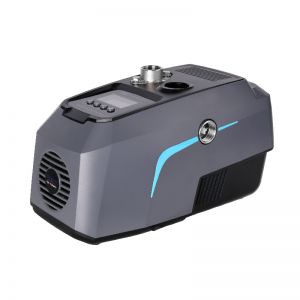
| Hydrobox 900 | Maximum flow 5.2 m³/h; maximum head 50 m; variable-frequency constant-pressure system | A compact boosting candidate for a suitable small building or zone; verify the Q–H duty point and maximum 6 bar system operating pressure. |
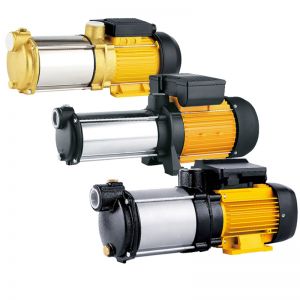
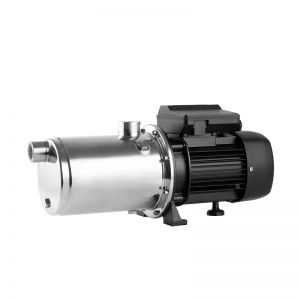
| MH horizontal multistage | Across the series, maximum flow range 60–365 L/min and maximum head range 22–137 m | Consider for a designed booster set where available space and required duty favour horizontal installation. |
| MV vertical multistage | Across the series, capacity up to 365 L/min; maximum head range 22–130 m | Consider for a vertical multistage arrangement with suitable control, piping and protection. |
Important: These are published series-level or maximum values, not proof that the example duty point is covered. Where a multistage pump is selected, the complete booster set—controller, sensors, check valves, source tank and protections—must also be designed. Confirm wetted-material suitability for the intended water supply.
| Situation | Initial approach | What to confirm |
|---|---|---|
| Small system with variable daily use | Single VFD booster may suit | Minimum-flow control, pressure range, pump curve and noise |
| Higher peak flow or large load variation | Multiple pumps in parallel may suit | Staging logic, duty point for each pump, redundancy and controls |
| Tall building with high lower-floor pressure | Pressure zones or pressure-reducing arrangements may be required | Pipe and fixture pressure ratings, maximum static pressures and local codes |
| Unreliable mains inlet | Evaluate an approved break tank and suitable pump protection | Backflow prevention, water quality, tank refill rate and dry-run protection |
A high pressure setpoint chosen only for the top floor may create excessive pressure downstairs. Building pressure zoning, pressure-reducing devices and backflow prevention should be reviewed by a qualified designer under the rules applicable to the installation location.
Building type, number of floors and height of the critical outlet above the booster.
Number and type of fixtures and design simultaneous flow (m³/h).
Minimum incoming pressure or minimum break-tank water level.
Required outlet pressure at the most unfavourable fixture during flow.
Main pipe diameter, approximate length, valves, filters and estimated friction loss.
Power supply: voltage, frequency and phase.
Control preference: fixed speed, VFD, multi-pump staging, standby unit and protection.
Maximum pressure rating, water quality, installation space and local compliance requirements.
Send these project values with the desired duty point when requesting a selection from Stream Pumps. For background on booster layouts, see How a Booster System Maintains Pressure in Buildings.
No. Floor count helps estimate elevation, but the design also needs simultaneous flow, residual pressure, friction losses and source pressure.
No. Maximum flow and maximum head are normally different points on the pump curve. Check the required duty point against the exact model curve.
Not necessarily. Smaller zones may use a single suitable pump. Larger buildings may need staged pumps, standby capacity or multiple pressure zones depending on the hydraulic design and service requirements.
Choose the duty point first, then the pump. Calculate demand flow and required pressure boost at the most unfavourable outlet, verify inlet conditions and lower-floor pressure limits, then match a Stream model or booster set to the published Q–H curve. This prevents oversizing based solely on building height or maximum head.
Address
No.17 XeDa Jimei Ind. Park, Xiqing Economic Development Area, Tianjin, China
Telephone
+86 13816508465
QUICK LINKS