+86 13816508465
Pump Knowledge
Nov. 20, 2026
To estimate solar panel capacity for a water pump, start with daily water demand and total dynamic head—not just the pump motor's rated wattage. Convert the required water lifting into daily hydraulic energy, account for pump-system efficiency and design-month solar irradiation, then check whether the selected solar array meets the controller's voltage, current and power limits. A preliminary watt-peak (Wp) estimate is a starting point, not a complete system design.
For off-grid irrigation and borehole water supply, panel sizing should be verified against the selected pump's flow–head curve and expected daily output in the least favourable operating month. FAO's water-lifting guidance follows this energy-first approach.
| Input | Why it matters |
|---|---|
| Daily water volume (m³/day) | Determines how much water must be delivered each day. |
| Total dynamic head (m) | Includes dynamic water level, delivery elevation, pressure requirements and pipe losses. |
| Design-month solar resource | Use local monthly irradiation (or equivalent peak sun hours), not an arbitrary year-round average. |
| Pump/controller efficiency | Converts hydraulic energy demand into required electrical energy. |
| Controller and PV electrical limits | Array voltage, current, power and cold/hot temperature limits must match the specific controller. |
Important distinction: Total well depth is not automatically the pump's required head. In a pumping well, the dynamic water level and delivery conditions are more relevant to head calculation; installation depth is a separate constraint.
For water, a convenient approximate hydraulic energy relationship is:
Hydraulic energy (kWh/day) ≈ Daily water volume (m³/day) × Total dynamic head (m) ÷ 367
Then estimate the electrical energy entering the pump system:
Electrical energy (kWh/day) ≈ Hydraulic energy ÷ Wire-to-water efficiency
These formulas estimate energy, not guaranteed daily water yield. Actual efficiency changes with pump speed, flow, head and sunlight, so the performance curve and controller behaviour must be evaluated.
Assume an irrigation site needs 12 m³ of water per day at a 35 m total dynamic head. For a first-pass estimate, assume 4.5 peak sun hours in the design month, 35% combined wire-to-water efficiency, and an 80% PV performance factor.
| Parameter / Result | Value / Calculation | Note |
|---|---|---|
| Daily water demand | 12 m³/day | Illustrative irrigation requirement |
| Total dynamic head | 35 m | Includes water lift, delivery pressure and pipe losses |
| Design peak sun hours | 4.5 h/day | Assumed design-month value; verify at site |
| Wire-to-water efficiency | 35% | Illustrative combined controller/motor/pump efficiency |
| PV performance factor | 80% | Illustrative allowance for operating losses |
| Daily hydraulic energy | 12 × 35 ÷ 367 = 1.14 kWh/day | Fresh water, approximate |
| Daily electrical energy | 1.14 ÷ 0.35 = 3.27 kWh/day | At assumed system efficiency |
| Estimated PV array capacity | 3.27 ÷ (4.5 × 0.80) = 0.91 kWp | Preliminary energy-balance estimate |
| Illustrative module count | 2 × 500 Wp = 1.0 kWp | Only if electrical voltage/current compatibility is confirmed |
Preliminary result: About 0.91 kWp of photovoltaic capacity is indicated by this simplified energy balance. Two hypothetical 500 Wp modules would provide 1.0 kWp on paper, but they are not automatically a compatible array: module series/parallel configuration must satisfy the chosen controller's start voltage, MPPT operating range, maximum open-circuit voltage and input current. The pump must also deliver the target water volume at the specified head under varying irradiance.
All values in this worked example are illustrative assumptions, not measured Stream pump performance, a supplier quotation or a guaranteed solar panel recommendation.
Hydraulic duty matters: A 750 W pump label does not tell you whether it can deliver the required m³/day at your site's actual head.
Solar output changes: A 1 kWp array is rated under standard test conditions, not guaranteed to produce 1 kW throughout the day.
Panel wiring matters: Even adequate total wattage is unusable if the array's voltage/current falls outside controller limits.
Seasonality matters: Cloudier months may coincide with higher irrigation demand. Size for the critical month, not only annual average sun hours.
Storage matters: A water tank can provide water outside sunny hours without assuming the pump works at night. Battery or AC-backup requirements need separate design.
| Situation | What to check first |
|---|---|
| Water output falls in late afternoon | Actual irradiance, minimum operating power and daily production; some reduction is normal. |
| Controller will not start | PV voltage at startup, polarity, wiring and controller specifications. |
| Panels have adequate watts but pump underdelivers | Actual head, pump curve, shading, temperature and electrical compatibility. |
| Dry-season demand increases | Critical-month demand, available water source yield, monthly irradiation and tank capacity. |
| Night pumping is required | Stored water, compatible battery system or a correctly specified AC/DC backup configuration. |
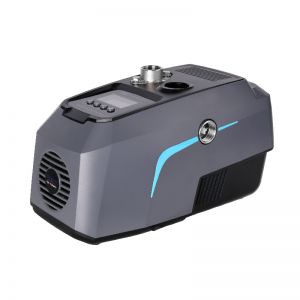
For deep-well applications, the Stream AC/DC Solar Deep Well Pump product page lists MPPT control and protective functions including dry-run, over/under-voltage, overload, over-temperature and over-current protection. These listed features are product-specific; the final PV string sizing and water output must be checked against the selected model and controller data.
Buyers can also review the Stream Solar Pump Range and the existing Solar Pump Controller Guide for related system considerations.
Send these details with a solar pump RFQ:
Country and nearest installation location (for monthly solar data).
Daily water requirement in m³/day and irrigation season.
Well diameter, static and dynamic water levels, and sustainable well yield.
Delivery elevation, outlet pressure and pipe length/diameter.
Required pumping hours and water tank capacity.
Available PV modules: power, Vmp, Imp, Voc, Isc and temperature coefficients.
Pump/controller model or requested supply configuration (DC only or AC/DC).
Any backup power requirements and site operating constraints.
Once these inputs are available, compare feasible pump models at the target operating point, then verify PV string sizing and daily water delivery. Contact Stream Pumps with your project requirements to request a suitable product quotation and supporting technical data.
Possibly, but the wattage ratio alone is insufficient. Confirm required flow and head, daily solar resource, controller input limits and expected operating hours.
That depends on irradiance, shading, panel configuration, controller settings and the pump's minimum power requirement. Peak sun hours are an energy-equivalent measure, not a guarantee of full-power pumping for that many clock hours.
Not necessarily. Many direct-solar systems pump into a storage tank during the day. Batteries or compatible backup supplies become relevant when night-time pumping or continuous electrical operation is required.
Size solar panels from water demand, total head, site sunlight and real pump-system performance—not from motor wattage alone. Use the energy formula for an initial Wp estimate, then verify the complete pump, controller, array and storage design before purchasing.
Technical References
Food and Agriculture Organization of the United Nations (FAO), Water Lifting Devices — Solar Pumping. Basis for the water-volume/head energy calculation and preliminary array sizing approach.
GIZ / FAO SPIS Toolbox, Solar-Powered Irrigation Systems. Further guidance on field inputs and complete system design. All numerical examples above are independent teaching assumptions, not laboratory tests or published Stream model ratings.
Address
No.17 XeDa Jimei Ind. Park, Xiqing Economic Development Area, Tianjin, China
Telephone
+86 13816508465
QUICK LINKS