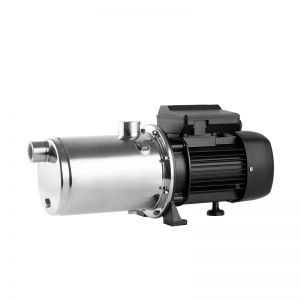
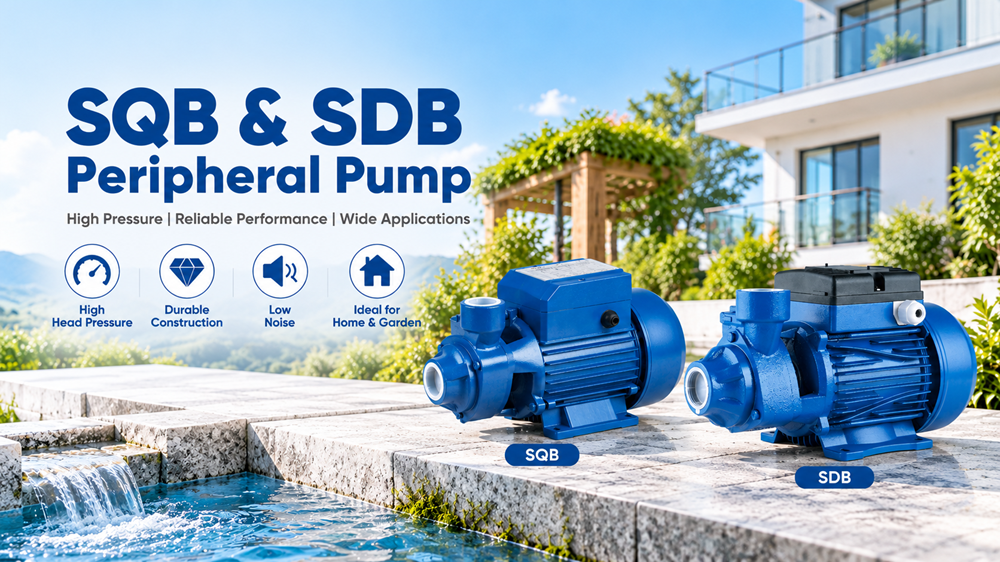
When a home, garden or small water supply system needs additional pressure, a compact peripheral water pump can be a practical and economical solution. Peripheral pumps are particularly useful where relatively high head is required at modest flow rates.
The Stream SQB and SDB series are two cast iron peripheral pump families developed for clean-water supply, household pressure boosting and garden irrigation. Both use a peripheral impeller design, but they serve slightly different product positioning requirements.
The SQB is Stream's Hot Sale Peripheral Pump, emphasizing simple construction, reliability and affordability. The SDB is the Premium Peripheral Pump, featuring a distinctive Stream exterior design, stable operation and a clearly specified brass impeller.
What Is a Peripheral Water Pump?
A peripheral pump, sometimes called a regenerative turbine pump or peripheral impeller pump, uses an impeller with numerous small blades around its outer edge. As the impeller rotates, water circulates repeatedly through the narrow peripheral hydraulic channel, gaining energy before leaving the discharge port.
This hydraulic principle allows a relatively small pump to generate useful pressure for domestic water supply, pipeline boosting and irrigation.
Peripheral pumps are generally more appropriate for applications requiring higher pressure and moderate flow than for large-volume, low-head drainage.
Introducing the Stream SQB Hot Sale Peripheral Pump
The Stream SQB series is designed as a practical and economical electric peripheral pump for clean water and chemically non-aggressive liquids.
Its principal features include simple construction, convenient installation, efficient operation and reliable performance.
The SQB range includes three principal models:
| Model | Power | Maximum Flow | Maximum Head |
|---|---|---|---|
| SQB60 | 0.37 kW | 35 L/min | 35 m |
| SQB70 | 0.55 kW | 45 L/min | 55 m |
| SQB80 | 0.75 kW | 46 L/min | 65 m |
These specifications represent the published maximum values for each model. The actual flow at a particular head must be determined from the performance curve.
Typical SQB applications include garden sprinkling, washing booths, water supply from suitable wells or pools, household pressure boosting and villa water supply.
Learn more about the Stream SQB Hot Sale Peripheral Pump.
Introducing the Stream SDB Premium Peripheral Pump
The Stream SDB series is positioned as a premium compact peripheral pump for domestic and garden water systems.
It combines high-pressure capability at relatively low motor power with stable operation and a distinctive exterior design.
Stream specifies a cast iron pump body, aluminum motor housing and brass impeller for the SDB series.
| Model | Power | Maximum Flow | Maximum Head |
|---|---|---|---|
| SDB60 | 0.37 kW | 40 L/min | 38 m |
| SDB70 | 0.55 kW | 45 L/min | 55 m |
| SDB80 | 0.75 kW | 46 L/min | 65 m |
The SDB is suitable for pipeline pressurization, garden irrigation and domestic water supply. It can also be used as the pumping component in an appropriately designed small automatic pressure system.
Explore the Stream SDB Premium Peripheral Pump.
Stream SQB vs SDB: What Is the Difference?
The two series share the same general peripheral pumping principle, similar installation requirements and many of the same applications.
| Feature | SQB Hot Sale | SDB Premium |
|---|---|---|
| Product Positioning | Economical, practical range | Premium design range |
| Pump Type | Peripheral pump | Peripheral pump |
| Motor Power | 0.37–0.75 kW | 0.37–0.75 kW |
| Maximum Series Flow | 46 L/min | 46 L/min |
| Maximum Series Head | 65 m | 65 m |
| Pump Body | Cast iron | Cast iron |
| Motor Housing | Aluminum | Aluminum |
| Impeller Material | Confirm by model | Brass |
| Applications | Domestic supply, boosting, garden | Domestic supply, boosting, garden |
The SDB60 has slightly higher published maximum flow and head than the SQB60. However, the 70 and 80 models have the same published maximum performance figures. Therefore, the SDB should not automatically be described as hydraulically superior across every model.
How Does a Peripheral Pump Generate Pressure?
Unlike a conventional centrifugal pump with a comparatively open impeller passage, a peripheral pump uses many small blades arranged around the impeller circumference.
During rotation, water repeatedly exchanges energy with the impeller through the peripheral channel. This regenerative action allows the pump to build pressure in a compact hydraulic assembly.
The design is particularly useful for domestic water pressure boosting, small irrigation systems and other applications where high flow volume is not the primary requirement.
Why Peripheral Pumps Are Popular for Domestic Water Supply
Many household water problems involve insufficient pressure rather than extremely high water consumption.
Examples include weak tap pressure, a garden sprinkler with inadequate coverage or a small water system supplying outlets through long pipes.
A peripheral pump can provide additional head without requiring a large industrial pumping system.
Its compact dimensions also make it practical for residential utility areas, small pump rooms and garden installations.
Domestic Water Pressure Boosting
Both SQB and SDB can be used for appropriate domestic pressure-boosting applications.
When a water source provides insufficient pressure, the pump can increase the pressure available to downstream outlets.
However, the selected model must deliver sufficient flow at the required operating head. A high maximum-head figure alone does not guarantee satisfactory pressure when several taps are open simultaneously.
Local water-supply regulations should also be checked before connecting a booster pump directly to a municipal main. In some installations, an intermediate storage tank or approved break-tank arrangement may be required.
Garden Irrigation and Sprinkler Systems
Garden irrigation is a common application for peripheral water pumps.
A sprinkler needs enough pressure to generate the intended spray pattern and watering radius. If pressure is insufficient, coverage may become uneven.
Stream SQB and SDB pumps can be considered for small garden sprinkler systems where their performance curves match the required flow and head.
For large irrigation zones requiring substantial water volume, a centrifugal or multistage pump may be more appropriate.
Water Supply from Wells and Storage Tanks
The SQB series is also promoted for water supply from wells and pools.
When drawing water from a source below pump level, the suction conditions must be evaluated carefully.
Peripheral pumps should not automatically be treated as self-priming pumps. The pump and suction line may need to be filled before starting, and a foot valve may be required to retain prime.
Actual suction capability depends on water level, piping resistance, installation elevation and the specific pump configuration.
Small Automatic Pressure Systems
A peripheral pump can be combined with suitable control components to create an automatic domestic water system.
Common components include a pressure switch, pressure tank, pressure gauge, check valve and appropriate dry-running protection.
The pressure switch can start the pump when system pressure falls and stop it when the upper pressure setting is reached.
A pressure tank helps reduce unnecessary short cycling by storing a small amount of pressurized water.
Neither the SQB nor SDB should be assumed to include a pressure switch or pressure tank as standard simply because it can be used in an automatic system.
Cast Iron Pump Body
Both series use a cast iron pump body.
Cast iron offers a rigid, established construction material for domestic surface pumps and is commonly used in economical water-supply equipment.
For long service life, the pumped liquid must be compatible with the pump materials. Both series are intended for clean water or suitable non-corrosive liquids.
Aluminum Motor Housing
Stream specifies aluminum motor housings for the SQB and SDB.
The motors are enclosed and externally ventilated. Adequate ventilation clearance is therefore important during installation.
A pump should not be installed in a sealed, poorly ventilated compartment unless the complete arrangement has been evaluated for motor cooling.
Brass Impeller in the SDB Series
The SDB product specifications identify a brass impeller.
Brass is widely used in compact water-pump impellers because it offers good machinability and suitable performance in compatible clean-water environments.
Impeller material for the SQB should be confirmed from the selected model's technical documentation rather than assumed to be identical to the SDB.
Operating Conditions
| Parameter | SQB | SDB |
|---|---|---|
| Maximum Ambient Temperature | 40°C | 40°C |
| Maximum Liquid Temperature | 80°C | 80°C |
| Maximum Pressure | 10 bar | 10 bar |
| Pump Body | Cast iron | Cast iron |
| Motor Housing | Aluminum | Aluminum |
| Motor Design | Enclosed, externally ventilated | Enclosed, externally ventilated |
| Impeller | Confirm by model | Brass |
| Insulation | Confirm by model | Class B/F |
| Duty | Confirm by model | Continuous rated |
The maximum pressure rating is a working-condition limit, not a statement that every pump model can generate 10 bar of differential pressure.
Peripheral Pump vs Centrifugal Pump
Peripheral and conventional centrifugal pumps are both rotodynamic pumps, but they have different hydraulic characteristics.
| Comparison | Peripheral Pump | Conventional Centrifugal Pump |
|---|---|---|
| Typical Strength | Relatively high head at modest flow | Broader flow capability |
| Hydraulic Design | Peripheral regenerative channel | Conventional centrifugal impeller |
| Typical Applications | Small boosting and garden systems | General transfer, boosting and irrigation |
| Solids Handling | Requires clean liquid | Depends on impeller design |
| Selection Priority | Required pressure and modest flow | Required duty point and flow range |
Peripheral Pump vs Multistage Centrifugal Pump
A multistage centrifugal pump uses several impellers in series to progressively increase head.
A peripheral pump generates pressure through its regenerative hydraulic channel, generally within a simpler compact arrangement.
For small domestic installations, peripheral pumps can provide an economical option. For higher flow requirements, multiple outlets or more demanding pressure systems, a suitable multistage centrifugal pump may offer a better operating match.
How to Choose Between SQB60, SQB70 and SQB80
The three SQB models offer progressively higher published maximum head and different maximum flow capabilities.
SQB60 can be considered for smaller water-demand applications, SQB70 for higher-head requirements, and SQB80 where the application needs the higher available head range.
However, final selection must always be based on the pump performance curve and the actual system duty point.
How to Choose Between SDB60, SDB70 and SDB80
The same selection principle applies to the SDB series.
SDB60 offers a published maximum head of 38 m, SDB70 reaches 55 m and SDB80 reaches 65 m.
The model with the highest maximum head is not automatically the most efficient choice for every installation.
Choose the model that provides the required operating flow and head without excessive oversizing.
Understanding Flow and Head
Flow rate describes how much water the pump delivers over time, commonly expressed in liters per minute.
Head describes the energy per unit weight of water supplied by the pump, commonly expressed in meters.
For water near normal temperature, 10 meters of head corresponds to approximately 1 bar of pressure difference.
This is a useful approximation for understanding pump specifications, but the actual outlet pressure also depends on suction pressure, elevation and system losses.
Why Maximum Flow and Maximum Head Cannot Be Combined
A common selection mistake is to assume that a pump can produce its maximum published flow at its maximum published head.
In normal centrifugal and peripheral pump performance curves, maximum head occurs at or near zero flow, while maximum flow occurs at much lower head.
The actual operating point is determined by the intersection of the pump curve and the system resistance curve.
How to Estimate Total Dynamic Head
For a typical open water-supply system, total dynamic head includes the elevation difference, required delivery pressure and hydraulic friction losses.
Long pipes, elbows, filters, valves and narrow hoses all increase system resistance.
Before selecting a pump, estimate the required flow and the total head at that flow.
Why Oversizing Can Reduce System Performance
Choosing a pump that produces much more head than required can create excessive pressure, unnecessary throttling and inefficient operation.
For small domestic systems, oversized pumps may also cause rapid pressure-switch cycling if the pressure tank and controls are not correctly matched.
A properly sized pump generally provides a more balanced system than simply selecting the largest available motor.
Installation Guidelines
Install on a Stable Base
Use a secure, level foundation to limit vibration and mechanical stress.
Protect the Pump from Weather
Install the pump in a suitable protected, ventilated location according to its electrical protection rating.
Keep the Suction Pipe Short
Minimize suction-side restrictions and avoid unnecessary bends.
Prevent Air Leaks
Air entering the suction line can prevent proper priming and reduce pump performance.
Prime Before Starting
Fill the pump and suction line as required by the installation instructions. Never assume the pump can operate dry.
Use Appropriate Electrical Protection
Provide proper grounding, overload protection and any residual-current protection required by local regulations.
Common Peripheral Pump Problems
The Pump Runs but No Water Comes Out
Check priming, suction-line air leaks, water availability, foot valve condition and suction restrictions.
Water Pressure Is Too Low
Check whether the required flow and head exceed the selected model's performance curve. Also inspect filters and piping for excessive resistance.
The Pump Is Unusually Noisy
Possible causes include cavitation, air entering the suction line, loose mounting or operation outside the appropriate hydraulic range.
The Motor Overheats
Check voltage, ventilation, operating conditions and motor loading. Disconnect power before inspection.
The Automatic System Starts Too Frequently
Inspect pressure-switch settings, pressure-tank precharge, check valve operation and possible system leaks.
Frequently Asked Questions
What is the difference between SQB and SDB?
SQB is Stream's economical Hot Sale Peripheral Pump range, while SDB is the Premium Peripheral Pump range with distinctive styling and a specified brass impeller. Their application and performance ranges are broadly similar.
Which series has higher pressure?
The SDB60 has a slightly higher published maximum head than SQB60. The 70 and 80 models have identical published maximum head values in both series.
Can SQB and SDB boost household water pressure?
Yes, both are intended for appropriate domestic pressure-boosting applications.
Are these pumps suitable for garden irrigation?
Yes. Both series can serve suitable small garden irrigation systems when correctly matched to the required flow and pressure.
Can they pump dirty water?
No. These pump families are intended for clean water or suitable non-corrosive liquids without abrasive solids.
Are they self-priming pumps?
Self-priming capability is not established by the published descriptions of these two series. Follow the specific model's priming instructions.
Can they be used with a pressure tank?
Yes. An appropriate peripheral pump can be integrated into a properly designed pressure-tank system using compatible control equipment.
Do they automatically start and stop?
The basic pump descriptions do not establish integrated automatic pressure control. External controls may be used in suitable systems.
What is the maximum liquid temperature?
Both series list a maximum fluid temperature of 80°C under their stated operating conditions.
What is the maximum ambient temperature?
The maximum specified ambient temperature is 40°C.
What is the pump body made of?
Both SQB and SDB use cast iron pump bodies.
Does the SDB have a brass impeller?
Yes. Stream specifies a brass impeller for the SDB series.
Which model should I choose?
Determine the required flow and total dynamic head, compare the relevant performance curves, and then choose the model and product series that best fit the application and purchasing requirements.
Conclusion: Choosing the Right Stream Peripheral Water Pump
The Stream SQB and SDB series provide two practical options for compact domestic peripheral pumping.
Both are designed around the advantages of peripheral hydraulics: useful pressure generation, compact construction and suitability for clean-water supply and garden applications.
The SQB emphasizes economical, straightforward performance, while the SDB provides a premium product presentation with a specified brass impeller and additional published construction details.
Because their hydraulic ranges overlap substantially, selection should not be based on product positioning alone.