+86 13816508465
Pump Introductions
Sep. 10, 2026
Not every sewage application requires a cutter or grinder pump.
In many domestic and light commercial wastewater systems, the main requirement is simply to move dirty water containing suspended solids without frequent blockage.
For these applications, a vortex submersible sewage pump can provide a simple and reliable solution.
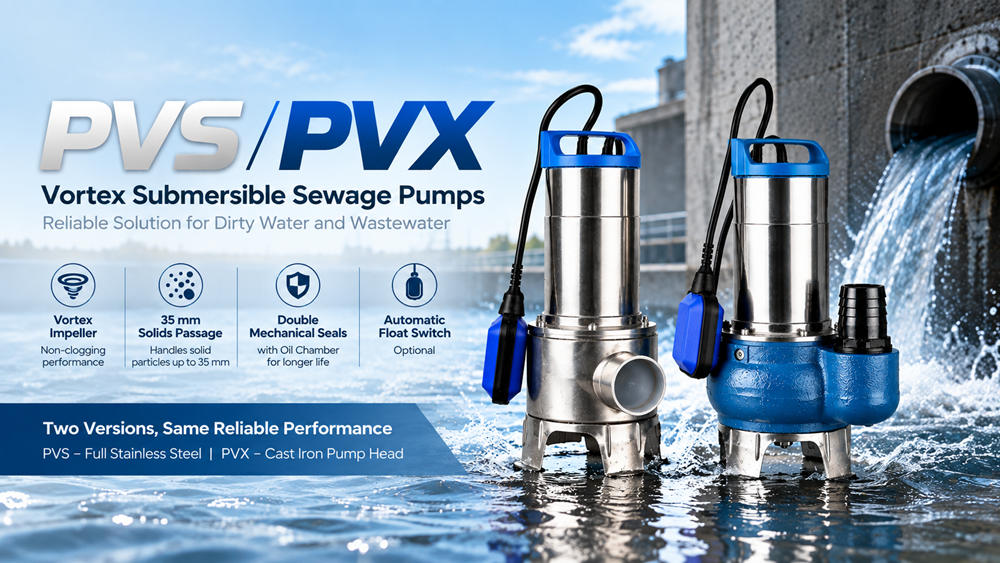
The Stream PVS and PVX series are compact submersible sewage pumps designed for dirty water, domestic wastewater, cesspools, collection pits and flooded areas.
Both series use a wide vortex hydraulic passage that allows compatible solids up to approximately 35 mm to pass through the pump.
Their applications and hydraulic concept are very similar.
The main difference is construction material:
PVS — full stainless steel construction
PVX — cast iron pump-head configuration combined with corrosion-resistant metal components
This gives users two material options for the same general wastewater-pumping role.
The Stream PVS and PVX are submersible sewage and dirty-water pumps designed to operate directly inside the pumped liquid.
Instead of using a suction pipe from above, the pump is completely submerged in the collection pit, wastewater tank or flooded area.
Water enters the lower hydraulic section and is moved through the pump by a vortex-type impeller and wide passage.
The main applications include:
Domestic wastewater disposal
Cesspool emptying
Sewage collection pits
Flooded basements and cellars
Underground parking drainage
Car wash wastewater
Dirty-water transfer
General sump drainage
The PVS and PVX are closely related pump families.
They are intended for similar wastewater applications and use the same general vortex solids-handling concept.
The key difference is the material configuration.
| Feature | Stream PVS | Stream PVX |
|---|---|---|
| Main Construction | Full stainless steel | Cast iron pump-head configuration |
| Water Type | Dirty water / wastewater | Dirty water / wastewater |
| Hydraulic Concept | Vortex solids passage | Vortex solids passage |
| Maximum Solids Passage | Up to 35 mm | Up to 35 mm |
| Typical Positioning | Corrosion-resistant premium version | Robust and economical sewage-pump version |
A vortex impeller is commonly used in wastewater pumps because it allows a relatively open hydraulic passage.
Instead of forcing every solid particle directly through narrow impeller channels, the rotating impeller creates a swirling flow inside the pump casing.
This vortex helps carry suspended solids toward the discharge.
The result is lower direct contact between some solids and the impeller blades.
This can help reduce blockage when pumping dirty water containing compatible particles.
The PVS/PVX series is designed to pass solids up to approximately 35 mm under suitable operating conditions.
This is significantly larger than the particle passage of a typical clean-water drainage pump.
The larger passage makes the pump suitable for water containing:
Small organic solids
Soft debris
Small wastewater particles
Light sludge
General suspended contaminants
However, the 35 mm rating should not be interpreted as permission to pump every hard object smaller than 35 mm.
Metal objects, stones, gravel and highly abrasive material can still damage the hydraulic components.
The PVS/PVX should not be confused with a sewage cutter pump.
A vortex pump normally tries to allow solids to pass through the hydraulic system without changing their size.
A cutter pump actively chops or shreds fibrous material before or during pumping.
| Feature | PVS/PVX Vortex Pump | Cutter Pump |
|---|---|---|
| Main Solids Strategy | Pass solids through wide hydraulic path | Cut or shred solids |
| Best For | General dirty water and sewage solids | Fibrous wastewater |
| Cutting Mechanism | No dedicated cutter | Yes |
A grinder pump takes solids reduction even further.
Instead of simply cutting long material, a grinder mechanism can repeatedly shear and reduce fibrous wastewater into smaller pieces.
This can be useful where narrow pressure pipelines or difficult fibrous sewage are present.
The PVS/PVX has a simpler role.
It is designed to move dirty water and compatible solids through a large vortex passage without requiring a grinding mechanism.
A vortex sewage pump can be particularly suitable when:
The wastewater contains general suspended solids
Fibrous waste is not the dominant problem
A simple non-clog hydraulic passage is preferred
The system does not require intensive solids grinding
Domestic or light commercial wastewater needs to be transferred reliably
The PVS version is designed with full stainless steel construction.
For wastewater service, stainless steel provides several practical advantages:
Improved corrosion resistance
Durable external finish
Good resistance to wet environments
Reduced risk of external rust
Premium material positioning
This can make the PVS attractive where corrosion resistance and material durability are priorities.
The PVX uses a cast iron pump-head configuration.
Cast iron is widely used in sewage and drainage pumps because it offers:
High structural rigidity
Good mechanical durability
Good vibration damping
Economical manufacturing
Long history in wastewater applications
This makes the PVX a practical choice where robust construction and cost efficiency are important.
| Factor | PVS Stainless Steel | PVX Cast Iron |
|---|---|---|
| Corrosion Resistance | Higher | Depends more on coating and water chemistry |
| Structural Rigidity | High | High |
| Weight | Depends on configuration | Typically heavier in pump-head section |
| Typical Buyer Priority | Corrosion resistance and premium construction | Robustness and cost efficiency |
The PVS/PVX uses double mechanical seals with an oil chamber for leakage protection.
This is an important feature in a submersible pump because the motor operates while surrounded by wastewater.
The mechanical seals form a barrier between the hydraulic section and the motor.
Using two sealing stages provides additional protection compared with relying on a single seal alone.
The oil chamber between mechanical seals provides lubrication and cooling for the sealing surfaces.
It also creates an additional protective zone between the pumped wastewater and the electric motor.
This type of construction is widely used in submersible sewage pumps.
The PVS/PVX can be equipped with a float switch for automatic operation.
The float moves with the wastewater level inside the pit or collection tank.
When the water level rises sufficiently, the float switch starts the pump.
As the level falls, the float eventually stops the pump.
Wastewater normally enters a collection pit gradually.
Without automatic control, someone would need to manually switch the pump on every time the pit fills.
A float switch allows the pump to respond automatically to changing water levels.
This makes the system much more practical for household and light commercial use.
Domestic wastewater is one of the main applications of the PVS/PVX series.
Wastewater from utility areas, wash areas and general drainage systems may contain suspended particles that a normal clean-water pump is not designed to handle.
A 35 mm vortex sewage pump provides a larger hydraulic passage for these contaminants.
Stream specifically lists cesspool emptying as an intended application.
A cesspool or wastewater collection chamber may contain dirty water and suspended solids.
The PVS/PVX can be placed directly into the chamber and used to transfer the wastewater to the required discharge location.
In buildings located below the level of the main drainage line, wastewater may need to be collected in a pit and pumped upward.
A submersible sewage pump is well suited to this arrangement because it operates directly inside the collection chamber.
Flooding in underground rooms can involve much dirtier water than a normal plumbing leak.
Water entering from outdoors may carry:
Soil particles
Small debris
Organic material
Suspended solids
A vortex dirty-water pump is more tolerant of these conditions than a clean-water drainage pump.
Underground parking areas can collect rainwater, wash water and drainage runoff.
Stream lists underground car parks among the intended applications for the PVS/PVX.
The pump can be installed in a sump to automatically remove accumulated water where the liquid characteristics remain within the specified limits.
Car wash drainage can contain dirt, suspended particles and general debris washed from vehicle surfaces.
A vortex sewage pump can be used for appropriate collection and transfer applications.
Where large quantities of sand, oil or aggressive chemicals are present, the complete wastewater system should be evaluated separately.
It can handle general wastewater solids within its hydraulic passage, but it does not have a dedicated cutting or grinding mechanism.
Large quantities of wipes, cloth, rope-like fibers or similar materials can still wrap around hydraulic components.
Where fibrous waste is the main problem, a cutter or grinder pump such as a dedicated Stream sewage cutter series may be more appropriate.
Small amounts of fine sediment may be present in dirty water, but the PVS/PVX should not be treated as an abrasive slurry pump.
Large quantities of sand and grit can accelerate wear of:
Impeller surfaces
Pump casing
Mechanical seals
Bearings and shaft components
For construction slurry or highly abrasive water, use a dedicated dewatering or slurry pump.
| Product Series | PVS / PVX |
| Pump Type | Vortex Submersible Sewage Pump |
| PVS Construction | Full Stainless Steel |
| PVX Construction | Cast Iron Pump-Head Configuration |
| Maximum Solids Passage | 35 mm |
| Maximum Immersion Depth | 5 m |
| Liquid Temperature | 0–40°C |
| Liquid pH Range | 6.5–8.5 |
| Seal System | Double Mechanical Seals with Oil Chamber |
| Automatic Operation | Float Switch Available |
| Feature | PVS/PVX | Clean Water Pump |
|---|---|---|
| Water Type | Dirty water / wastewater | Clear or lightly contaminated water |
| Solids Passage | Up to 35 mm | Typically much smaller |
| Hydraulic Design | Vortex / wide passage | Clean-water impeller |
| Typical Application | Sewage pits and dirty-water sumps | Pools, tanks and clean drainage |
The PVS/PVX and SVD can both handle wastewater, but they solve different solids problems.
| Feature | PVS/PVX | SVD |
|---|---|---|
| Main Concept | Pass solids through vortex passage | Cut or grind fibrous solids |
| Dedicated Cutter | No | Yes |
| Best Application | General dirty water and sewage solids | Fibrous sewage and clog-prone wastewater |
The SWQG is a more specialized grinder-pump family.
It actively reduces fibrous material using dedicated cutting and grinding components.
The PVS/PVX is simpler and better suited where the primary requirement is wide solids passage rather than aggressive solids reduction.
This difference is important when selecting a sewage pump.
Higher corrosion resistance is preferred
Full stainless steel construction is desirable
The pump will be used regularly in wet environments
Premium material construction is important
Robust cast iron construction is preferred
Cost efficiency is important
The wastewater is suitable for cast iron pump components
A conventional sewage-pump material combination is acceptable
Material choice is only one part of pump selection.
The correct model should also be selected according to:
Required flow rate
Total dynamic head
Solids size
Water chemistry
Pit depth
Operating frequency
Discharge pipe size
Electrical supply
Maximum solids passage tells you what size particle can pass through the hydraulic system.
It does not tell you whether the pump can meet the required hydraulic duty.
The actual pump model should be selected using the performance curve.
The required system duty is determined by both:
Flow — how much wastewater must be moved
Head — how much hydraulic resistance the pump must overcome
Total dynamic head can include:
Vertical lift
Pipe friction
Check valve resistance
Elbow losses
Required discharge pressure
Long, narrow discharge pipes can create substantial friction loss.
When a submersible sewage pump stops, wastewater inside the vertical discharge pipe can flow backward toward the collection pit.
A correctly selected check valve can prevent this reverse flow.
This can reduce repeated pumping of the same wastewater.
Where a float switch is used, allow enough room for it to move without becoming trapped against the wall of the pit.
Do not position the pump directly inside deep sludge or loose sediment.
An undersized discharge pipe can create unnecessary pressure loss and reduce actual pump capacity.
Use the appropriate handle or lifting arrangement.
Stream specifies that the pumped dirty water should not be chemically aggressive toward the pump materials.
Remove foreign objects that may restrict the hydraulic passage.
Seal condition is critical to protecting the submerged electric motor.
Make sure it moves freely and switches reliably.
Where practical, rinsing the pump with clean water after heavily contaminated drainage can reduce residue buildup.
Damage to the power cable can compromise electrical safety and water-tightness.
They are vortex submersible sewage pumps designed for dirty water, domestic wastewater, cesspools and drainage applications containing compatible solids.
The main difference is construction material. PVS is the full stainless steel version, while PVX uses a cast iron pump-head configuration.
Stream specifies maximum solids passage up to approximately 35 mm.
No dedicated cutting system is specified. They rely primarily on a wide vortex hydraulic passage rather than chopping solids.
No. They are better classified as vortex sewage pumps. A grinder pump uses a dedicated mechanism to reduce fibrous solids before discharge.
Yes. Domestic wastewater disposal is one of the intended applications.
Yes. Stream specifically lists cesspool emptying as an application.
Yes. Flooded cellars and similar areas are among the listed applications.
Yes. Underground car park drainage is included among the Stream application examples.
A float switch is available for water-level-controlled automatic operation.
The specified maximum immersion depth is 5 meters.
The specified liquid-temperature range is 0–40°C.
Stream lists a permitted liquid pH range of 6.5–8.5.
They can handle general wastewater solids, but where long fibers, wipes or cloth are a major clogging risk, a dedicated cutter or grinder pump may be more appropriate.
They should not be treated as abrasive slurry pumps. Large amounts of sand and gravel can cause accelerated wear.
Neither is universally better. PVS emphasizes full stainless steel corrosion resistance, while PVX provides a robust cast iron pump-head option. The correct choice depends on water chemistry, budget and application requirements.
The Stream PVS and PVX provide a straightforward approach to domestic and light commercial wastewater pumping.
Rather than using complex cutting or grinding mechanisms, the pumps rely on a wide vortex hydraulic passage to move dirty water and compatible solids up to approximately 35 mm.
This makes them suitable for domestic wastewater, cesspools, collection traps, flooded cellars, underground parking areas and general dirty-water drainage.
The two versions allow users to choose the construction material that best matches their requirements.
PVS provides full stainless steel construction for users who prioritize corrosion resistance and premium material durability.
PVX provides a cast iron pump-head configuration for applications where robust conventional sewage-pump construction and cost efficiency are important.
Both versions share the same essential product philosophy:
Keep the hydraulic passage open, allow compatible solids to pass and provide reliable submerged wastewater transfer without unnecessary complexity.
For homes, small commercial properties, drainage pits and wastewater collection systems that do not require dedicated cutting or grinding, the Stream PVS/PVX family provides a practical vortex sewage-pump solution.
Address
No.17 XeDa Jimei Ind. Park, Xiqing Economic Development Area, Tianjin, China
Telephone
+86 13816508465
QUICK LINKS