+86 13816508465
Pump Knowledge
Oct. 26, 2026
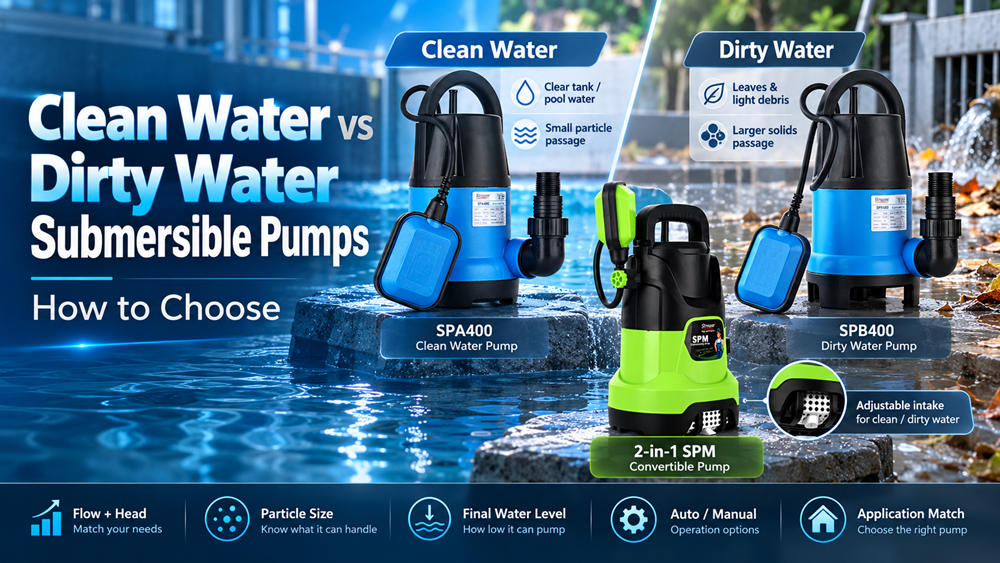
Choose a clean-water submersible pump when the liquid is relatively free of debris, and a dirty-water pump when it contains compatible leaves, sediment or small solids. The key is not the appearance of the water alone: check the size and type of suspended material, required flow and head, water level, and pump limits before ordering. A dirty-water pump is not automatically a sewage or slurry pump.
This buyer's guide explains how to identify your drainage duty, compare pump types and prepare a specification a supplier can actually quote.
| Selection factor | Clean-water pump | Dirty-water pump |
|---|---|---|
| Typical water | Clear tank or pool water | Rainwater with leaves or light debris |
| Solids passage | Usually smaller | Usually larger; model-specific |
| Hydraulic design | Optimized for relatively clean liquid | May use vortex or other solids-handling design |
| Not automatically suitable for | Leaves, gravel, fibrous waste | Raw sewage, abrasive slurry, long fibers |
Important: A 35 mm passage rating describes a stated particle-size capability under specified conditions; it is not a guarantee against blockage by long fibers, plastic bags, rags or heavy sediment.
Do not rely only on labels such as “basement water” or “pond water.” Inspect what the liquid actually contains and select the pump for the worst reasonable operating condition.
| Water condition | Starting point | Check before buying |
|---|---|---|
| Clear tank or pool water | Clean-water pump | Chemical compatibility; required residual water level |
| Rainwater with leaves | Dirty-water pump | Debris shape and maximum particle size |
| Muddy water with much sand | Application-specific dewatering pump | Abrasive concentration and materials |
| Toilet sewage or fibrous waste | Dedicated sewage/grinder pump | Fibers, solids, piping and duty point |
| Unknown or chemically contaminated water | Do not choose by water clarity alone | Liquid composition and material compatibility |
Stream's published series provide three useful selection examples:
SPA clean-water pump: published particle passage up to 5 mm; suitable for compatible relatively clear drainage duties.
SPB dirty-water pump: vortex design with published particle passage up to 35 mm; suitable for compatible water containing small debris.
SPM convertible pump: adjustable bottom filter allows clean-water and dirty-water intake configurations; published dirty-water passage up to 35 mm.
For detailed product construction and current specifications, compare the Stream SPA and SPB series and Stream SPM 2-in-1 pump. If a more durable body construction is required for a compatible drainage duty, review the Stream SGW stainless steel dirty-water pump.
Specification caution: Maximum particle size is only one selection parameter. It does not describe the complete pump curve or prove performance with abrasive slurry, sewage, chemicals or hot liquids.
Choosing by motor watts alone. Confirm required flow and total dynamic head at the same operating point.
Assuming “dirty water” includes sewage. Long fibers and waste require a dedicated sewage-handling design.
Ignoring fine abrasive sediment. Particle passage does not mean the impeller and seals can tolerate continuous sand abrasion.
Ignoring the final water level. Check minimum operating depth, inlet clearance and float-switch movement if near-flat-floor drainage is needed.
Water source and liquid composition
Solids: maximum size, shape, fibers and approximate concentration
Required flow rate (m³/h or L/min)
Total dynamic head (m), including piping losses
Water temperature and expected operating duration
Power supply, installation dimensions and automatic/manual control preference
When requesting a quotation, include photos of the liquid and installation area if available. A specification such as “750 W dirty-water pump” alone does not establish whether the model will work.
Often yes, provided the liquid and operating point are compatible. A clean-water model may still be more suitable for consistently clear water or low-residual drainage requirements.
Not necessarily. Sewage often contains fibers and difficult waste that require an appropriately designed sewage or grinder pump. See the Stream sewage pump range.
No. Blockage depends on debris shape, quantity, pump hydraulics and operating conditions, not only particle diameter.
Clear water usually points toward a clean-water pump; water containing compatible debris generally calls for a dirty-water design. For abrasive slurry, fibers, sewage or chemically aggressive liquids, the application must be evaluated separately. Always confirm flow, head and operating limits from the actual model's technical data.
Need to compare options? Send your drainage requirements to Stream Pumps for model selection and quotation.
Address
No.17 XeDa Jimei Ind. Park, Xiqing Economic Development Area, Tianjin, China
Telephone
+86 13816508465
QUICK LINKS