+86 13816508465
Pump Introductions
Oct. 19, 2026
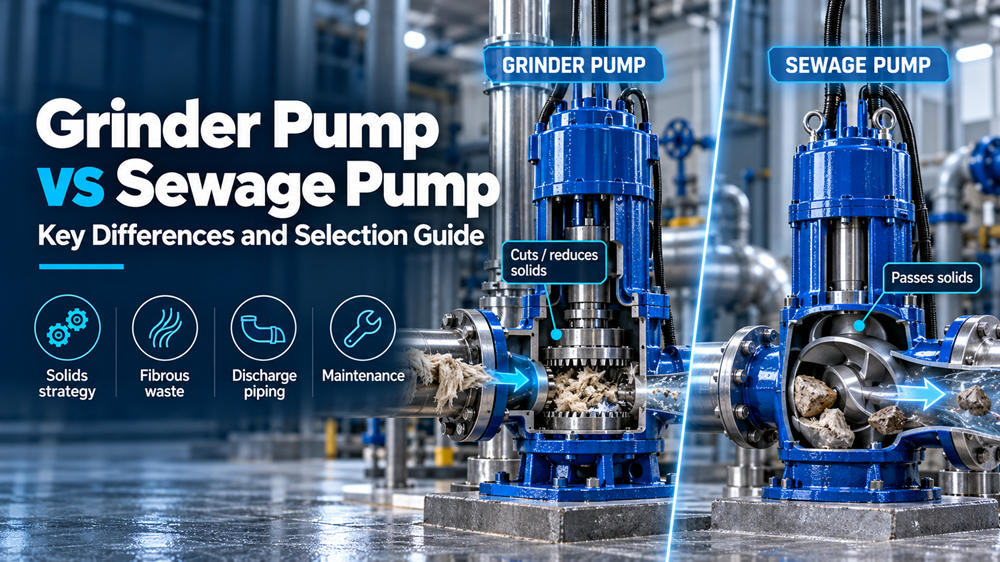
BLUF: Choose a grinder pump when compatible fibrous or soft solids need to be cut or macerated before being pumped, especially in properly engineered pressure-sewer installations. Choose a conventional sewage pump when the priority is transferring wastewater with solids that can pass through the pump's hydraulic passage. Neither design is universally better: the correct choice depends on the wastewater, required flow and head, pipework, and maintenance conditions.
The most useful distinction is reduce solids versus pass solids. A cutter or grinder reduces troublesome material; a vortex or free-passage sewage pump is primarily designed to transport solids within its rated passage size.
A grinder uses interacting cutting surfaces or another macerating arrangement to break down compatible soft solids and fibers. A cutter pump can instead use an impeller-mounted blade or cutting device. These mechanisms are not identical, so buyers should confirm the actual design instead of relying only on the product name.
Grinding can make a pump suitable for a designed small-diameter pressure sewage system, but does not by itself establish an allowable discharge pipe size. The system must still meet flow, pressure, velocity, and manufacturer requirements.
A conventional sewage pump generally transports compatible solids without deliberately grinding them. Vortex and free-passage impellers use different hydraulic paths, but both are assessed by the actual solids-passage rating, pump curve, and intended service. Long fibers can still cause ragging in some sewage pumps, even if the nominal solid size is within the passage rating.
| Selection factor | Grinder / cutter pump | Conventional sewage pump |
|---|---|---|
| Solids strategy | Cuts or reduces compatible material | Passes compatible material through hydraulics |
| Fibers and soft waste | Useful where fibrous clogging is a concern | Performance depends on impeller design and waste |
| Rigid solids | Not intended to crush stones or metal | Only solids within rated passage and material limits |
| Discharge piping | May support engineered pressure sewer designs | Sized for the selected pump and wastewater transport |
| Maintenance focus | Cutter/grinder wear and foreign-object damage | Impeller blockage, passage and wear |
| Best fit | Compatible fibrous sewage or designated pressure-sewer duty | General sewage and solids within rated passage |
Identify the waste. Is it mainly toilet paper, hair, and compatible soft fibers, or wastewater containing discrete solids that need to pass intact? Check for sand, stones, grease, and aggressive chemicals separately.
Confirm the installation. Is wastewater being lifted from a local collection pit, or conveyed into a designed pressure-sewer network?
Calculate the duty point. Specify required flow and total dynamic head at the same operating point. Motor wattage alone cannot establish suitability.
Review piping. Confirm actual discharge diameter, length, elevation, fittings, and any required minimum transport velocity.
Check service conditions. Confirm allowable liquid temperature and chemistry, solids rating, control method, duty cycle, and access for cleaning.
Stream offers several relevant designs, but model specifications and construction must be verified for the exact product being quoted:
| Stream series | Published design emphasis | When to investigate |
|---|---|---|
| SWQG | Cast-iron grinder pump range | Fibrous sewage requiring solids reduction |
| SVD | 750–1800 W cutter designs; 2200 W grinder-type design, as described in series documentation | Different types of compatible fibrous waste; confirm exact variant |
| SVX | Vortex sewage pump; published maximum solids passage up to 35 mm | General wastewater containing compatible passable solids |
Important: The SVX solids-passage figure describes a passage limit, not permission to pump any hard 35 mm object. A grinder's cutting feature does not make it suitable for sand, metal, or construction debris. Confirm every pump's hydraulic curve and material limits before ordering.
Choosing by horsepower alone: the required flow/head duty point matters more than nameplate power by itself.
Assuming bigger solids passage means fiber-proof: flexible cloth can wrap around rotating parts even when discrete solids can pass.
Assuming every grinder works with small pipes: allowable pipework depends on pump and system hydraulic design.
Ignoring abrasive debris: grit can accelerate wear of cutting surfaces, impellers and seals.
Before asking for a quotation, provide: (1) wastewater source and solids description; (2) approximate fiber or rag content; (3) required flow; (4) total dynamic head; (5) discharge pipe diameter and length; (6) supply voltage/frequency; (7) liquid temperature and chemistry; (8) pit dimensions and control preference; and (9) quantity and destination market.
A complete request helps compare models on equivalent duty conditions. Explore Stream's grinder pump range and sewage pump range before selecting a specific design.
No. A grinder is valuable when solids reduction solves a real problem. For general wastewater, a properly sized conventional sewage pump may be the simpler choice.
Many sewage pumps are intended for domestic wastewater, but suitability depends on the exact impeller, wastewater composition and installation. Heavy fibrous loading can create ragging problems.
Do not assume so. Grinder mechanisms generally target compatible soft solids and fibers, not hard or highly abrasive debris.
No. Flow, total dynamic head, pipe losses, waste characteristics and the manufacturer's operating curve must also be checked.
Choose based on the waste and the hydraulic system, not the label. Grinder and cutter pumps reduce compatible troublesome solids; conventional sewage pumps transport solids within their designed passages. For a reliable purchase decision, match the wastewater to the mechanism, then check flow, head, pipework, and actual model limits.
Need help comparing configurations? Review the Stream grinder pump range and sewage pump range, then share your flow, head, pipe size and wastewater details when requesting a quotation.
Technical references and scope
U.S. Environmental Protection Agency, Wastewater Technology Fact Sheet: Pressure Sewers (background on grinder pumps and pressure sewer applications).
Stream product information: SVD, SWQG, and SVX. This is a purchasing and selection guide, not an independent laboratory performance test.
Previous: None
Next: Stream SPP2-4.5-0.1 Submersible Puddle Pump: 2mm Low Level Water Removal Guide
Address
No.17 XeDa Jimei Ind. Park, Xiqing Economic Development Area, Tianjin, China
Telephone
+86 13816508465
QUICK LINKS