+86 13816508465
Sep. 04, 2026
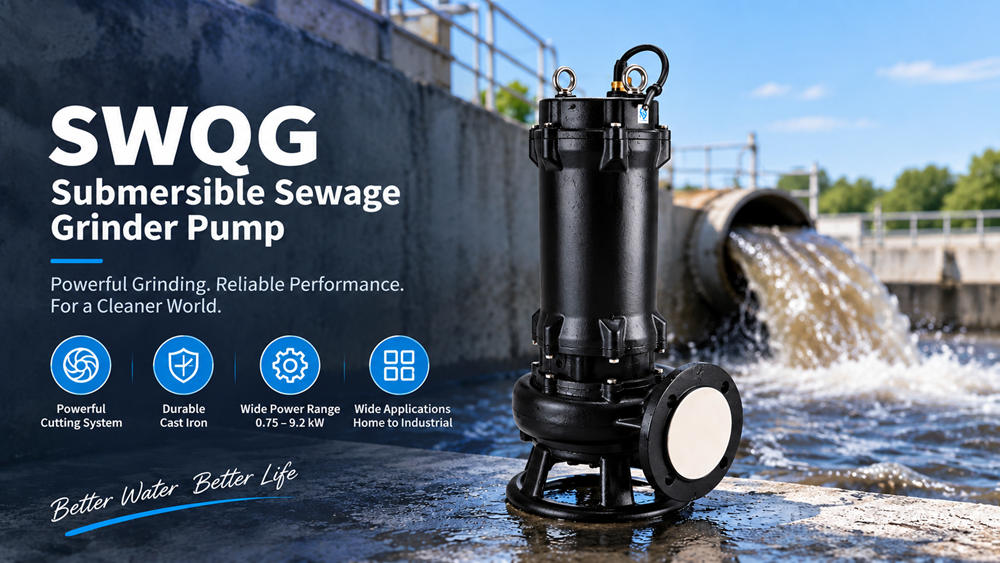
Wastewater pumping requirements can vary enormously.
A small residential septic tank may require only a compact single-phase pump, while a municipal pumping station, livestock facility or industrial wastewater system may need several kilowatts of motor power, large discharge connections and substantially higher flow capacity.
The Stream SWQG Cast Iron Submersible Grinder Pump series is designed to cover this unusually wide range of wastewater applications within one product family.
Starting from compact 0.75 kW models suitable for household and light-duty sewage handling, the range extends to heavy-duty three-phase models up to 9.2 kW for commercial, municipal, agricultural and industrial wastewater systems.
Across the complete series, the SWQG combines a spiral vortex impeller with a hardened cutter ring to reduce fibrous and soft solid waste before it can create serious clogging problems inside the pump or discharge pipeline.
With a broad hydraulic range of approximately 20–140 m³/h, head ratings from 15–48 m and discharge sizes from DN50 to DN100 across the available models, the SWQG can be selected for everything from residential sewage pits to larger wastewater pumping stations.
This guide explains how the SWQG grinding system works, why its cast iron construction is suited to demanding wastewater service, how different power levels serve different markets and how to select a grinder pump for household, agricultural, commercial, municipal and industrial applications.
The Stream SWQG is a submersible sewage grinder pump designed for wastewater containing fibrous materials and compatible solids that can cause conventional pumps to clog.
The pump operates completely submerged in the wastewater and combines several important functions in one unit:
Wastewater pumping
Fibrous waste reduction
Non-clog hydraulic transport
Automatic motor protection
Heavy-duty submerged operation
Its characteristic hydraulic system combines a spiral vortex impeller with a hardened cutter ring installed around the suction area.
As wastewater enters the pump, fibrous and soft solid material encounters the rotating hydraulic components and cutter ring.
The material is torn, sheared and reduced before continuing through the pump and discharge pipeline.
One of the strongest advantages of the SWQG is the width of the range.
| Series Parameter | SWQG Range |
|---|---|
| Motor Power | 0.75–9.2 kW |
| Flow Capacity | Approximately 20–140 m³/h across the series |
| Head Range | Approximately 15–48 m across the series |
| Discharge Range | DN50–DN100 |
| Pump Body | Heavy-Duty Cast Iron |
| Impeller | Spiral Vortex Impeller |
| Cutting System | Hardened Cutter Ring + Grinding Impeller System |
These figures describe the overall SWQG product family rather than one individual pump.
Maximum flow and maximum head should not be interpreted as occurring simultaneously. Final selection should always be made using the individual model performance curve and the actual system duty point.
A sewage pump is not a one-size-fits-all product.
The difference between pumping wastewater from a small household sump and transferring sewage from a municipal collection station can be enormous.
Required flow, pipeline diameter, static head, pipe friction and operating hours can all change dramatically.
This is why the SWQG series extends from small single-phase units into substantially larger three-phase industrial models.
At the lower end of the range, compact SWQG models provide a practical solution for smaller wastewater systems.
Typical applications can include:
Residential sewage pits
Septic tanks
Small commercial properties
Farm drainage
Small wastewater transfer stations
Single-phase power availability also makes these models particularly relevant where three-phase electrical supply is not available.
As motor power and hydraulic capacity increase, the SWQG becomes suitable for systems requiring more wastewater flow and higher pumping head.
This part of the range can serve livestock farms, aquaculture facilities, commercial buildings, construction projects and medium-sized sewage collection systems.
At the upper end of the range, SWQG models reach motor power up to 9.2 kW.
These larger pumps are designed for applications requiring substantially higher capacity, larger discharge pipes and more demanding operating cycles.
Typical applications include:
Municipal sewage pumping
Industrial wastewater transfer
Large livestock facilities
Commercial wastewater stations
Drainage and flood-control systems
Large septic and wastewater collection pits
The SWQG does more than simply provide a large opening for wastewater solids to pass through.
Its hydraulic design actively reduces fibrous waste.
The system combines two key components:
A spiral vortex grinding impeller
A hardened cutter ring
As the motor rotates the impeller, wastewater is drawn toward the suction opening.
Fibrous and soft solid materials entering this area are exposed to the rotating impeller and the closely matched cutter ring.
The relative movement creates mechanical shear and grinding action.
Long fibers are shortened and soft solids are reduced before the wastewater enters the main hydraulic flow path.
The SWQG is particularly interesting because it combines characteristics normally associated with both cutter and grinder pumps.
The cutter ring provides a defined cutting surface, while the vortex impeller creates the hydraulic movement required to transport wastewater and continuously present contaminants to the grinding zone.
Instead of treating cutting and pumping as completely separate functions, the two actions work together.
This combination helps reduce the risk of fiber entanglement while maintaining useful wastewater flow.
Vortex impellers are widely used in sewage applications because they reduce direct contact between many solids and the main rotating hydraulic surfaces.
The rotating impeller creates a swirling flow inside the pump chamber.
This vortex helps move wastewater and contaminants toward the discharge while reducing the number of narrow passages through which all solids must physically travel.
The SWQG adds a grinding system to this vortex concept.
The result is a hydraulic design intended to combine clog resistance with solids reduction.
Many wastewater pump failures are not caused by one large solid object.
Long flexible materials can be even more troublesome.
Examples include:
Wipes
Cloth fibers
Hair
Plastic film
Rope-like organic material
Livestock waste fibers
Paper products
Other flexible contaminants
Unlike rigid particles, flexible material can wrap around an impeller, shaft or hydraulic component.
Once wrapping begins, additional fibers can accumulate around the first obstruction.
This process is commonly called ragging.
Ragging can reduce pump capacity, increase motor load and eventually stop the pump completely.
The cutter ring is one of the key wear components of the SWQG grinding system.
Stream specifies a high-chromium alloy cutter ring hardened to approximately 48–52.
The high hardness provides the cutting surface with improved resistance to mechanical wear during repeated interaction with fibrous wastewater contaminants.
Correct clearance between the cutter ring and rotating hydraulic component is also important.
If the gap becomes excessive through wear, cutting efficiency can decrease.
A cutting system works most effectively when the rotating and stationary components remain closely matched.
If the gap becomes too large, flexible material can bend through the opening instead of being effectively sheared.
Maintaining appropriate clearance helps produce more effective cutting and reduces the likelihood of long fibers passing through intact.
This principle is common in dedicated wastewater grinder systems where rotating and stationary cutting surfaces work together to reduce solids size.
A good grinder pump should not rely on cutting components alone.
The entire hydraulic system must be designed to keep the processed wastewater moving.
The Stream SWQG combines:
Spiral vortex hydraulic flow
Hardened cutter ring
Closely matched cutting components
Wide wastewater passages
Heavy-duty motor construction
This integrated approach is what gives the pump its non-clogging characteristics.
The SWQG uses cast iron construction rather than the lightweight plastic or thin stainless housings commonly found on small domestic utility pumps.
For larger wastewater pumps, cast iron offers several practical characteristics:
High structural rigidity
Mechanical durability
Good vibration damping
Suitability for larger pump casings
Good heat-transfer characteristics
This makes cast iron a widely used material for municipal, commercial and industrial submersible wastewater pumps.
Stream applies electrophoretic surface treatment to the SWQG pump body.
The coating provides an additional protective layer on the cast iron surface and helps improve resistance to the wet and corrosive environment normally associated with wastewater systems.
Surface treatment does not make the pump suitable for every chemically aggressive liquid, so wastewater chemistry should still remain within the specified operating conditions.
Protecting the electric motor from wastewater is one of the most important engineering requirements in any submersible sewage pump.
The SWQG uses a dual mechanical seal system with silicon carbide sealing surfaces.
Silicon carbide is widely used in wastewater mechanical seals because of its hardness and wear resistance.
The double-seal configuration provides multiple sealing barriers between the hydraulic section and the motor chamber.
The SWQG motor is designed for fully submersible operation and is specified with IP68 protection.
Class B/F insulation options support operation across different motor configurations in the product range.
Because the pump operates directly in the wastewater, the submerged motor design eliminates the need for surface suction piping and allows a compact sewage-pit installation.
Wastewater pumps can experience abnormal motor loads if hydraulic conditions change or if fibrous material temporarily interferes with the grinding mechanism.
The SWQG includes automatic motor protection according to motor configuration.
Single-phase versions can use overload protection, while three-phase systems can incorporate over-current protection within the appropriate control system.
Protection devices help reduce the risk of motor damage, but they do not replace correct pump sizing and maintenance.
The wide SWQG range allows the same basic grinder-pump concept to be used across very different sectors.
Smaller SWQG models can transfer household wastewater from septic chambers, sewage pits and low-level collection tanks where gravity drainage is not possible.
Septic wastewater contains toilet paper, organic solids and fibrous material that can challenge conventional pumps.
The cutter and grinder system helps reduce this waste before pumping.
Farms can generate wastewater containing organic fibers, feed residue and other soft solids.
Larger SWQG models can provide the flow capacity required for appropriate agricultural sewage and wastewater-transfer applications.
Fish ponds and aquaculture facilities periodically require drainage and sludge-contaminated water transfer.
Where the solids and water characteristics remain within the pump's operating limits, the SWQG can provide a robust submersible drainage solution.
Construction sites may accumulate wastewater, groundwater and contaminated drainage water.
The rugged cast iron construction and wide power range make selected SWQG models suitable for appropriate site-drainage duties.
Shopping centers, hotels, restaurants, office buildings and other commercial properties can require sewage lifting systems where wastewater cannot flow by gravity to the main sewer.
A grinder pump can reduce troublesome fibrous waste before lifting it to the discharge system.
Municipal wastewater is particularly unpredictable because foreign materials can enter the sewer network.
The larger three-phase SWQG models provide a suitable platform for pumping stations requiring higher capacity and strong clog resistance.
Industrial facilities can require pumps for wastewater transfer between collection pits, treatment processes and discharge systems.
The SWQG can be considered where wastewater chemistry, temperature and solids characteristics are compatible with the pump's specified operating conditions.
The larger SWQG models can also be applied to suitable high-capacity drainage duties where contaminated water and soft debris make a conventional clean-water pump inappropriate.
Pump selection should account for the actual water solids content because heavy sand and highly abrasive construction slurry may require a dedicated abrasive drainage pump instead.
| Application | Typical Requirement | Relevant SWQG Advantage |
|---|---|---|
| Residential Sewage | Compact automatic sewage removal | Small single-phase models and grinder system |
| Septic Tanks | Fibrous and organic wastewater | Cutter ring and vortex impeller |
| Agriculture | Organic and fibrous wastewater | Wide flow range and clog resistance |
| Commercial Buildings | Reliable sewage lifting | Multiple pump sizes and automatic installation options |
| Municipal Systems | High capacity and difficult solids | Large three-phase models up to 9.2 kW |
| Industrial Wastewater | Continuous heavy-duty sewage transfer | Cast iron construction and broad hydraulic coverage |
A wastewater blockage can occur not only inside the pump but also downstream in the pipeline, elbows and valves.
Long fibrous material that successfully passes through a conventional pump may later collect inside a narrow pipe or around a valve.
A grinder pump reduces the length and size of this material before it enters the discharge line.
This can reduce the risk of downstream accumulation in correctly designed wastewater systems.
One advantage of grinding wastewater solids is that the processed material becomes easier to transport through a pressure pipeline.
This is particularly relevant when wastewater must travel over long distances or against significant elevation.
However, selecting a smaller pipe solely because the pump has a grinder is not recommended.
Pipe sizing must still consider:
Required flow rate
Minimum wastewater transport velocity
Total pipe length
Vertical elevation
Number of elbows and valves
Pipe material
Friction losses
As flow increases, pipe friction can increase dramatically.
A pump capable of producing 100 m³/h or more may lose a substantial amount of available head if the discharge pipe is undersized.
For this reason, the total dynamic head of the system must include both vertical lift and pipeline friction.
Selecting the correct pipe diameter can reduce energy losses and allow the pump to operate closer to its intended hydraulic duty point.
Pump head is not simply the vertical distance between the sewage pit and discharge point.
The pump must also overcome hydraulic resistance inside the pipeline.
A simplified relationship is:
Total Dynamic Head = Static Head + Pipe Friction Loss + Fitting Losses
The longer and narrower the discharge pipe, the greater the friction loss normally becomes.
Elbows, check valves, gate valves and other fittings also add additional hydraulic resistance.
For permanent sewage pumping stations, repeatedly entering a wastewater pit to disconnect pipework is undesirable.
An auto-coupling system provides a more practical installation method.
The pump is connected to guide rails and lowered toward a fixed discharge base at the bottom of the pit.
As the pump reaches the base, it automatically connects to the discharge connection.
When maintenance is required, the pump can be raised along the guide rails without manually dismantling the submerged discharge pipe.
This type of installation is especially useful for commercial, municipal and industrial wastewater systems.
Faster pump installation
Easier removal for maintenance
Reduced need to work inside sewage pits
Fixed and repeatable pump position
Practical installation for sewage treatment tanks and pumping stations
| Feature | Portable / Free-Standing | Auto-Coupling |
|---|---|---|
| Installation | Pump placed directly in pit | Pump lowered on guide rails |
| Maintenance | Discharge connection may need manual disconnection | Pump can be lifted from fixed discharge base |
| Typical Use | Temporary and smaller installations | Permanent commercial, municipal and industrial stations |
The broad SWQG range makes correct model selection particularly important.
Do not select the pump only according to motor power.
Estimate the maximum wastewater inflow and the required pump-down time.
Residential systems may need relatively modest flow, while municipal and industrial pits can require much larger capacity.
Include vertical lift, pipeline friction and fittings rather than using static height alone.
Determine whether the wastewater contains fibers, soft solids, organic material, sand or abrasive grit.
The SWQG is designed particularly for fibrous and compatible solid-laden sewage.
The SWQG range covers DN50 through DN100 configurations.
Pipe diameter should be matched to flow requirements and acceptable wastewater velocity.
Smaller applications may use single-phase electricity, while larger commercial and industrial systems normally use three-phase motors.
A household sewage pit may run only intermittently, whereas a municipal or industrial pump station can operate for substantially longer periods.
Portable installation may be appropriate for temporary drainage and smaller systems.
Permanent stations generally benefit from auto-coupling and guide-rail installation.
An oversized sewage pump can create problems rather than solve them.
If the pump empties a small collection pit extremely quickly, frequent start-stop cycling can occur.
A large pump operating far from its intended duty point may also suffer from poor hydraulic efficiency or unsuitable discharge velocity.
Correct selection should match the pump to the actual system rather than simply choosing the highest available motor power.
| Feature | SWQG Grinder Pump | Standard Vortex Sewage Pump |
|---|---|---|
| Fiber Handling | Actively cuts and grinds | Attempts to pass material intact |
| Cutter Ring | Yes | Normally no |
| Ragging Resistance | Enhanced through solids reduction | Depends mainly on vortex free passage |
| Pipeline Blockage Risk | Reduced by shortening fibrous waste | Long fibers can continue downstream |
Many grinder pumps on the market are designed primarily for residential sewage and pressure sewer applications.
The SWQG range is broader.
Its power range extends from residential-class 0.75 kW pumps through large three-phase industrial configurations up to 9.2 kW.
This allows users, distributors and contractors to work with one grinder-pump family across several project sizes.
| Factor | SWQG Series | Typical Small Grinder Pump |
|---|---|---|
| Power Range | 0.75–9.2 kW | Primarily small residential power range |
| Applications | Residential through industrial | Mostly residential / light commercial |
| Discharge Range | DN50–DN100 | Usually narrower product range |
| Installation | Free-standing or auto-coupling options | Often smaller pit installations |
The grinder system is designed primarily to handle sewage, fibers and compatible soft solids.
Grinding fibers and pumping abrasive sand are two different engineering requirements.
Large quantities of sand, gravel or highly abrasive slurry can accelerate wear on the cutter ring, impeller, pump casing and mechanical seals.
For heavy abrasive construction slurry, a dedicated dewatering or slurry pump may be more appropriate.
Selected large SWQG models can provide high wastewater and drainage flow, making them useful for appropriate emergency drainage or contaminated floodwater applications.
However, the type of floodwater should be assessed carefully.
Floodwater containing primarily sewage, organic debris and fibrous material can suit a grinder-pump concept better than water heavily loaded with sand, gravel or construction aggregate.
Cutting performance can decline as the grinding surfaces wear.
Periodic inspection helps identify excessive clearance or mechanical damage.
If flow or pressure decreases unexpectedly, check whether foreign material has entered the hydraulic chamber.
Submersible motor reliability depends heavily on seal condition.
Seal inspection and lubricant maintenance should follow the applicable service schedule.
Three-phase pumps should be operated with correctly configured electrical protection against overload and abnormal current conditions.
Guide rails, discharge bases and sealing surfaces should remain correctly aligned and free from excessive corrosion or debris.
The SWQG is a full-range cast iron submersible sewage grinder pump family designed to cut and grind fibrous wastewater solids while providing non-clog sewage transport.
The SWQG family covers motor power from approximately 0.75 kW to 9.2 kW.
Across the series, available models cover approximately 20–140 m³/h depending on the selected pump and operating point.
The product family provides head coverage up to approximately 48 m depending on model and flow condition.
The SWQG series covers discharge sizes from approximately DN50 to DN100.
Yes. Smaller models can be used for suitable residential sewage pits, septic tanks and domestic wastewater systems.
Yes. Agriculture, aquaculture sewage and fish pond cleaning are among the applications associated with the series.
Yes. Larger three-phase models can be selected for appropriate municipal sewage and wastewater pumping applications.
Yes. Factory wastewater is one of the intended application categories, provided the wastewater chemistry, temperature and solids are compatible with the pump materials and operating limits.
The pump combines a spiral vortex impeller with a hardened cutter ring to cut, grind and shorten fibrous contaminants before they can wrap around the hydraulic components or enter the discharge pipeline at full size.
Stream specifies a high-chromium alloy cutter ring with hardened construction for improved wear resistance.
Yes. The SWQG uses a dual mechanical seal arrangement with silicon-carbide sealing surfaces.
The current Stream product specification lists the SWQG motor with IP68 protection and Class B/F insulation configurations.
The specified maximum immersion depth is 5 meters.
The specified operating liquid temperature range is 0–40°C.
The specified liquid pH range is 6.5–8.5.
No. The correct pump should be selected according to flow, total dynamic head, wastewater characteristics, pipe diameter and installation conditions. A larger motor is not automatically a better choice.
An auto-coupling system allows the pump to be lowered on guide rails and automatically connect to a fixed discharge base at the bottom of a wastewater pit. This simplifies removal and maintenance in permanent pumping stations.
The most important advantage of the Stream SWQG is the combination of grinder technology and unusually broad product coverage.
At the lower end of the range, compact single-phase models provide a practical sewage solution for homes, septic systems, farms and small commercial installations.
Moving upward through the range, larger pumps provide the flow, head and three-phase motor power required for commercial buildings, aquaculture, construction projects and medium-sized sewage stations.
At the top end, motor power reaches 9.2 kW with large-capacity configurations suitable for demanding municipal and industrial wastewater systems.
Across the complete range, the core SWQG hydraulic concept remains consistent: a spiral vortex impeller works together with a hardened cutter ring to reduce fibrous waste, resist clogging and maintain wastewater movement through the pump and discharge system.
Heavy-duty cast iron construction, IP68 motor protection, dual silicon-carbide mechanical seals, automatic motor protection and optional auto-coupling installation further extend the series from simple wastewater drainage into permanent pumping-station applications.
For homeowners, agricultural users, contractors, distributors, municipal projects and industrial wastewater operators, the Stream SWQG provides one scalable grinder-pump family capable of covering a remarkably wide range of sewage-pumping requirements.
Address
No.17 XeDa Jimei Ind. Park, Xiqing Economic Development Area, Tianjin, China
Telephone
+86 13816508465
QUICK LINKS