+86 13816508465
Pump Introductions
Sep. 04, 2026
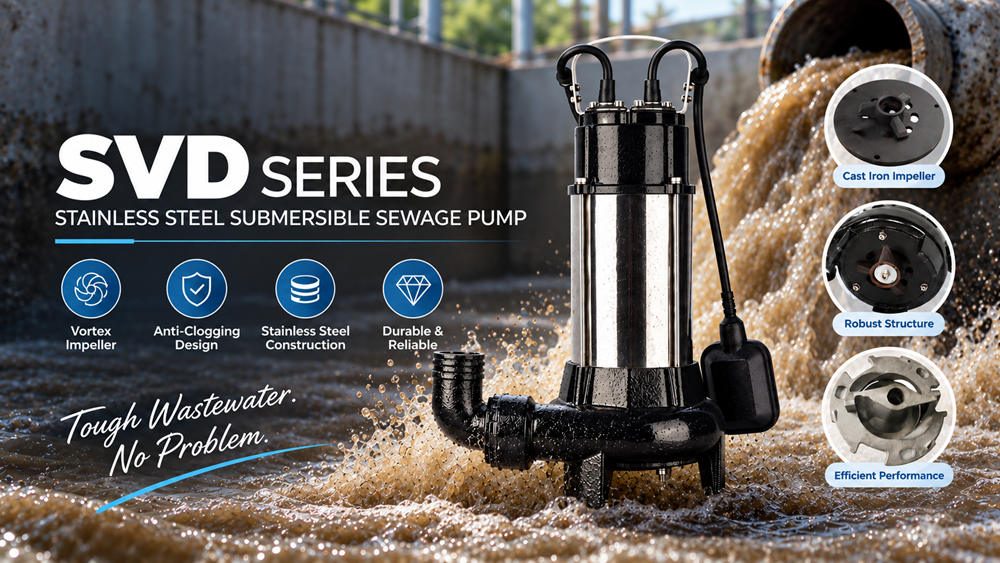
Fibrous wastewater presents a very different pumping challenge from ordinary dirty water.
Materials such as cotton, gloves, wipes, cloth fragments, hair, paper and other soft solids can wrap around a conventional sewage pump impeller, restrict the hydraulic passage and eventually stop the pump completely.
The Stream SVD Submersible Sewage Cutter Pump series is designed specifically for these demanding wastewater applications.
Instead of relying only on a large free passage to allow contaminants to pass through the pump, the SVD actively reduces fibrous and soft solid material before or while it enters the main hydraulic passage.
What makes the SVD series particularly interesting is that it does not use exactly the same cutting mechanism across the complete power range.
The 750 W to 1800 W SVD models use a traditional high-speed cutter impeller, where the rotating cutting geometry directly chops and tears fibrous waste.
The 2200 W version uses a different grinder-style cutting system designed to produce a more intensive crushing and macerating action.
Understanding this difference makes it easier to select the correct SVD pump for domestic sewage, septic tanks and other wastewater applications containing troublesome fibrous waste.
The Stream SVD is a stainless-steel-cased submersible sewage pump family equipped with cutting or grinding mechanisms for wastewater containing fibrous and soft solid contaminants.
The pump operates completely submerged in the wastewater and combines three basic functions:
Drawing wastewater into the pump
Reducing troublesome fibrous material
Transferring the processed wastewater through the discharge system
This active solids-reduction process distinguishes the SVD from a conventional sewage pump that depends primarily on large internal passages to move solids without changing their size.
The SVD is particularly suitable where fibrous contaminants are more likely to cause blockage than large rigid solids.
One of the most important details about the SVD range is that the lower and higher power versions do not use exactly the same solids-reduction mechanism.
| SVD Version | Cutting Technology | Primary Action | Best Description |
|---|---|---|---|
| 750–1800 W | High-Speed Cutter Impeller | Cuts, tears and shreds fibrous waste during rotation | Cutter / Shredder Pump |
| 2200 W | Grinder-Type Cutting System | Repeated cutting, crushing and macerating action | Grinder / Macerating Pump |
Both systems are designed to reduce the risk of sewage blockage, but they achieve this goal in different ways.
The 750 W to 1800 W SVD models use the more traditional cutter-pump approach.
The cutting structure is incorporated into the rotating impeller assembly.
As wastewater enters the pump inlet, the rapidly rotating cutting edges intercept long and flexible contaminants.
Instead of allowing cloth, cotton or similar fibers to enter the hydraulic chamber at full length, the cutter impeller chops and tears them into shorter pieces.
The reduced material then travels through the pump together with the wastewater.
A cutter impeller combines hydraulic pumping and mechanical cutting within the rotating assembly.
As the motor rotates the impeller at high speed, the cutting geometry encounters incoming fibrous material.
The interaction produces mechanical shear.
Long fibers are shortened, soft material is torn apart and larger flexible pieces become easier to transport through the pump and discharge pipe.
This type of action is particularly effective against materials that are difficult for conventional sewage pumps because they bend and wrap instead of behaving like rigid particles.
A flexible fiber creates a different problem from a hard solid.
A small stone normally either passes through the hydraulic channel or becomes physically blocked.
A long piece of cloth or fiber can bend around the impeller.
Once part of the material becomes trapped, rotation can pull the remaining material tightly around the shaft or impeller.
Additional fibers can then accumulate around the first piece.
This process is commonly called ragging.
As ragging becomes more severe, it can cause:
Reduced wastewater flow
Loss of hydraulic efficiency
Higher motor load
Increased vibration
Overheating
Mechanical seal damage
Complete pump blockage
A cutter impeller attacks this problem before long fibers have an opportunity to form a large wrapped mass.
The traditional SVD cutter configuration is particularly useful for soft and fibrous wastewater contaminants such as:
Cotton fibers
Cleaning cloth fragments
Gloves
Hair
Paper
Toilet tissue
Soft organic waste
Other compatible fibrous sewage
The SVD product should not be interpreted as an industrial crusher capable of processing every foreign object.
Hard metal, stones, extremely abrasive material and large rigid objects can still damage a cutter pump.
The 2200 W SVD is different from the lower-power cutter-impeller versions.
It still uses cutting elements, but the operating principle is closer to a dedicated sewage grinding mechanism than to a simple blade-shaped cutter impeller.
Instead of relying primarily on one high-speed cutting edge passing through the sewage, the grinder-type assembly creates repeated mechanical interaction between rotating and stationary cutting surfaces.
Incoming fibrous and soft solid material is trapped momentarily within the grinding zone and subjected to repeated shear, tearing and crushing action.
The result is a smaller and more consistently reduced wastewater solid before it continues through the hydraulic section of the pump.
A typical sewage grinder mechanism consists of two interacting elements:
A rotating cutting or grinding component driven by the motor shaft
A stationary cutting surface positioned around or ahead of the pump inlet
As the rotating component passes the stationary cutting section, wastewater solids caught between them are subjected to intense mechanical shear.
One single rotation may not completely reduce the material.
Instead, the waste can experience repeated cutting and crushing until the pieces become small enough to move through the pump.
This repeated size-reduction action is why the mechanism is more accurately described as grinding or macerating rather than simple chopping.
The difference can be understood by comparing a knife with a grinder.
A knife is designed primarily to divide something into smaller pieces with direct cutting strokes.
A grinder repeatedly works material between moving surfaces until the particle size is reduced further.
Wastewater cutter and grinder pumps follow a similar distinction.
| Characteristic | Cutter Impeller | Grinder-Type System |
|---|---|---|
| Main Action | Cutting and shredding | Repeated cutting, crushing and maceration |
| Cutting Elements | Primarily rotating cutter geometry | Rotating and stationary grinding/cutting surfaces |
| Resulting Waste | Shorter chopped pieces | Smaller, more finely reduced material |
| Typical Strength | Good flow and effective fiber cutting | More intensive solids size reduction |
A larger motor provides more power for demanding mechanical solids reduction.
Grinding wastewater requires energy not only to move the liquid but also to repeatedly deform, cut and crush incoming material.
The 2200 W SVD configuration therefore uses a more aggressive grinder-style architecture suited to applications where reducing difficult fibrous material is a higher priority.
The result is not simply a higher-power version of the smaller SVD cutter pump.
It represents a different cutting concept within the same SVD sewage pump family.
These terms are often used loosely in the wastewater pump market, but they are not always technically identical.
A cutter pump normally uses sharp rotating cutting edges to chop fibers and soft solids into shorter pieces.
It generally tries to maintain useful wastewater flow while preventing long material from wrapping around the impeller.
A grinder pump uses a more intensive size-reduction mechanism to grind or macerate wastewater solids into relatively small pieces.
Many dedicated grinders use a rotating cutting head working against a stationary cutting ring or plate.
A chopper pump normally uses robust cutting elements designed to chop difficult fibrous or solid material while handling relatively high wastewater flows.
Exact terminology varies among manufacturers, so pump buyers should look at the actual mechanical design rather than relying only on the words “cutter” or “grinder” in the product name.
One of the traditional advantages of a true grinder system is the ability to significantly reduce wastewater solids before pumping.
Once large soft contaminants are reduced to much smaller pieces, they are less likely to block a relatively small discharge pipe.
This is one reason grinder pumps are commonly used in pressurized wastewater systems where sewage needs to travel long distances or where gravity sewer installation is impractical.
However, pipe diameter should always be selected according to the actual pump performance, wastewater characteristics and system design rather than assuming that every cutter pump can automatically use a very small pipeline.
Cutting mechanisms are designed primarily for fibrous and soft solids.
They should not be confused with abrasive slurry pumps.
Sand and other highly abrasive particles can cause accelerated wear on close-clearance grinding surfaces, cutter edges, mechanical seals and hydraulic components.
Where wastewater contains significant sand or grit, the pump should be selected specifically for abrasive service.
The SVD series uses a stainless steel outer casing to provide improved corrosion resistance in wastewater environments.
Wastewater pump housings are continuously exposed to moisture and contaminants, making material selection important for long-term durability.
The stainless steel casing also gives the SVD a compact construction suitable for domestic and light wastewater installations.
The SVD is particularly useful in residential wastewater systems where toilet paper, hair, cleaning fibers and other soft contaminants may enter the drainage system.
Stream specifically identifies domestic kitchen wastewater as one of the applications for the SVD series.
Kitchen wastewater may contain fibrous food residue and other soft contaminants that benefit from active cutting before discharge.
Septic tanks can contain toilet paper, organic matter, hair and other soft solids.
A cutter or grinder pump can reduce this material before wastewater is transferred to another treatment or disposal location.
Where wastewater collects below the level of the main sewer connection, a submersible sewage pump can automatically lift the wastewater to the required discharge point.
Suitable SVD models can also be considered for compatible commercial wastewater applications where fibrous soft solids are present.
A submersible sewage pump operates directly inside the wastewater collection chamber.
This eliminates the need for the pump to draw sewage through a long suction pipe.
Instead, wastewater enters the pump directly and is pushed toward the discharge.
This arrangement provides several practical advantages:
Compact installation
No surface suction priming requirement
Motor cooling from surrounding liquid
Reduced above-ground equipment footprint
Suitable operation inside septic tanks and sewage pits
| Product Series | SVD |
| Pump Type | Submersible Sewage Cutter / Grinder Pump |
| Power Range Discussed | 750 W–2200 W |
| 750–1800 W Cutting System | High-Speed Cutter Impeller |
| 2200 W Cutting System | Grinder-Type Cutting and Macerating System |
| Maximum Immersion Depth | 5 m |
| Liquid Temperature | 0–40°C |
| Liquid pH Range | 6.5–8.5 |
| Feature | Stream SVD | Standard Sewage Pump |
|---|---|---|
| Fibrous Waste Strategy | Cuts or grinds fibers before/during pumping | Attempts to pass material through the hydraulic channel |
| Fiber Reduction | Yes | Normally no |
| Ragging Resistance | Improved through active cutting | Depends on impeller design and free passage |
| Typical Waste | Fibers, cloth, gloves and compatible soft solids | General wastewater and passable solids |
Stream also offers the SV grinder pump, but the SV and SVD should not be treated as identical designs.
The SV25 uses a special single-channel vortex grinding impeller where grinding, turbulence and wastewater pumping are closely integrated within the hydraulic impeller itself.
The SVD family focuses more directly on mechanical cutting and grinding systems.
| Feature | SVD | SV |
|---|---|---|
| Main Concept | Dedicated cutter / grinder mechanisms | Grinding action integrated with single-channel vortex impeller |
| Cutting Style | Direct cutting or repeated grinder action depending on model | Grinding, tearing and macerating within hydraulic flow |
| Series Variety | Multiple power levels and two cutter concepts | Specialized grinding-impeller model |
The wastewater contains common fibrous materials
Cotton, gloves, hair or cloth fragments are common contaminants
Efficient cutting combined with sewage transfer is required
A conventional cutter-pump architecture is suitable for the installation
More intensive solids reduction is required
Fibrous waste is particularly troublesome
Repeated grinding and macerating action is preferred
The application requires the highest-power configuration within this SVD range
No.
Choosing a sewage pump only according to motor wattage can result in poor system design.
Pump selection should also consider:
Required wastewater flow
Total discharge head
Type of solids and fibers
Required discharge pipe diameter
Operating frequency
Collection pit volume
Installation depth
The cutting system should be matched to the type of contamination rather than simply choosing the largest available motor.
The SVD is designed to solve wastewater problems created by fibrous and relatively soft solids.
Examples include gloves and cotton specifically highlighted in Stream's product information.
These materials can be extremely difficult for a standard pump because they are flexible enough to wrap around the impeller but strong enough to remain intact.
Active cutting breaks this continuous fiber structure.
Once the material is shortened, it becomes significantly easier for the wastewater flow to transport it through the discharge system.
A grinder or cutter does not make a sewage pump indestructible.
The following materials should not intentionally be introduced into the pumping system:
Metal objects
Large stones
Heavy construction debris
Large quantities of sand
Extremely hard plastics
Other objects outside the pump's intended wastewater conditions
Abrasive contamination is particularly important because it can accelerate wear of cutting and grinding surfaces.
The pump should be positioned so wastewater can enter the cutting area freely.
Do not bury the inlet directly in heavy settled sludge.
Where the selected SVD configuration includes automatic float control, the float must be able to move without becoming trapped against a wall, pipe or other component.
A grinder pump reduces the risk of blockage but cannot compensate for an incorrectly designed discharge pipe.
Pipe diameter, length, vertical elevation and fittings should all be considered.
If wastewater performance declines significantly, the cutting mechanism should be checked for foreign objects, wear or accumulated material.
Always isolate the electrical supply before inspecting, cleaning or touching any cutter or grinder mechanism.
The SVD is a family of submersible sewage pumps equipped with cutter or grinder mechanisms for handling wastewater containing fibrous and soft solid material.
It can be described as both depending on the selected version. The 750–1800 W models use traditional high-speed cutter impellers, while the 2200 W version uses a more intensive grinder-type cutting system.
A cutter impeller uses rotating cutting geometry to chop and shred fibrous contaminants as wastewater enters and passes through the pump.
The 2200 W model uses a grinder-style cutting mechanism with more intensive repeated cutting, crushing and macerating action rather than relying only on the traditional cutter-impeller arrangement used by the lower-power versions.
Cutting primarily shortens waste into chopped pieces, while grinding repeatedly reduces solids through interacting cutting surfaces to create smaller material.
Yes. Cotton is specifically identified by Stream as one of the fibrous materials for which the cutting system provides effective performance.
Gloves are also specifically mentioned in the Stream product description as an example of material that benefits from the cutter system.
Yes. Stream lists household and domestic wastewater, particularly kitchen wastewater, among the intended applications.
Yes. Septic tank systems containing compatible soft solids are one of the specified applications.
The SVD is primarily designed for wastewater containing fibrous and soft solids rather than highly abrasive sand. Large amounts of grit or sand can accelerate wear of cutters, grinding components and seals.
The specified maximum immersion depth is 5 meters.
The specified liquid temperature range is 0–40°C.
The Stream SVD product specification states a liquid pH range of 6.5–8.5.
Not in every application. A grinder or cutter pump is particularly valuable where fibers and soft solids create blockage problems. For wastewater dominated by large passable solids or abrasive material, another sewage impeller design may be more appropriate.
The most important feature of the Stream SVD series is not simply the presence of a cutter.
It is the availability of two different solids-reduction concepts within the same sewage pump family.
From 750 W to 1800 W, the SVD uses a traditional high-speed cutter impeller designed to rapidly cut and shred cotton, gloves, cloth and other fibrous contaminants before they can wrap around the hydraulic components.
At 2200 W, the cutting system changes to a more intensive grinder-type mechanism that combines rotating and stationary cutting action to repeatedly shear, crush and macerate sewage solids.
This gives the SVD series greater flexibility than a single cutting design.
Users dealing with general fibrous domestic wastewater can choose the traditional cutter-impeller configuration, while applications requiring stronger solids reduction can move toward the 2200 W grinder-style design.
Combined with submersible construction, stainless steel casing and suitability for household wastewater and septic systems, the Stream SVD provides a practical solution for sewage applications where fiber clogging is a recurring concern.
Address
No.17 XeDa Jimei Ind. Park, Xiqing Economic Development Area, Tianjin, China
Telephone
+86 13816508465
QUICK LINKS