+86 13816508465
Pump Knowledge
Jun. 25, 2026
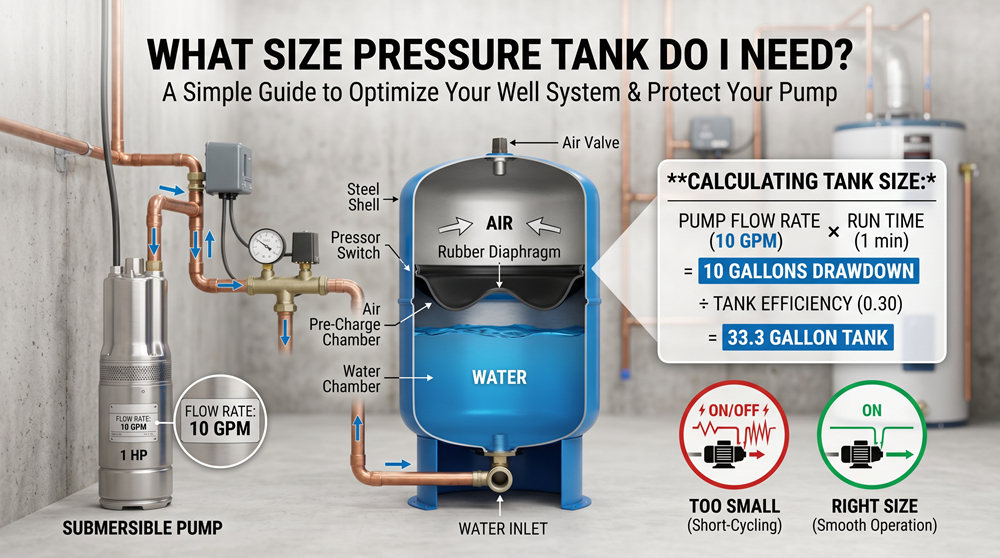
To size a water pump pressure tank, multiply your pump's flow rate (GPM) by the minimum run time (1–2 minutes) to find the required drawdown. Since drawdown is only about 30% of total tank volume, a 10 GPM pump needs roughly 10 gallons of drawdown, which means a tank with around 30–33 gallons of total volume.
You just invested in a quality water pump for your home, and now you are staring at a catalog of pressure tanks ranging from 2 to 100 gallons. Which one is actually right for you?
Guessing here is a costly mistake. Pick a tank that's too small, and your pump will short-cycle itself to an early grave. Go too big, and you waste money, space, and risk water sitting stagnant. Neither outcome is fun to fix.
The good news? Sizing a pressure tank isn't guesswork at all. It comes down to a single, simple formula and one number printed right on your pump. This guide walks you through how to calculate pressure tank size correctly, explains the often-misunderstood concept of drawdown, and shows you how to use your Stream Pumps flow rate to lock in the perfect match for your home water system.
Here's where most homeowners go wrong. People assume a 20-gallon pressure tank holds 20 gallons of usable water. It doesn't—not even close.
A pressure tank holds two things: compressed air and water, separated by a rubber diaphragm or bladder. As your pump pushes water in, the air compresses. When you turn on a faucet, that compressed air pushes the water back out—without the pump needing to switch on. The actual amount of water the tank can deliver before the pump kicks back in is called drawdown.
Drawdown is the number that matters. And it's usually only about 30% of the total tank volume. So that "20-gallon" tank might give you just 6 to 7 gallons of real, usable drawdown.
The takeaway is simple: size your tank based on the drawdown you need, not the total volume printed on the box. Skip this step, and even a large-looking tank can leave your pump cycling far too often.
Sizing your tank correctly takes three steps and a bit of basic math. Grab a flashlight and head to your pump—you'll need to read its nameplate first.
Step 1: Find your pump's flow rate (GPM or L/min)
Every pump has a flow rate, measured in gallons per minute (GPM) or liters per minute (L/min). This tells you how much water your pump moves at your home's working pressure.
Look at the nameplate on your Stream Pumps jet pump or submersible pump. You want the working flow rate at your typical pressure setting—usually 30–50 PSI or 40–60 PSI for domestic systems. If the nameplate gives you a performance range, match it to the cut-in and cut-out pressure of your system.
This is why accurate manufacturer data matters so much. With Stream Pumps, the flow rate is clearly listed, so you don't have to guess.
Step 2: Determine the minimum run time
Electric pump motors generate heat every time they run. They need enough run time to dissipate that heat and avoid overheating. The widely accepted rule is that a pump should run for at least 1 to 2 minutes each time it turns on.
For most small domestic jet pumps and submersible pumps, a 1-minute minimum run time is a safe, standard target. Larger or higher-horsepower pumps often benefit from a 2-minute target to protect the motor over the long haul.
Step 3: Apply the golden formula
Now put the two numbers together. Here's the calculation that determines your required drawdown:
Pump Flow Rate (GPM) × Minimum Run Time (Minutes) = Required Drawdown
Let's run a real example. Say your Stream Pumps jet pump delivers 10 GPM, and you want a 1-minute run time:
10 GPM × 1 minute = 10 gallons of drawdown
Because drawdown is only about 30% of total volume, you then work backward to find the tank size:
10 gallons of drawdown ÷ 0.30 = roughly 33 gallons of total tank volume
So a pump pushing 10 GPM needs a tank in the 30 to 33-gallon range. A smaller 5 GPM pump would only need around 5 gallons of drawdown, or a tank near 15–17 gallons total. The higher your flow rate, the bigger the tank you need.
Getting the size wrong has real consequences—and they fall into two camps.
If your tank is too small: Your pump turns on and off every few seconds. This is called short-cycling, and it's the single biggest killer of water pumps. Each start puts stress on the motor bearings, the mechanical seal, and the pressure switch. Over weeks and months, that constant cycling wears out components and can destroy the pump entirely. Short-cycling also creates uneven, fluctuating water pressure at your taps.
If your tank is too big: The good news is an oversized tank won't damage your pump. The bad news? You've paid more upfront for capacity you don't need, you've given up valuable basement or utility space, and water can sit unused for long stretches. In low-use households, that stagnant water can affect taste and quality. Bigger isn't automatically better—right-sized is.
For most homes, landing within a few gallons of your calculated target gives you the best balance of pump protection, steady pressure, and value.
Your tank math is only as reliable as the pump data you start with. If a pump's stated flow rate is inflated or vague, your whole calculation falls apart—and you end up with a mismatched system.
This is where Stream Pumps stands out. Every Stream Pumps surface jet pump and domestic submersible pump ships with clear, accurate performance curves and detailed nameplates. You can see exactly what flow rate to expect at any given head or pressure, which means your drawdown calculation is trustworthy from the start.
Durability matters too. Stream Pumps engineers its domestic pumps with heavy-duty copper motors and built-in thermal protection, so they hold up under heavy daily use. A pump built to last, paired with a correctly sized tank, gives you a water system you can rely on for years. Founded in 1997 and now selling to more than 110 countries, Stream Pumps backs its products with the kind of consistent quality control that makes accurate sizing possible.
How do I know my pump's GPM if there's no nameplate?
If the nameplate is missing or unreadable, check the original product documentation or the manufacturer's website for the pump's performance curve. For Stream Pumps products, you can find precise specs at www.streampumps.com. As a last resort, you can measure flow manually by timing how long it takes to fill a known container, but the published spec is far more accurate.
Is a bigger pressure tank always better?
No. A larger tank protects your pump just fine, but you pay more upfront and sacrifice space, and water can stagnate in low-use homes. The goal is to match the tank to your pump's flow rate, not to buy the biggest one available.
How much drawdown does a typical home need?
It depends entirely on your pump's flow rate. A common 10 GPM domestic pump needs about 10 gallons of drawdown, which equals roughly a 30–33 gallon tank. A smaller 5 GPM pump needs only about 5 gallons of drawdown. Always calculate based on your specific pump rather than a one-size-fits-all number.
Why does drawdown matter more than total tank volume?
Drawdown is the actual usable water your tank delivers before the pump restarts—and it's only about 30% of total volume. Total volume includes compressed air that never reaches your taps. Sizing by drawdown is the only way to guarantee your pump gets the run time it needs.
Can the wrong tank size really damage my pump?
Yes, an undersized tank can. It causes short-cycling, where the pump starts and stops every few seconds. This rapidly wears out motor bearings, seals, and the pressure switch, and it's a leading cause of premature pump failure.
What pressure settings should I use for my home?
Most domestic systems run at either 30–50 PSI or 40–60 PSI, set by the pressure switch. Use the same pressure range when reading your pump's flow rate so your drawdown calculation reflects real-world performance.
Get your water system sized right
Sizing your pressure tank correctly does two things: it keeps your water pressure steady, and it adds years to your pump's life. The process boils down to three simple moves—check your pump's GPM on the nameplate, multiply by your minimum run time to get drawdown, then divide by 0.30 to find your total tank volume.
Do the math once, and you'll never have to second-guess your setup again.
Need help matching a pump to your household needs? Visit www.streampumps.com to explore our robust lineup of domestic jet pumps and submersible pumps, and view their precise performance specs. Get your system sized right today.
Address
No.17 XeDa Jimei Ind. Park, Xiqing Economic Development Area, Tianjin, China
Telephone
+86 13816508465
QUICK LINKS