+86 13816508465
Pump Knowledge
Jul. 22, 2026
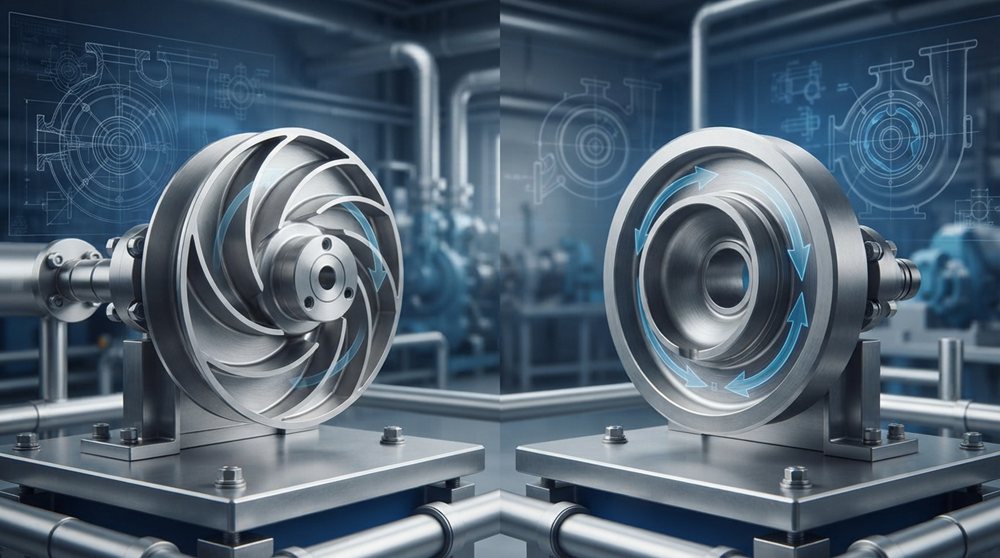
The key difference between semi-open and vortex impellers in submersible pumps is not their shape—it's how far the impeller sits from the front of the pump casing. Semi-open impellers run with tight clearance for high efficiency but can jam on fibrous solids. Vortex impellers recess deeper into the volute, creating a swirling action that passes solids through without contact, making them the preferred choice for raw sewage and fibrous waste.
Choosing the wrong submersible pump for a wastewater or industrial application is an expensive mistake. A blocked pump submerged three meters underground doesn't just stop working—it triggers emergency retrieval, costly repairs, and potentially hours of downtime. Yet time and again, buyers select impeller types based on surface-level appearances rather than what actually drives performance.
Semi-open and vortex impellers often look deceptively similar when sitting on a workbench. Both lack a full front shroud. Both are commonly used in submersible sewage and drainage pumps. But the internal geometry—specifically, how the impeller is positioned relative to the front of the pump casing—determines everything: how efficiently the pump moves fluid, how it handles solids, and whether it clogs under load.
This post breaks down exactly how each impeller type works inside a submersible pump casing, where each design excels, and how to match the right pump to your specific application. Tianjin Streampumps Industry Co., Ltd., a manufacturer with over 25 years of submersible pump engineering experience, offers both designs across its sewage and drainage pump range—so the guidance here is grounded in real-world application knowledge.
Most buyers focus on flow rate, head pressure, and motor power when selecting a submersible pump. Far fewer ask about internal clearance—the distance between the impeller and the front wall of the pump casing (also called the volute).
This gap, sometimes referred to as 【distance height,】 is one of the most consequential design decisions in a submersible pump. A tight clearance means fluid is pushed out with minimal leakage back through the gap, which keeps volumetric efficiency high. A large clearance means the impeller doesn't push fluid directly—instead, it induces a rotational, vortex-like flow that draws solids through without mechanical contact.
Here's the counterintuitive part: two impellers can look nearly identical from the outside and produce completely different performance outcomes, purely because of how they are seated within the casing. This is why understanding internal pump geometry—not just impeller shape—is critical when specifying a submersible pump for contaminated or fibrous fluid applications.
A semi-open impeller has blades on one side (the back) and is open on the front, without a full shroud. When installed in a submersible pump, the impeller sits very close to the front casing wall—typically within a fraction of a millimeter. This tight clearance is intentional. It minimizes backflow around the impeller tips, maintaining high volumetric efficiency and strong head pressure.
The result is a pump that moves fluid decisively and efficiently. Semi-open impeller submersible pumps are well-suited for:
Slurry and muddy water — construction dewatering, mining runoff, and excavation sites
Lightly contaminated industrial fluids — process water with fine suspended particles
Agricultural drainage — irrigation return water and field runoff with sediment
The tradeoff is sensitivity to fibrous materials. When long solids—wipes, rags, stringy vegetation, or hair—enter the narrow gap between the impeller and casing wall, they have nowhere to pass through cleanly. The gap is simply too tight. Fibers wrap around the blade roots, torque spikes, and the pump jams. In a submersible application, that jam means retrieval from the wet well or tank before any intervention is possible.
Semi-open impeller pumps typically require periodic adjustment of the clearance gap as wear occurs over time, adding a maintenance consideration that operators should factor into total cost of ownership.
A vortex impeller—also called a recessed impeller—solves the clogging problem through a fundamentally different internal layout. Rather than sitting close to the front casing wall, the vortex impeller is positioned further back, recessed into the volute. This creates a large, unobstructed clearance space between the impeller and the pump's inlet.
The impeller doesn't push fluid directly. Instead, its rotation generates a swirling action—a liquid vortex—inside the casing. This vortex creates a vacuum-like effect that draws fluid, solids, and long fibrous materials through the pump body. Critically, the solids travel through the large clearance zone without ever contacting the impeller blades themselves.
The practical outcome is a true non-clogging design. Long fibers, rags, wipes, and even soft solids pass through the pump body with minimal resistance. For submersible sewage pumps handling raw municipal wastewater, this is not a nice-to-have—it's a fundamental requirement.
Vortex impeller submersible pumps are best suited for:
Raw sewage and municipal wastewater — residential and commercial wet wells
Industrial waste streams — food processing effluent, textile wastewater, and paper mill discharge
Any application with unpredictable solid content — where fibrous or stringy materials may be present
The tradeoff is efficiency. Because the vortex impeller doesn't directly contact the fluid, some energy is lost in the indirect pumping action. Vortex pumps typically generate lower head pressure and consume more energy per unit of fluid moved compared to semi-open designs of similar size. For high-head applications or large-volume transfers where energy cost is significant, this matters.
The table below summarizes the core differences between semi-open and vortex impeller submersible pumps across the factors that matter most in selection decisions:
Feature | Semi-Open Impeller Submersible Pump | Vortex Impeller Submersible Pump |
|---|---|---|
Internal Clearance | Very tight (close to pump casing) | Large (recessed into the volute) |
Pumping Action | Direct mechanical pushing of fluid | Creates a liquid vortex (vacuum effect) |
Solids Handling | Moderate (risk of fibrous tangling) | Excellent (true non-clogging design) |
Efficiency & Head | Higher efficiency, higher head | Lower efficiency, lower head |
Best For | Slurries, dirty water, mining runoff | Raw sewage, long fibers, industrial waste |
Neither design is universally superior. The right choice depends entirely on what the pump will be asked to move—and the consequences of getting it wrong.
The starting point for any submersible pump selection decision is an honest assessment of the fluid. Two questions drive the answer:
1. What solids are present, and are they fibrous or unpredictable?
2. Is energy efficiency or pumping head a primary constraint?
Choose a semi-open impeller submersible pump if:
The fluid contains predictable, fine-to-medium solids (sediment, sand, or soft slurry particles)
High head pressure is required
Energy efficiency is a significant operating cost concern
The installation allows for periodic maintenance to reset clearance tolerances as the pump wears
Choose a vortex impeller submersible pump if:
The fluid contains rags, wipes, hair, vegetation, or any long fibrous material
The application involves raw or partially treated sewage
The pump installation is difficult to access (deep wet wells, remote locations)
Minimizing emergency retrieval and unplanned downtime outweighs the efficiency difference
The cost of a single emergency underwater retrieval—labor, crane or lifting equipment, lost operational time—often exceeds the energy cost difference between an efficient semi-open pump and a slightly less efficient vortex design over an entire season. For sewage applications specifically, the vortex design is almost always the safer long-term investment.
Tianjin Streampumps Industry Co., Ltd. manufactures robust submersible pumps across both impeller configurations. Established in 1997 and supplying to more than 110 countries, Streampumps engineers submersible sewage pumps, drainage pumps, and construction pumps designed for demanding real-world conditions. Both semi-open and vortex impeller designs are available, allowing project engineers and procurement teams to select the configuration that matches the specific fluid characteristics and site requirements—rather than defaulting to a one-size-fits-all approach.
The choice between a semi-open and vortex impeller submersible pump ultimately comes down to two things: the internal clearance geometry of the pump casing, and the nature of the fluid being pumped. Semi-open impellers deliver efficiency and head for dirty-but-predictable fluids. Vortex impellers deliver reliability and clog resistance for anything fibrous, unpredictable, or raw.
Getting this decision right before installation saves far more than it costs. Getting it wrong—with a jammed pump submerged in a live sewage wet well—is a lesson most operators prefer not to learn twice.
If you're specifying a submersible pump for a wastewater, drainage, or industrial fluid application, the engineers at Streampumps can help you identify the right impeller configuration for your conditions. Visit www.streampumps.com to explore the full submersible pump range or reach out directly to discuss your project requirements.
The key difference is internal clearance. A semi-open impeller sits very close to the front pump casing wall to maximize efficiency through direct fluid displacement. A vortex impeller is recessed further back into the volute, creating a large clearance space and a swirling vortex action that passes solids through without impeller contact.
Vortex impeller pumps clog less because solids never need to pass through a tight mechanical gap. The recessed impeller creates a rotational vortex that draws fibrous materials—rags, wipes, hair, and soft solids—through the large clearance zone without those materials contacting the impeller blades.
Semi-open impeller pumps can handle lightly contaminated water and fine solids, but they are generally not recommended for raw sewage or applications with long fibrous content. The tight clearance between the impeller and casing makes them vulnerable to jamming when wipes, rags, or stringy material enter the pump.
Semi-open impeller submersible pumps are more energy efficient. The tight clearance minimizes backflow and maximizes volumetric efficiency, producing higher head pressure per unit of energy. Vortex impellers sacrifice some efficiency because the indirect pumping action loses energy in the swirling motion.
Choose a vortex impeller submersible pump when the fluid contains fibrous or unpredictable solids—raw sewage, food processing waste, textile effluent, or any stream where wipes and rags are likely. Also choose vortex when the pump location is difficult to access, since avoiding emergency retrieval typically outweighs any efficiency cost.
Yes. Tianjin Streampumps Industry Co., Ltd. manufactures submersible pumps with both semi-open and vortex impeller configurations across its sewage, drainage, and construction pump product lines. Their engineering team can advise on the appropriate design based on specific fluid characteristics and site conditions.
Address
No.17 XeDa Jimei Ind. Park, Xiqing Economic Development Area, Tianjin, China
Telephone
+86 13816508465
QUICK LINKS