+86 13816508465
Pump Troubleshooting
Jul. 27, 2026
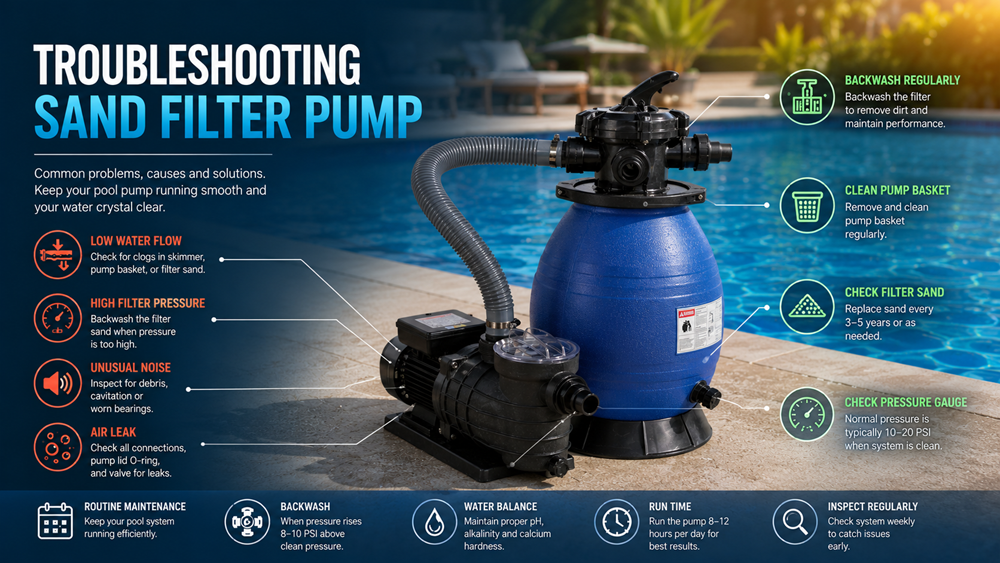
The three most common reasons a commercial sand filter pump loses flow are clogged filtration media, broken internal laterals, and air leaks on the suction side. Each issue has a distinct symptom and a clear repair pathway—identifying which one you're dealing with early can prevent costly system downtime.
Even the most robust water treatment systems require periodic attention. Sand filter pumps operate under sustained pressure, handling continuous debris loads across demanding commercial and industrial environments. Over time, mechanical wear and filtration buildup create conditions that degrade performance—often gradually, before operators notice a problem.
The difficulty is that reduced flow, pressure anomalies, and air contamination can each trace back to very different root causes. Misdiagnosing the symptom wastes time, delays repairs, and risks further damage to downstream equipment. This guide, prepared by the engineering team at Stream Pumps, walks through the three most common mechanical failures in commercial sand filter pumps, how to identify each one, and the correct corrective action for each scenario.
This is the most frequently reported issue in commercial sand filtration systems—and fortunately, it is often the most straightforward to resolve.
As a sand filter operates, it traps suspended particles within the filtration media. Over time, that accumulated debris creates resistance. The pump must work harder to push water through the bed, causing pressure inside the filter tank to rise while the flow rate returning to the system drops. Most commercial systems are configured to trigger a backwash cycle when pressure rises 8–10 PSI above the clean baseline reading.
The standard fix: Backwash and rinse
A properly executed backwash cycle reverses flow through the filter, dislodging and flushing trapped debris out to waste. Following the backwash with a rinse cycle resettles the sand bed before returning the system to service. In most cases, this restores pressure and flow to normal operating levels within minutes.
When backwashing isn't enough
If pressure remains elevated after a full backwash and rinse sequence, the problem is no longer surface-level fouling. Hard water deposits, oils, or biological contaminants can cause sand grains to calcify and clump together—a condition commonly referred to as channeling or calcification. In this state, water finds paths of least resistance through the media rather than filtering through the entire bed uniformly.
The only effective remedy at this stage is complete sand replacement. Stream Pumps recommends scheduling full media replacement every three to five years under normal operating loads, with more frequent inspections in facilities with high mineral content or heavily contaminated source water.
Sand appearing in the water returning to the pool, tank, or distribution system is not a water quality issue—it is a mechanical failure that requires immediate attention.
The filtration sand is retained within the tank by a set of laterals (also called the lateral assembly or underdrain manifold) positioned at the base of the filter vessel. These components are fitted with fine slots or perforations that allow filtered water to pass through while blocking sand particles. A central standpipe connects the lateral assembly to the multiport valve at the top of the tank.
The culprit: Broken laterals or a cracked standpipe
Sand returning to the system almost always indicates that one or more laterals have cracked or broken, or that the standpipe itself has developed a fracture. Both failures create an unintended passage through which sand bypasses the filtration assembly entirely and re-enters the water supply.
The repair process
There is no shortcut here. The tank must be completely emptied of sand before the lateral assembly or standpipe can be accessed and replaced. This is labor-intensive but necessary—partial drainage will not provide adequate access, and attempting to work around the sand risks leaving fragments of broken plastic in the system.
Stream Pumps designs its filter internals using heavy-duty PVC and ABS components, chosen specifically for their resistance to impact cracking and chemical degradation. Facilities that have experienced repeated lateral failures may be using components manufactured to lower tolerances—an upgrade to higher-grade internals during the repair can extend the service interval significantly.
Once replacement components are installed and the tank is refilled with fresh filtration media, confirm that no residual sand is returning to the system before returning to full operation.
Pumps are engineered to move water. When air enters the system, the pump loses its hydraulic prime—the fluid seal that allows it to generate suction and maintain pressure. A pump running with entrained air will cavitate, overheat, and wear prematurely. Left unaddressed, air ingestion can damage mechanical seals and impeller components within a relatively short operating period.
The culprit: A suction-side air leak
Air bubbles in the return lines, or a pump that repeatedly loses prime, almost always point to an air leak on the suction side of the system—between the water source and the pump inlet. Unlike a pressure-side leak, which would result in visible water loss, a suction-side air leak draws air inward rather than pushing water outward, making it harder to detect visually.
Where to inspect first
Begin with the pump lid O-ring. This is the single most common source of suction-side air ingestion in commercial sand filter systems. The O-ring can dry out, deform, or develop small cracks over time, particularly in installations where the pump lid is removed frequently for maintenance. Remove the lid, inspect the O-ring carefully, lubricate it with the appropriate silicone-based lubricant, and reseat it firmly.
If the pump lid seal is intact, proceed to:
Suction-side valves: Check gate and ball valves on the inlet line for worn valve seals or loose packing
Pipe unions: Inspect union fittings for hairline cracks or loose threaded connections
Suction pipe fittings: Any joint between the water source and the pump inlet is a potential ingress point for air
A practical diagnostic method is to apply a soap solution to suspected leak points while the system is running under normal pressure. Air ingestion will cause the solution to bubble at the exact location of the breach.
The three failure modes described above are common, well-understood, and correctable through standard maintenance procedures. However, if a pump is cycling through these symptoms with increasing frequency—or if repairs are no longer restoring performance to acceptable operating levels—the underlying issue may be the pump itself.
Commercial sand filter pumps have a defined service lifespan. High cycle frequency, operating consistently outside of design pressure ranges, or being undersized for a facility's current water volume demand can accelerate wear beyond the point where maintenance provides a reliable return.
If your current pump is approaching the end of its service life, or if failures are recurring despite corrective action, the Stream Pumps sales engineering team can assist with a replacement evaluation. Stream Pumps' sales engineers apply a structured vetting process—reviewing current operating pressure, failure frequency, pipe dimensions, and flow requirements—to ensure that any recommended replacement unit is correctly matched to your facility's specific demands.
Contact the Stream Pumps team to discuss your system's performance and explore whether an upgrade is the right next step.
How often should a commercial sand filter be backwashed?
Backwash frequency depends on water quality and usage load, but most commercial systems require backwashing when the filter pressure rises 8–10 PSI above the clean baseline, or on a scheduled interval (commonly weekly or bi-weekly). High-load environments may require more frequent cycles.
How do I know if my filter sand needs to be replaced?
If backwashing no longer restores normal pressure and flow, or if the sand bed has been in service for more than three to five years under standard operating conditions, a full media replacement should be evaluated. Calcified or channeled sand cannot be restored through backwashing alone.
Can a broken lateral be repaired, or does it need full replacement?
Broken laterals should be replaced, not repaired. Patching plastic components inside a pressurized filtration system is not a reliable long-term solution, and partial failures often indicate that other laterals in the assembly are similarly degraded. Full lateral assembly replacement is the recommended course of action.
What causes a commercial pump to repeatedly lose prime?
Recurring prime loss almost always points to a persistent air leak on the suction side. Common sources include a worn or improperly seated pump lid O-ring, cracked pipe unions, or loose suction-side fittings. Identifying and sealing the specific ingress point is necessary to resolve the issue permanently.
When should a commercial sand filter pump be replaced rather than repaired?
Consider replacement when repair costs are approaching 50% or more of a new unit's cost, when the pump is undersized for current operational demands, or when the same failure modes recur within short intervals despite corrective maintenance. A Stream Pumps sales engineer can assess whether repair or replacement provides the better long-term value for your facility.
Previous: None
Next: Stop Frequent Pump Cycling: Troubleshooting Pressure Tanks
Address
No.17 XeDa Jimei Ind. Park, Xiqing Economic Development Area, Tianjin, China
Telephone
+86 13816508465
QUICK LINKS