+86 13816508465
Jul. 27, 2026
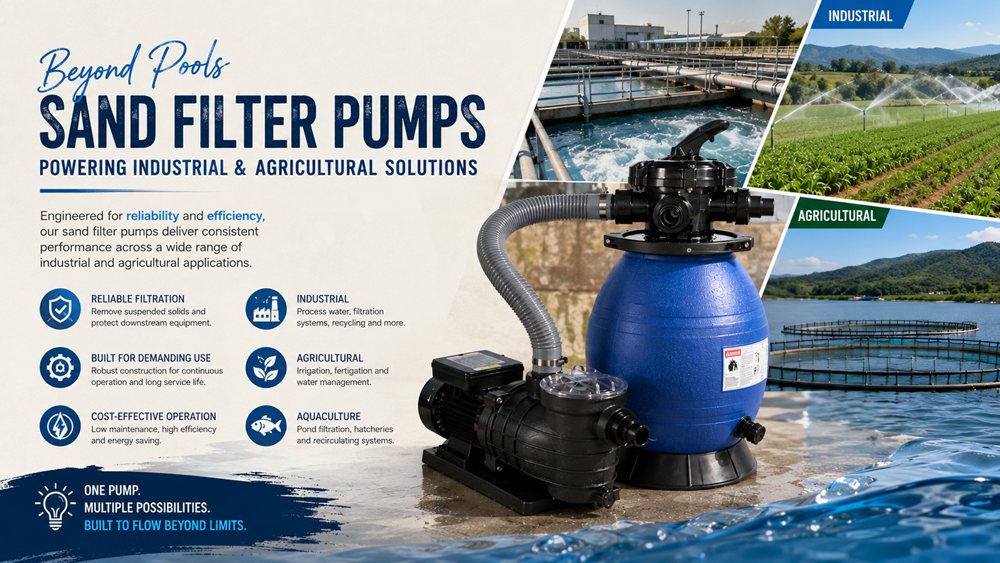
Commercial sand filter pumps are critical infrastructure in agriculture, industrial cooling, and aquaculture—not just swimming pools. Stream Pumps engineers continuous-duty filtration systems that protect these high-stakes operations from sediment, particulates, and organic waste that cause costly equipment failure and production loss.
Sand filter pumps are widely associated with commercial swimming pools. That association, while accurate, tells only a fraction of the story. Across agriculture, heavy industry, and commercial aquaculture, sand filtration is a frontline defense against equipment failure, production loss, and contamination events that can cost operators significantly more than the price of a filter pump.
The common thread across these sectors is this: unfiltered water is expensive. Whether it clogs an irrigation emitter, scales a heat exchanger, or suffocates a fish stock, suspended solids and particulates create operational risk at scale. Stream Pumps designs commercial sand filter pumps specifically for these demanding, continuous-duty environments—where uptime is non-negotiable and equipment failure has direct revenue consequences.
This article details three heavy-duty B2B applications where sand filtration is mission-critical, and explains what separates an industrial-grade pump from a standard commercial unit.
Farms drawing irrigation water from rivers, lakes, or groundwater wells are working with raw, unprocessed water. That water carries silt, algae, organic debris, and fine particulates—all of which move freely through intake lines until they reach the narrow passages of a precision drip irrigation system.
Drip emitters typically operate within a flow range of 0.5 to 2 liters per hour. Even a modest accumulation of fine sediment will partially or fully block these emitters, resulting in uneven water distribution across the field. The downstream consequences are significant: uneven crop growth, localized drought stress, and in severe cases, complete section failure during critical growing periods.
Installing a commercial sand filter pump as the primary treatment stage removes suspended solids before water enters the distribution network. Sand media—typically graded silica sand—captures particles as small as 20 microns, depending on bed depth and flow rate, protecting emitters and reducing the frequency of manual line flushing.
Stream Pumps' agricultural filtration units are engineered with high-flow impellers designed to move large volumes of raw source water through dense sand media without pressure loss at the distribution head. This is a critical design requirement: agricultural irrigation systems operate across extended pipe runs, and maintaining consistent outlet pressure directly determines how evenly water reaches each emitter across a large field.
For farms operating multi-zone systems or center-pivot configurations, pump performance consistency across variable load conditions is equally important. Stream Pumps' hydraulic design accounts for these fluctuations, delivering stable filtration output regardless of intake variability.
Industrial cooling towers function as continuous air-water contact systems. In doing so, they act as collection points for airborne dust, pollen, industrial particulates, and biological matter pulled in from the surrounding environment. Over time, these materials accumulate in the recirculating water as suspended solids.
The consequences are well-documented in industrial maintenance literature. Suspended solids contribute to sludge formation, which settles on heat exchanger surfaces as scale deposits. Scale acts as a thermal insulator, reducing heat transfer efficiency and forcing the cooling system to work harder to achieve the same output. Left unaddressed, this degradation increases energy consumption, accelerates component wear, and can lead to unplanned shutdowns.
Side-stream filtration addresses this problem by continuously diverting a portion of the recirculating water—typically 10–15% of total system flow—through a sand filter before returning it to the cooling tower basin. This approach does not interrupt primary system operation. Instead, it progressively reduces the suspended solids concentration in the basin water over time, preventing accumulation rather than reacting to it.
The operating environment of a cooling tower places specific demands on filtration pump hardware. High ambient temperatures, chemical treatment additives, and the corrosive nature of concentrated recirculating water require pumps with heavy-duty mechanical seals and corrosion-resistant wetted components. These specifications are standard in Stream Pumps' commercial filtration line, making their units well-suited to the thermal and chemical exposure typical of industrial cooling applications.
Commercial aquaculture—particularly recirculating aquaculture systems (RAS) used for salmon, tilapia, shrimp, and other high-value species—generates substantial organic waste loads. Uneaten feed and fish excrement break down into ammonia and dissolved organic compounds that are toxic to aquatic livestock at elevated concentrations.
In high-density production environments, water quality can deteriorate within hours if filtration is insufficient. Suspended solids interfere with gill function, promote pathogen growth, and reduce dissolved oxygen availability. The commercial stakes are high: a water quality failure in a mature RAS system can result in significant livestock mortality and lost production cycles.
Effective aquaculture filtration requires rapid water turnover rates to remove suspended solids before organic breakdown progresses. Sand filtration serves as the primary mechanical filtration stage, capturing fine particulates that bypass drum filters or settling systems.
Continuous operation—24 hours a day, 7 days a week—is not optional in commercial aquaculture; it is the baseline requirement. Stream Pumps provides continuous-duty motors specifically rated for this type of uninterrupted service. Unlike standard commercial pool pumps that are designed for intermittent operation, Stream Pumps' aquaculture-grade units maintain stable flow rates across extended run cycles without thermal degradation or seal failure, ensuring consistent water clarity and protecting the livestock investment.
Across these three applications, several common engineering requirements emerge. Stream Pumps addresses each through its commercial and industrial product lines:
Continuous-duty motor design: Stream Pumps' motors are built for sustained operation without the performance degradation associated with standard-duty units cycled into industrial roles.
High-efficiency hydraulics: Dense sand media creates significant pressure drop across the filter bed. Stream Pumps' impeller and volute geometry is optimized to overcome this resistance while maintaining target flow rates—a critical factor in both irrigation pressure maintenance and cooling tower side-stream performance.
Corrosion-resistant construction: Wetted components in cooling tower and aquaculture applications face chemical exposure that accelerates degradation in standard materials. Stream Pumps' commercial line uses materials selected for resistance to the specific chemical environments found in these sectors.
Accessible maintenance design: In production environments, filter backwashing and pump servicing must be completed quickly to minimize downtime. Stream Pumps units are engineered with rapid-access service points that reduce mean time to maintenance.
These are not incidental features. They represent the design gap between a pump specified for a swimming pool and one specified for a production environment.
The correct sand filter pump for agricultural irrigation is not necessarily the correct pump for a cooling tower side-stream circuit. Flow rate requirements, operating pressures, water chemistry, and duty cycle all vary significantly between applications—and selecting a pump without accounting for these variables introduces operational risk.
Stream Pumps' sales team works with a structured project assessment process to identify the right solution for each specific application. The evaluation covers key parameters including source water type and quality, target filtration micron rating, system flow requirements, and daily operating hours. This information allows Stream Pumps' technical representatives to propose a filtration solution matched to the actual demands of the application environment, rather than a generalized specification.
To initiate a project review for your agricultural, industrial, or aquaculture filtration requirement, contact the Stream Pumps team directly. Providing detailed information about your application during the initial inquiry will allow the team to respond with a precise, application-specific recommendation.
Pool pumps are designed for intermittent, low-duty-cycle operation with relatively clean source water. Industrial sand filter pumps, such as those in Stream Pumps' commercial line, are built for continuous 24/7 operation, higher flow rates, corrosive water chemistry, and the pressure demands of large-scale distribution or recirculation systems.
Graded silica sand filter media typically captures particles in the 20–100 micron range, depending on media grade, bed depth, and flow velocity. Finer filtration requirements may call for multi-media or supplemental filtration stages downstream.
Backwash frequency depends on the suspended solids load in the source water. High-turbidity agricultural water or aquaculture systems with heavy waste loads may require daily backwashing, while cooling tower side-stream circuits in lower-particulate environments may operate for several days between cycles. Stream Pumps can advise on expected maintenance intervals based on application-specific parameters.
Stream Pumps' corrosion-resistant commercial line is suitable for brackish and marine aquaculture environments. Material specifications should be confirmed with the Stream Pumps technical team based on salinity levels and chemical treatment profiles.
To enable an accurate assessment, prepare details on your water source type, required flow rate, operating pressure, filtration target (micron rating), chemical treatment in use (if any), and intended daily operating hours. The Stream Pumps sales team uses this information to structure a precise product recommendation.
Previous: None
Next: How to Size a Commercial Sand Filter Pump: Flow Rates, Turnover, and Efficiency
Address
No.17 XeDa Jimei Ind. Park, Xiqing Economic Development Area, Tianjin, China
Telephone
+86 13816508465
QUICK LINKS