+86 13816508465
Pump Knowledge
Apr. 26, 2026
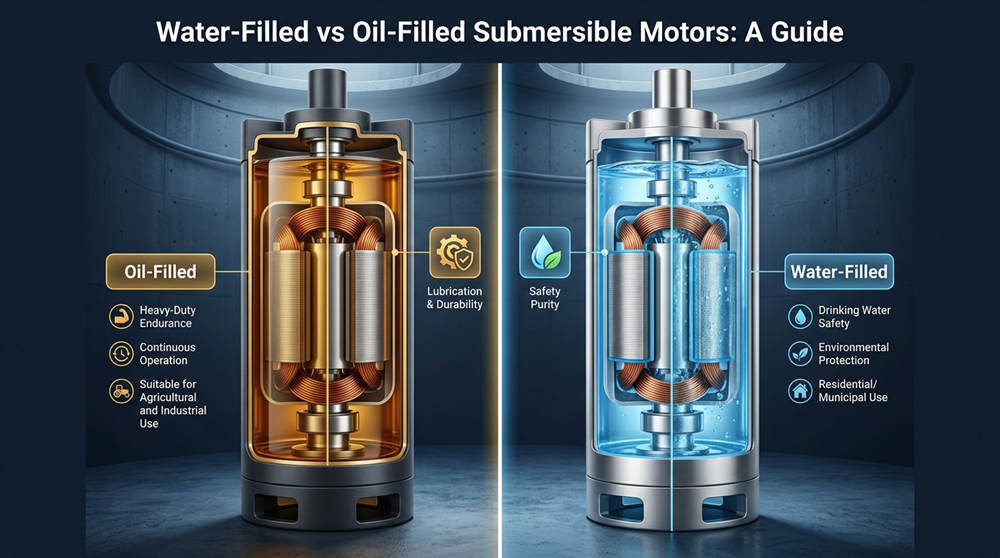
When you drop a deep well pump hundreds of feet underground, the motor is thrust into a hostile environment. It must survive in a dark, high-pressure, and entirely enclosed space while operating flawlessly for years. Running heavy loads to push water straight up against the forces of gravity generates immense heat. How does this critical piece of machinery keep itself cool and properly lubricated without burning out?
Engineers have tackled this complex thermal and mechanical problem by developing two primary methods to protect the internal windings of a submersible motor. The first approach involves filling the motor casing with specialized dielectric oil. The second approach relies on filling the internal cavity with a carefully formulated clean water mixture. Both engineering strategies serve the same core purpose—motor cooling and lubrication—but they achieve this goal in completely different ways, carrying distinct implications for performance, maintenance, and environmental impact.
Selecting the correct deep well pump involves far more than simply checking horsepower and flow rates. The fluid housed inside the motor dictates how the system handles continuous operation, what happens when internal seals wear out, and whether the unit can be repaired after a failure. Stream Pumps breaks down the technical differences, pros, and cons of water-filled vs oil-filled submersible motors so you can make the right investment for your specific borehole project.
Oil-filled motors are engineered for raw endurance. In this design, the motor casing is filled with a highly refined, dielectric (non-conductive) oil. This fluid entirely submerges the internal copper stator windings and the rotor, acting as both a primary coolant and a heavy-duty lubricant.
The dielectric nature of the oil means it does not conduct electricity, preventing short circuits within the motor while providing a protective barrier around the electrical components. As the motor runs and generates heat, the oil absorbs this thermal energy rapidly. It then circulates internally, transferring the heat to the outer stainless steel casing, which is continuously cooled by the groundwater flowing past the motor and up into the pump intake.
Oil offers exceptional lubrication for the mechanical bearings inside the motor. This continuous, high-viscosity hydrodynamic lubrication drastically reduces metal-on-metal friction, ensuring a very long mechanical lifespan even under severe stress.
Furthermore, oil absorbs and dissipates heat highly efficiently. This prevents the motor from overheating during intense, continuous operation, making it highly resilient in demanding applications. The presence of oil also provides excellent protection against internal rust and corrosion. Because the oil displaces air and moisture, oxidation cannot occur. Additionally, the fluid provides a strong buffer against voltage fluctuations, protecting the sensitive electrical windings from electrical stress.
The primary drawback of an oil-filled system is the inherent environmental risk. If the mechanical seal fails due to abrasive sand or general wear, there is a possibility that oil could leak out of the motor casing and into the well water.
Modern, high-quality manufacturers like Stream Pumps mitigate this risk heavily by exclusively using food-grade, non-toxic oil. This eliminates the danger of severe groundwater contamination and significantly reduces customer panic should a leak occur. However, even with safe, FDA-approved fluids, a seal failure can leave an unpleasant taste or a visible sheen on the water. No rural homeowner or municipal planner wants to taste or see oil in their drinking water supply.
Water-filled, or water-lubricated, submersible motors take a completely different engineering approach. Instead of oil, the motor cavity is filled with clean water, often mixed with a non-toxic antifreeze and anti-corrosion fluid to protect the internals during transport and storage.
Because water conducts electricity, the internal electrical components must be entirely isolated. The copper windings in a water-filled motor are heavily coated in special waterproof polymer insulation. This prevents the electrical current from shorting out in the water bath. As the motor operates, the internal water circulates around the insulated windings, absorbing heat and transferring it to the outer casing.
The most significant advantage of this technology is that it is 100% environmentally safe. If a mechanical seal fails and the internal liquid leaks into the borehole, it is simply water mixing with water. There is zero risk of groundwater contamination, making this a drinking water safe pump solution.
Additionally, many water-filled motors are highly maintainable. They are frequently designed as a rewindable submersible motor. If the motor burns out due to a lightning strike or severe electrical fault, a trained technician can open the casing, remove the damaged wire, and rewind new waterproof copper wire. This makes the motor repairable and extends the long-term value of the equipment.
Water simply does not lubricate as effectively as oil. To compensate for this lack of natural viscosity, the internal bearings in a water-filled motor must be manufactured from high-grade carbon and ceramic materials. While highly effective, these bearings can be more sensitive to thrust loads than their oil-lubricated counterparts. Furthermore, because the motor contains water, it is susceptible to freezing. If the motor is stored improperly above ground during harsh winter conditions before installation, the internal water can freeze, expand, and crack the casing or damage the delicate internal insulation.
When evaluating water-filled vs oil-filled submersible motors, it helps to look at how they stack up across critical performance categories.
Water-Filled wins unequivocally. Because there is no risk of chemical or hydrocarbon contamination, water-filled motors are often mandatory for municipal drinking water projects and residential wells in strictly regulated developed countries.
Oil-Filled wins this category. Due to the superior lubrication provided by the dielectric oil, these motors excel under heavy, continuous loads. They can handle the grueling demands of running at maximum capacity for weeks on end.
Water-Filled wins for repairability. The rewindable nature of many water-filled designs allows for targeted repairs. Conversely, oil-filled motors are typically sealed units. If an internal winding fails or the oil leaks, the entire motor is usually discarded and replaced.
Understanding the engineering limitations and strengths of each motor type is critical for a successful installation.
These units are the undisputed choice for residential drinking water wells. They provide peace of mind that the family's water supply will remain pristine. They are also the standard for municipal water supply networks, where regulatory bodies strictly prohibit the introduction of foreign fluids into aquifers. Finally, they are ideal for environmentally sensitive ecological reserves or protected wetlands.
Oil-filled units dominate in heavy-duty commercial scenarios. For deep agricultural irrigation—where pumps run 24/7 during dry seasons to keep crops alive—the unmatched bearing lubrication of an oil-filled motor is essential. Stream Pumps agriculture solutions frequently utilize oil-filled designs to maximize crop yields. They are also highly suited for industrial groundwater extraction, mining dewatering, and remote off-grid farming operations where continuous uptime is more critical than minor aesthetic water risks.
The longevity of a borehole pump motor ultimately depends on keeping the internal fluid inside the motor, and keeping the abrasive, mineral-heavy well water outside.
Regardless of the fluid inside, Stream Pumps uses advanced mechanical seals and pressure-compensating diaphragms in every unit. As a motor heats up, the fluid inside expands. Our pressure-compensating diaphragms flex to accommodate this internal expansion, maintaining a perfect pressure equilibrium with the outside environment. This prevents the mechanical seals from blowing out under pressure. Furthermore, our advanced silicon carbide mechanical seals act as an impenetrable barrier, ensuring complete seal integrity against abrasive sand.
Stream Pumps understands that no two boreholes are identical. We offer full customization, providing both oil-filled and water-filled technologies perfectly matched to your local environmental regulations, flow requirements, and budget constraints.
Selecting the right deep well pump comes down to balancing environmental safety against extreme mechanical endurance. A residential drinking water well demands the absolute purity of a water-filled motor. Conversely, a large-scale agricultural operation pulling thousands of gallons an hour requires the bulletproof lubrication of an oil-filled design. You must know your water's end-use before you drop the pump.
Are you drilling a new municipal drinking water well or upgrading an agricultural irrigation system? Contact the Stream Pumps deep well experts to select the perfect submersible motor for your next project.
Address
No.17 XeDa Jimei Ind. Park, Xiqing Economic Development Area, Tianjin, China
Telephone
+86 13816508465
QUICK LINKS