+86 13816508465
Pump Knowledge
Apr. 26, 2026
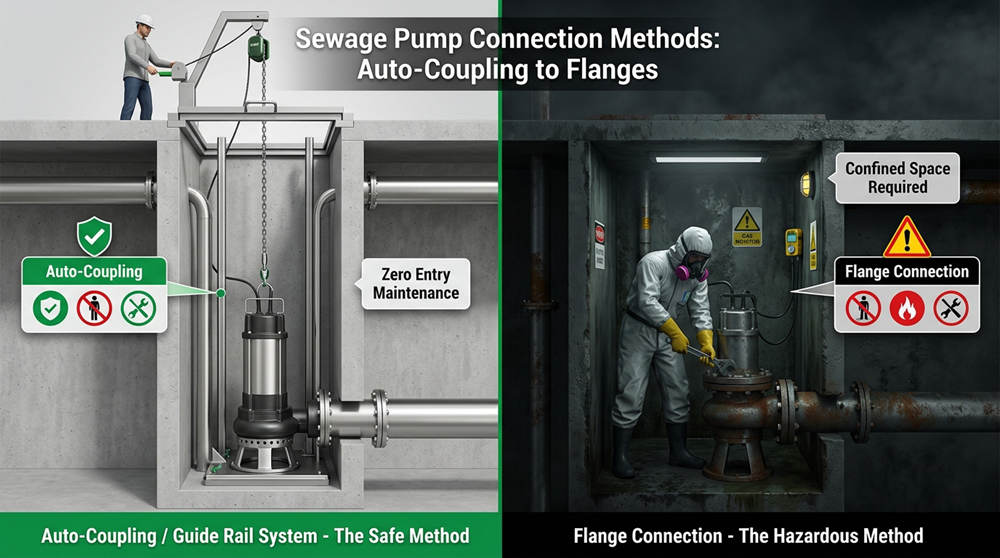
A submersible sewage pump spends its life in the worst environment imaginable. It operates in a dark, corrosive wet pit filled with toxic gases and unpredictable solids. When a mechanical failure occurs or routine maintenance is required, how your team retrieves that equipment can literally be a matter of life and death. Facility managers and wastewater engineers know that a pump is only as reliable as the infrastructure supporting it.
The installation factor plays a massive role in long-term operational success. The specific way your pump connects to the discharge piping dictates your entire maintenance protocol, facility safety standards, and expected downtime during repairs. A poor connection choice can turn a 15-minute visual inspection into a day-long confined space entry operation requiring specialized permits, tripods, and gas monitors.
Stream Pumps has spent years analyzing these challenges in the field. To help engineers, civil contractors, and plumbers choose the safest and most efficient setup for their wastewater projects, we have broken down the four primary sewage pump connection methods. Understanding the mechanical advantages and limitations of each system ensures your next lift station design prioritizes both performance and human safety.
For modern municipal and commercial wastewater engineering, the auto-coupling guide rail system is the undisputed benchmark. This method is engineered specifically to eliminate the hazards of wet pit maintenance while providing a highly secure, leak-free connection.
At the core of an auto-coupling guide rail system is a heavy-duty discharge base. This base is permanently bolted to the floor of the wet pit and connected directly to the main discharge piping. Two vertical guide rails extend from this anchored base all the way up to an access hatch at the surface level. The submersible pump itself is fitted with a specialized matching bracket designed to glide along these rails.
When it is time for a pump installation, operators attach a lifting chain to the unit and lower it through the surface hatch. The pump slides smoothly down the vertical guide rails. As it reaches the bottom, the bracket automatically engages with the discharge base. The sheer weight of the pump, combined with the engineered angle of the bracket, creates a perfect, watertight seal against the base. No bolts, threads, or manual locking mechanisms are required.
The primary advantage of the auto-coupling guide rail system is human safety. Zero human entry is required to install or remove the equipment. Technicians can simply use a hoist to lift the pump out of a 30-foot toxic pit, perform necessary inspections on the surface, and drop it back into place without ever climbing down a ladder. This effectively removes the immense risks associated with confined space entry, toxic gas exposure, and deep-water hazards.
This method is universally recommended for municipal lift stations, large commercial buildings, and deep wastewater treatment plant (WWTP) tanks where safe pump maintenance and rapid deployment are absolute priorities.
When dealing with extreme pressures and massive flow volumes, sometimes a permanent, rigid installation is required. Flanged pump connections provide an uncompromisingly strong link between the pump and the piping infrastructure.
In this setup, the pump’s discharge port features a flat metal rim, or flange, complete with standardized bolt holes. This rim aligns perfectly with a matching flange on the discharge pipe. A heavy-duty gasket is placed between the two metal surfaces, and a series of high-strength bolts are threaded through the holes and tightened to specific torque tolerances.
A flanged pump connection is incredibly secure. It is specifically designed to handle massive flow volumes and very high system pressures without vibrating loose over time. The structural integrity of a bolted flange ensures that aggressive fluid dynamics and water hammer effects do not compromise the seal.
The major drawback of this method becomes apparent during maintenance. To remove a submersible pump with a flanged connection, the wet pit must be completely drained. A worker must then physically enter the pit to manually unbolt the flange. This triggers strict safety protocols, including hazardous gas monitoring and confined space entry permits, which drastically increases maintenance costs and system downtime.
Because of the maintenance challenges in wet environments, flange connections are best suited for dry-pit sewage installations, massive industrial pumps, or permanent surface-level wastewater setups where the equipment is readily accessible.
For smaller scale projects, threaded pipe connections offer a straightforward, cost-effective solution. This method is ubiquitous in residential plumbing and light commercial applications where flow rates and pressures are relatively low.
In a threaded setup, the pump discharge port features internal or external threads. These are typically standard 2-inch or 3-inch NPT (National Pipe Thread) or BSP fittings. Standard PVC, galvanized, or stainless steel pipes are screwed directly into the pump to create the discharge line. Plumbers often use thread seal tape or pipe dope to ensure a watertight connection.
Threaded connections are fast and inexpensive to implement. Local plumbers can install them quickly using standard hand tools, completely avoiding the need for specialized heavy equipment or complex engineering blueprints. The materials are widely available, keeping initial project costs extremely low.
While easy to install, this method has distinct limitations. Threaded connections are not suitable for massive industrial pressures, as the threads can become points of vulnerability under extreme stress. Furthermore, removing the pump usually requires cutting the PVC pipe or unscrewing a union fitting located deep inside the pit. Over time, threads can corrode or seize, making pump extraction frustrating and labor-intensive.
This method is the standard choice for residential basement ejector pumps, small home septic tanks, and light commercial drainage systems where the pit depth is shallow and the fluid volume is highly manageable.
Wastewater management is not always a permanent affair. Floods, bypass operations, and construction projects require rapid, temporary pumping solutions. Flexible hose connections provide the agility needed for these demanding scenarios.
Instead of hard piping, this method utilizes a hose barb or a Camlock quick-disconnect fitting to attach a flexible, lay-flat hose directly to the pump discharge. Camlock fittings allow operators to secure the hose with a simple pulling motion on two levers, creating a tight seal in seconds.
The primary benefit of a flexible hose connection is ultimate mobility. A pump can be dropped into a flooded area, connected to a lay-flat hose, and activated in a matter of minutes. When the job is done, the hose is disconnected and rolled up, and the pump is loaded onto a truck for the next site.
Flexible hose connections are the preferred method for construction site dewatering, mobile municipal flood response teams, and temporary bypass pumping during WWTP repairs or pipeline rehabilitations.
Selecting the right sewage pump connection method is only the first step. The quality of the materials and the precision of the manufacturing ultimately determine the success of your installation. Stream Pumps brings a distinct engineering advantage to every wastewater project.
We specialize in precision machining, manufacturing our heavy-duty, leak-free auto-coupling bases from premium cast iron. This rigorous manufacturing process ensures a perfect, watertight seal every single time the pump is dropped down the rails. Our bases are built to withstand the highly corrosive nature of raw sewage, providing decades of reliable service.
Furthermore, Stream Pumps delivers complete solutions. We know that sourcing disparate parts from multiple vendors leads to compatibility issues and project delays. We provide the entire guide rail system, precisely angled brackets, upper rail supports, and heavy-duty lifting chains for a seamless, turnkey Stream Pumps lift station installation.
You cannot afford to let a poor installation method turn a routine maintenance task into a dangerous, day-long confined space operation. The connection between your submersible pump and your discharge piping is the critical link that defines your facility's operational safety. By understanding the specific applications for auto-coupling systems, flanges, threads, and flexible hoses, you can engineer a lift station that protects your workers and your bottom line.
Designing a new municipal lift station or upgrading a commercial septic system? Ensure maximum safety and efficiency from day one. Contact Stream Pumps to spec out a heavy-duty submersible pump with a complete auto-coupling system today.
Address
No.17 XeDa Jimei Ind. Park, Xiqing Economic Development Area, Tianjin, China
Telephone
+86 13816508465
QUICK LINKS