+86 13816508465
Pump Knowledge
Apr. 26, 2026
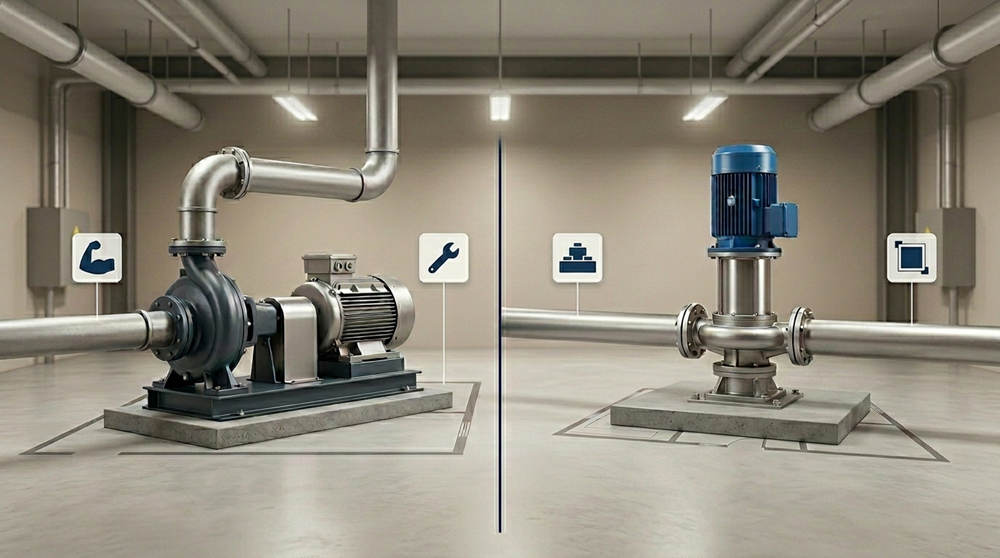
Floor space represents a premium commodity in modern commercial buildings and industrial plants. Every square foot dedicated to mechanical equipment is a square foot taken away from leasable office space, manufacturing lines, or operational logistics. For MEP engineers and facility designers, designing a highly efficient layout requires a delicate balance between maximizing hydraulic performance and minimizing the overall equipment footprint. You need reliable water movement, but you cannot afford to waste real estate.
When specifying standard centrifugal pumps, engineers inevitably face a classic debate. Should you prioritize the compact, space-saving vertical inline pump, or should you rely on the heavy-duty, traditional horizontal end suction pump? Both configurations move fluid effectively, but their structural differences dictate completely different approaches to facility layout, installation budgets, and long-term maintenance protocols.
Understanding the total cost of ownership for both systems is critical for project success. Balancing the initial installation savings of an inline configuration against the long-term maintenance ease of an end suction unit is a complex calculation. Stream Pumps is here to break down the structural differences, maintenance requirements, and ideal applications for both designs. By analyzing these mechanical fundamentals, you can ensure your next pump room design is engineered for maximum return on investment.
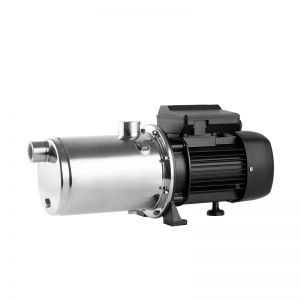
The horizontal end suction pump is the undisputed traditional workhorse of the fluid handling industry. In this configuration, fluid enters the pump horizontally, directly into the end of the impeller. The casing then directs the fluid outward, discharging it perpendicularly at a 90-degree angle out the top. These robust units typically sit horizontally on a heavy, cast-iron or fabricated steel baseplate.
The most significant operational benefit of this configuration is the back-pull-out pump design. This mechanical feature is a massive advantage for facility management teams and maintenance technicians. When a seal fails or an impeller requires inspection, technicians can remove the motor, coupling, and impeller from the back of the casing. They can perform this critical maintenance without ever disconnecting the heavy suction and discharge piping from the volute. This drastically reduces downtime and labor costs during routine service intervals.
Furthermore, end suction pumps offer unparalleled heavy-duty capabilities. Their horizontal orientation and secure baseplate mounting make them inherently stable. This stability allows them to handle extreme high-flow and high-pressure industrial applications that would cause excessive vibration in vertical units. When moving massive volumes of water, the horizontal design remains structurally sound over decades of continuous use.
The primary drawback of the end suction design is the massive footprint required for installation. These units demand a significant amount of floor space. To absorb vibrations and maintain structural integrity, the baseplate must be grouted to a dedicated, reinforced concrete housekeeping pad.
Installation is highly complex and labor-intensive. Because the motor and pump are mounted horizontally side-by-side, technicians must perform precise laser piping alignment between the motor shaft and the pump shaft. Any misalignment will cause premature bearing failure and mechanical seal leaks. Additionally, the 90-degree discharge angle inherently requires complex pipe elbow routing, which consumes even more premium space and adds friction loss to the system.
If the end suction pump is a robust workhorse, the vertical inline pump is the agile space saver. In an inline configuration, the suction and discharge ports are positioned in a straight line, exactly 180 degrees apart. The pump casing essentially acts like a large valve integrated directly into the pipeline. The motor sits vertically above the pump casing, completely altering the mechanical footprint.
The most obvious vertical inline pump advantages revolve around zero footprint installation. By stacking the motor vertically on top of the casing, this design takes up a mere fraction of the floor space required by a horizontal unit. In fact, many smaller inline models do not even require a concrete baseplate. They are simply supported by the structural integrity of the surrounding piping system and standard pipe hangers.
This straight-line design facilitates a highly streamlined installation process. Because the suction and discharge are inline, mechanical contractors can utilize straight-line piping runs. This eliminates the need for complex, space-consuming 90-degree elbows around the pump station. It also drastically reduces the labor hours required for plumbing work. The motor and pump share a common shaft or use a rigid coupling, completely eliminating the need for tedious laser shaft alignment on the job site.
While centrifugal pump space-saving designs offer incredible installation benefits, they do introduce specific maintenance challenges. To service the motor, mechanical seal, or impeller, the technician must lift the heavy motor straight up and completely off the casing. For larger horsepower models, this vertical lift frequently requires a ceiling crane, heavy-duty gantry, or specialized rigging equipment. If the pump room lacks overhead clearance, maintenance becomes incredibly difficult.
Additionally, the vertical orientation creates a much higher center of gravity. If the adjacent piping is not properly supported with appropriate isolation hangers and structural bracing, the pump can become highly sensitive to pipe vibrations. Over time, these unmitigated vibrations can cause seal degradation and motor bearing fatigue.
To simplify your pump room design decisions, here is a direct comparison of how these two configurations stack up across key engineering metrics:
Floor Space Required: Inline wins easily. Vertical integration can save up to 60% of the mechanical floor space compared to a horizontally mounted alternative.
Ease of Maintenance: End Suction wins. The horizontal back-pull-out feature means no overhead lifting is required, allowing a single technician to perform basic service safely and efficiently.
Installation Cost: Inline wins. With less concrete foundation work, fewer pipe elbows, and absolutely no baseplate laser alignment needed, contractor labor costs are significantly reduced.
Maximum Flow Capacity: End Suction wins. The low center of gravity and massive baseplate stability allow horizontal units to scale up efficiently for massive municipal or heavy industrial volumes.
There is no universally superior pump design. The optimal choice depends entirely on the unique constraints of your facility, your initial capital budget, and your long-term maintenance capabilities.
Vertical inline pumps shine in commercial environments where floor space translates directly to revenue. They are the premier choice for HVAC water pumps, specifically within chilled water loops and heating hot water systems in high-rise office buildings, hospitals, and hotels.
They are also incredibly valuable when retrofitting existing, crowded mechanical rooms. If you need to upgrade system capacity but cannot expand the physical walls of the basement, dropping a vertical inline pump directly into an existing straight pipe run is often the most cost-effective engineering solution.
Horizontal end suction pumps belong in environments where long-term durability and massive flow rates supersede spatial concerns. They are the standard specification for municipal water treatment plants, massive liquid transfer stations, and heavy industrial cooling towers.
Agricultural irrigation networks and remote processing plants also rely heavily on this configuration. In these expansive environments, floor space is abundant, but deploying specialized rigging equipment to lift a vertical motor is impractical. The ability to quickly pull the rotating assembly horizontally ensures minimal downtime for critical infrastructure.
Your choice between vertical and horizontal configurations dictates your installation budget and your maintenance schedule. However, regardless of the physical orientation you select, mechanical reliability must remain your top priority. Stream Pumps industrial solutions are explicitly engineered to deliver decades of uncompromising performance.
Whether you specify our compact, space-saving inline series or our rugged, high-capacity end suction series, every unit is manufactured to the highest industry standards. We utilize precision-cast impellers to maximize hydraulic efficiency and reduce internal turbulence. Our systems feature premium mechanical seals designed to withstand aggressive fluids and high-pressure differentials. Furthermore, we exclusively fit our pumps with energy-efficient motors designed to run cooler and last longer under continuous loads.
To further reduce your total cost of ownership, both our vertical and horizontal centrifugal pumps are fully compatible with Variable Frequency Drives (VFDs). By pairing our precision hydraulics with intelligent VFD controls, your facility can match pump speed precisely to real-time system demand. This integration eliminates wasted energy, reduces mechanical wear, and maximizes your operational energy savings.
There is no objectively wrong centrifugal pump design, only the wrong application for your specific mechanical room constraints. Your ultimate specification will permanently dictate your equipment footprint, your upfront installation budget, and the complexity of your future maintenance procedures. Weighing the initial cost savings of an inline installation against the accessible, back-pull-out maintenance of an end suction unit requires careful, facility-specific analysis.
Designing a new commercial HVAC system or planning a comprehensive upgrade for a heavy industrial water plant? Let the Stream Pumps engineering team review your mechanical blueprints. We offer consultative, engineering-focused guidance to help you navigate the total cost of ownership for your specific application. Contact us today for expert hydraulic sizing, layout recommendations, and reliable pump selection.
Address
No.17 XeDa Jimei Ind. Park, Xiqing Economic Development Area, Tianjin, China
Telephone
+86 13816508465
QUICK LINKS