+86 13816508465
Pump Knowledge
Apr. 26, 2026
A water pump is an incredibly powerful piece of machinery, but it operates completely blind. Without external guidance, it has no way of knowing if a storage tank is rapidly overflowing or if a deep well has completely run dry. The motor will simply continue to spin until it receives a signal to stop. That critical signal relies entirely on your level control system.
When a level control device fails, the consequences are immediate and expensive. If the system fails to turn the pump on, you face catastrophic flooding and potential environmental hazards. If the system fails to turn the pump off, the motor runs dry. Pumping air instead of liquid removes the natural cooling and lubrication the fluid provides. Within minutes, the mechanical seals melt, the motor burns out, and your facility faces thousands of dollars in emergency replacement costs.
Protecting your infrastructure means understanding the technology guarding it. Stream Pumps breaks down the mechanics behind traditional mechanical float switches and modern electronic level sensors. By comparing these two distinct technologies, facility managers and electrical control engineers can choose the ultimate protection for their fluid handling systems.
For decades, the standard method for managing liquid levels has been the mechanical float switch. You will find these devices hanging in residential basements, agricultural holding tanks, and municipal sumps across the globe.
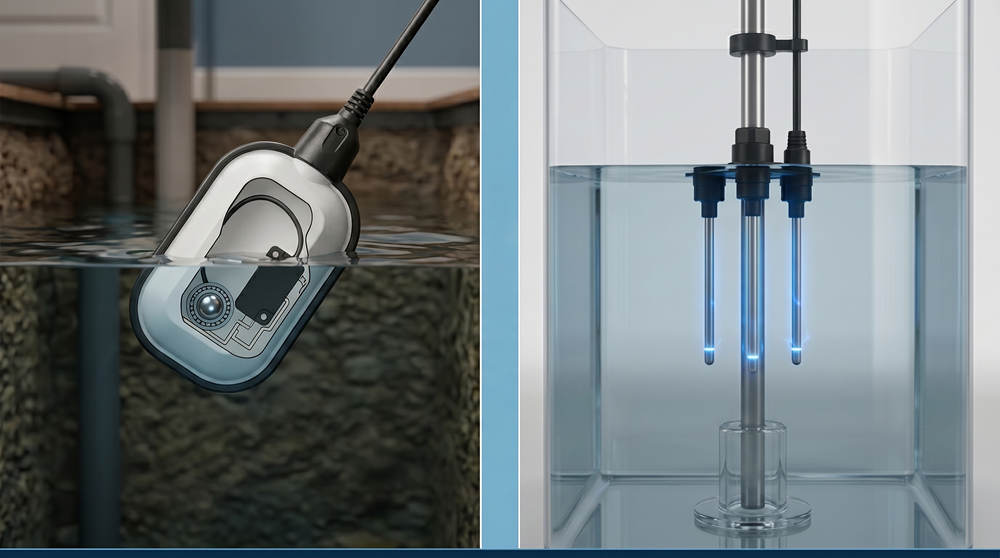
A float switch operates on basic buoyancy and gravity. The device consists of a watertight plastic or rubber bulb attached to a tethered cable. Inside this floating bulb sits a mechanical microswitch and a small, heavy object, typically a steel ball bearing.
As the water level in the pit or tank rises, the buoyant bulb floats upward and changes its angle. Once the bulb tilts past a specific degree, gravity forces the steel ball bearing to roll down a small internal track. The ball strikes the microswitch, closing the electrical circuit and sending a signal to start the pump. As the water level drops, the bulb tilts downward, the ball rolls away from the switch, the circuit opens, and the pump stops.
The primary benefit of a mechanical float switch is its extreme cost-effectiveness. These devices are inexpensive to manufacture and purchase. They are also incredibly simple to install. Because they operate as a basic physical switch, they do not require complex electrical programming, specialized software, or advanced calibration. You wire them directly into a basic control circuit, and they work immediately. This simplicity makes them perfect for basic residential sump pumps and temporary dewatering applications.
Despite their popularity, mechanical float switches carry significant inherent risks. The very nature of their design relies on moving parts, making them vulnerable to environmental hazards and physical wear.
Float switch failure is a common headache for plumbers and wastewater operators. Because the floats hang freely on cables, turbulent water can easily cause the cords to tangle together. A tangled float cannot tilt properly, meaning the pump will never receive the signal to activate. In tight sumps, a float can easily get pinned against the concrete wall or jammed underneath a discharge pipe.
Furthermore, float switches perform poorly in harsh wastewater environments. Heavy fats, oils, and grease (FOG) frequently coat the plastic housing. Over time, this grease accumulation becomes so heavy that the bulb loses its buoyancy entirely. It sinks to the bottom of the pit, leaving the facility completely vulnerable to overflows. Mechanical wear and tear on the internal microswitch is also inevitable, eventually leading to a failure that requires physical replacement of the entire unit.
Industrial environments demand a higher standard of reliability. Electronic level sensors, including probes and transducers, represent a massive technological leap forward. Instead of relying on a moving physical mechanism, these devices use advanced physics and electronics to monitor fluid levels.
Electronic sensors eliminate the need for a floating bulb. Instead, they utilize sophisticated technologies to measure the liquid accurately.
Conductive probes hang in the water and use the liquid itself to complete a low-voltage electrical circuit. When the water touches the highest probe, the pump turns on. When the water drops below the lowest probe, the circuit breaks, and the pump turns off.
A hydrostatic level sensor takes a different approach. Placed at the bottom of a tank or well, this pressure transducer measures the physical weight of the fluid resting above it. It translates that pressure reading into a highly accurate depth measurement.
Ultrasonic sensors sit above the liquid entirely. They emit high-frequency sound waves that bounce off the surface of the water and return to the sensor. By calculating the time it takes for the echo to return, the sensor determines the exact distance to the liquid surface.
The greatest strength of electronic level sensors is the complete absence of moving parts. Because nothing needs to float, tilt, or roll, these devices cannot get tangled or physically stuck.
Electronic sensors offer precise, continuous level monitoring. While a float switch only provides a simple [on] or [off] command, advanced sensors tell you exactly how many inches of water remain in your tank. This continuous data feed is crucial for preventing pump overflow and ensuring highly optimized pump cycling.
Adopting this modern technology requires a different infrastructure approach. Electronic sensors have a higher initial purchasing cost compared to basic plastic floats. Additionally, these sensors generate complex data signals that a raw motor cannot interpret alone. Utilizing this technology requires a dedicated smart control panel or a Programmable Logic Controller (PLC) to process the sensor data and safely operate the equipment.
When evaluating Level Sensors vs Float Switches for Water Pumps, the right choice depends on prioritizing reliability, precision, and maintenance capabilities.
Reliability: Sensors win convincingly. Removing moving parts results in vastly superior longevity. In turbulent environments, corrosive chemical tanks, or deep wells, electronic sensors perform consistently without the physical vulnerabilities that plague mechanical floats.
Precision: Sensors win. A mechanical float switch has a wide and sometimes unpredictable activation range depending on the length of its tether. Sensors and liquid level relays provide accuracy down to the millimeter, allowing operators to fine-tune their system cycles perfectly.
Cost & Simplicity: Floats win. If you are operating on a strict budget for a highly simplified system, mechanical floats provide basic functionality at the lowest possible price point.
Maintenance: Sensors win. Float switches require frequent pit inspections to ensure they are free from grease, untangled, and unjammed. Solid-state sensors and non-contact ultrasonic transmitters require significantly less physical intervention, keeping maintenance crews out of hazardous confined spaces.
Matching your control method to your specific environment is critical for maintaining automation reliability. Using the wrong technology guarantees premature failure.
Mechanical float switches are suitable for low-risk, highly supervised environments. Install them in residential basement sump pumps, where the water is generally clean and free of heavy debris. They also serve well in temporary construction dewatering jobs where simplicity and quick deployment are the primary goals. Finally, they work nicely as a redundant backup alarm in clean water holding tanks.
Electronic level sensors belong in critical infrastructure where failure carries a massive financial penalty. Deep well submersible pumps require probes. Dropping a tangled mechanical float 200 feet underground creates a maintenance nightmare; solid-state probes eliminate this risk.
Municipal wastewater lift stations also benefit heavily from electronic monitoring. Because grease destroys buoyancy, ultrasonic or hydrostatic sensors keep the system running regardless of the surface conditions in the pit. Commercial reverse osmosis systems, chemical dosing tanks, and industrial cooling towers also require the exact volume data that only continuous electronic transmitters can provide.
Transitioning to high-precision level sensors requires intelligent infrastructure to interpret the data. The sensor gathers the information, but the control panel serves as the brain of the operation.
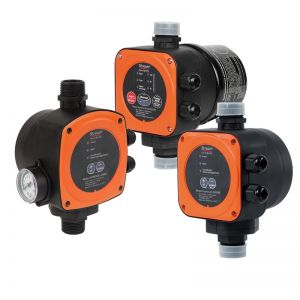
Stream Pumps offers a comprehensive solution with advanced submersible pump control panel technology. These intelligent control panels integrate seamlessly with electronic probes, transducers, and liquid level relays. By processing the exact water level data in real time, the Stream Pumps smart control system provides comprehensive motor defense.
The panel actively monitors the sensor data to provide absolute pump dry run protection, instantly shutting down power before the mechanical seals face any risk of overheating. The same intelligent enclosure provides phase-loss protection to guard against electrical grid anomalies, and overload protection to stop the motor if an impeller becomes physically jammed. By centralizing all logic and safety features into one box, operators gain total control over their fluid systems.
Matching your fluid control methodology to your operational environment is the key to longevity. Allowing a cheap plastic float switch to dictate the survival of a heavy-duty industrial pump is a dangerous gamble. Spending a slightly higher initial amount on electronic sensors serves as a highly effective, incredibly cheap insurance policy for your expensive pump motors.
Tired of untangling float cords, cleaning grease off plastic bulbs, or replacing burnt-out motors? Upgrade your system's intelligence and secure your infrastructure. Contact the Stream Pumps electrical control team to pair your pumps with high-precision level sensors and smart control panels today.
Address
No.17 XeDa Jimei Ind. Park, Xiqing Economic Development Area, Tianjin, China
Telephone
+86 13816508465
QUICK LINKS