+86 13816508465
Pump Knowledge
Jul. 27, 2026
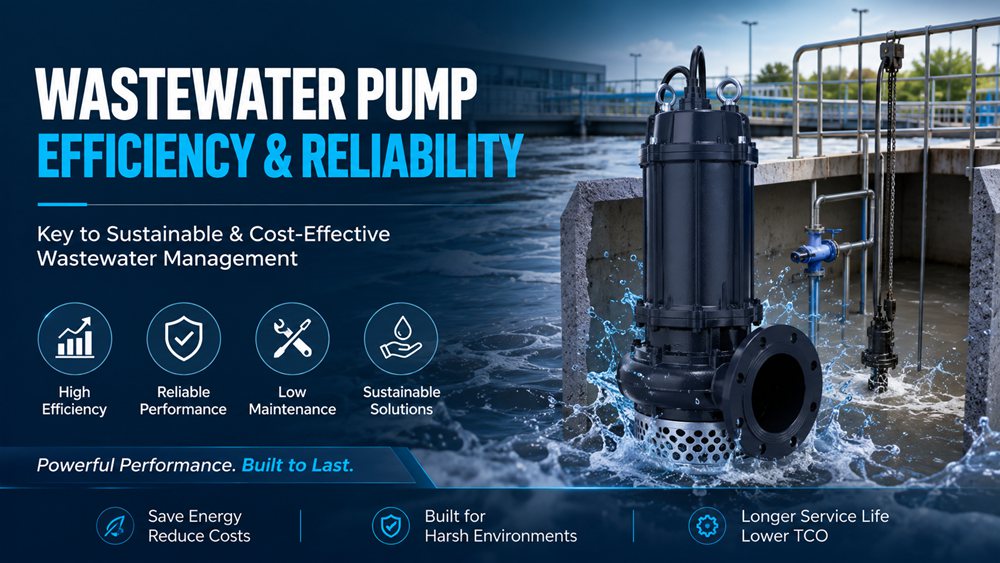
Wastewater pump selection requires balancing two competing priorities—hydraulic efficiency and operational reliability. Pumps optimized purely for efficiency often fail prematurely in demanding conditions, making impeller design, solids handling capability, and material selection equally critical factors in total lifecycle performance.
Pump efficiency is a product of two variables: motor efficiency and hydraulic efficiency. Together, they determine how effectively electrical input is converted into useful fluid movement. On paper, selecting the highest-efficiency pump available seems straightforward. In practice, wastewater applications introduce a far more complex set of variables—fibrous solids, abrasive grit, corrosive chemistries—that can render an efficiency-optimized pump unreliable within months of installation.
The most effective wastewater pump selection process starts not with an efficiency curve, but with a clear-eyed assessment of the operating environment. Understanding what the pump will encounter—and what failure modes are most likely—determines which design parameters matter most.
A pump with an impressive efficiency rating delivers zero savings when it's offline for repairs. This is the central risk of prioritizing efficiency over durability in wastewater applications: a pump that clogs frequently erases its energy cost advantage almost immediately.
The financial consequences of downtime extend well beyond the repair itself. Consider a realistic failure scenario in a municipal lift station:
Motor rewind costs: Rewinding a 15 HP motor typically costs around $2,000, not including labor or associated mechanical repairs.
Rental equipment: Temporary bypass pumping during an emergency can run approximately $1,000 per day.
Environmental penalties: A sewage spill resulting from pump failure can trigger regulatory fines starting at $500 per incident, with serious violations reaching five figures depending on volume and location.
When these costs are aggregated across multiple failure events in a single year, the efficiency advantage of a higher-rated pump disappears quickly. Facility managers focused solely on energy consumption at the design stage often underestimate the long-term financial exposure created by poor solids handling performance.
Reliability and efficiency are not mutually exclusive, but they must be deliberately balanced. Selecting for one without accounting for the other introduces risk that operational data will eventually make visible.
Before specifying an impeller type, review the pump's failure history in similar applications. Clogging, accelerated wear, and corrosion failures each point to different design deficiencies—and each requires a different solution. Municipal wastewater, sludge handling, and construction site dewatering all present distinct solids profiles that must be matched to the appropriate impeller geometry.
Fibrous materials—wet wipes, rags, and stringy organics—are among the most common causes of pump clogging in municipal wastewater systems. Cutter, grinder, and chopper-style impellers address this problem by reducing solids before they pass through the pump casing. The mechanical cutting action breaks down fibrous material into smaller particles, reducing the likelihood of blockages and protecting downstream piping and equipment.
The trade-off is measurable: cutting mechanisms introduce additional drag, which reduces hydraulic efficiency compared to open or semi-open impeller designs. For facilities managing high rag content, however, this efficiency reduction is typically justified by the substantial improvement in uptime and reduction in maintenance interventions.
Construction dewatering and industrial applications frequently involve abrasive grit, sand, and oversized solids that would rapidly wear down conventional impeller designs. Vortex impellers are specifically engineered for these conditions.
In a vortex configuration, the impeller is recessed away from the pump inlet. Rather than directly contacting solids, the impeller generates a rotating flow pattern that carries material through the casing with minimal direct impeller contact. This design significantly extends wear life in high-abrasion environments.
The efficiency trade-off is more pronounced with vortex impellers than with most other designs—they operate at lower hydraulic efficiency as a result of the recessed geometry. For applications where wear life is the primary concern, this trade-off is well justified. For applications with moderate solids and high energy cost sensitivity, a different impeller type may offer a better balance.
Impeller design determines how a pump handles solids. Material selection determines how long it survives doing so. The two decisions are closely linked and should be made together during the wastewater pump selection process.
High chrome iron alloys provide exceptional abrasion resistance and are well-suited for slurry pumping and dewatering applications where hard particles—sand, grit, and mineral fines—are present in high concentrations. The hardness of chrome iron significantly outperforms standard cast iron in these conditions, extending component life and reducing replacement frequency.
Stainless steel is the preferred material for corrosive environments, including applications involving industrial effluents, chemical process water, or wastewater with elevated chloride content. Stainless steel offers superior resistance to oxidation and chemical attack, making it the more durable choice where corrosion is the dominant failure mechanism.
Specifying the wrong material for a given application—even with the correct impeller design—can result in premature component failure and shortened service intervals. Material selection should always be driven by the chemistry and particle characteristics of the fluid being handled.
Dependable wastewater pump performance is the result of three balanced factors: hydraulic efficiency, solids handling capability, and material durability. Optimizing for any single factor in isolation creates vulnerabilities that real-world operating conditions will expose.
Facility managers and engineers responsible for wastewater pump selection should evaluate the full system context—not just the pump in isolation. Upstream conditions, such as the solids load entering the wet well, directly affect which impeller design is appropriate. Downstream equipment, including piping diameter, check valves, and discharge conditions, affects the hydraulic demands placed on the pump and must be accounted for in the selection process.
A structured approach to pump selection—one that integrates efficiency targets, solids handling requirements, material compatibility, and system hydraulics—reduces the likelihood of unexpected failures and supports more accurate lifecycle cost projections. The goal is not the most efficient pump, nor the most robust pump, but the most appropriate pump for the specific demands of the application.
What is the most important factor in wastewater pump selection?
No single factor determines the best pump. Wastewater pump selection requires balancing hydraulic efficiency, solids handling capability, and material durability. The relative weight of each factor depends on the application—municipal wastewater, sludge handling, and construction dewatering each have different priorities.
Why do high-efficiency wastewater pumps sometimes underperform in the field?
Pumps optimized for hydraulic efficiency are often designed with tighter clearances and impeller geometries that are vulnerable to clogging when fibrous solids or abrasive grit are present. Frequent clogging increases downtime, repair costs, and the risk of spills—erasing any energy savings the efficiency rating was expected to deliver.
What is a vortex impeller and when should it be used?
A vortex impeller is recessed away from the pump inlet, generating a rotating flow that carries solids through the casing with minimal direct contact. This design reduces wear in abrasive applications involving grit, sand, and large solids. The trade-off is reduced hydraulic efficiency compared to standard impeller types.
What materials are best for wastewater pumps in corrosive environments?
Stainless steel is the preferred material for corrosive wastewater applications, including those involving industrial effluents or elevated chloride content. High chrome iron alloys are better suited for abrasive slurry and dewatering applications where hardness and wear resistance are the primary requirements.
How can facility managers reduce unexpected pump failures in wastewater systems?
Reviewing the history of pump failures in similar applications is a critical first step. Identifying whether previous failures were caused by clogging, abrasion, or corrosion points directly to the impeller design and material selection decisions needed to improve reliability. Evaluating upstream solids load and downstream system conditions further reduces the risk of mismatched pump specifications.
Address
No.17 XeDa Jimei Ind. Park, Xiqing Economic Development Area, Tianjin, China
Telephone
+86 13816508465
QUICK LINKS