+86 13816508465
Jul. 23, 2026
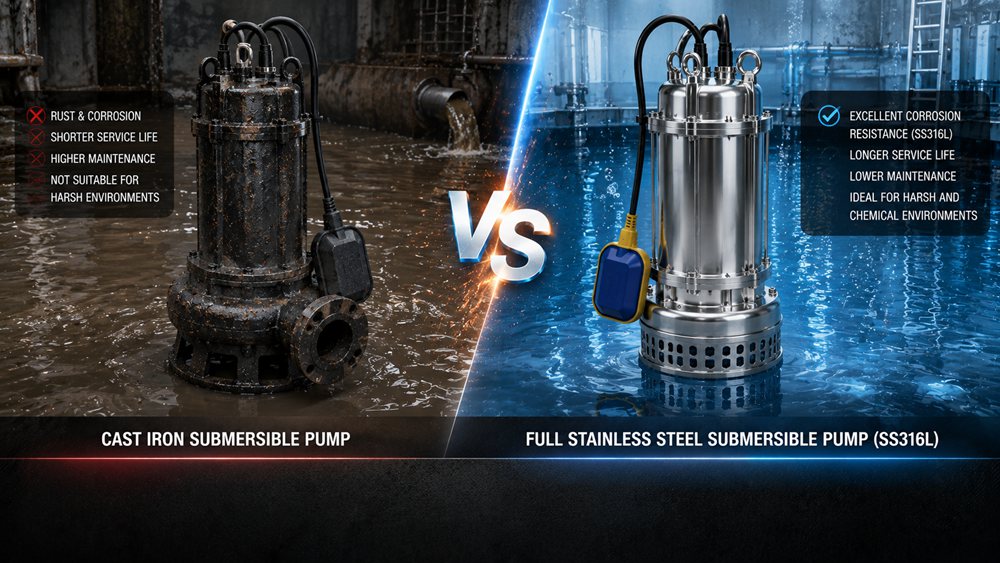
Premature submersible pump failure is most often a material mismatch, not a mechanical defect. Cast iron excels in high-impact, neutral-pH applications like municipal sewage and construction dewatering. Full stainless steel (SS304/SS316) is mandatory for corrosive, acidic, or marine environments. Matching material to fluid chemistry is the single highest-impact procurement decision you can make.
Most submersible pump failures that arrive back at a distributor's desk have one thing in common: the failure wasn't mechanical. The motor didn't burn out. The impeller wasn't undersized. The pump simply dissolved.
Corrosion caused by a mismatch between the pump material and the pumped fluid is one of the most expensive and most preventable problems in industrial fluid management. A cast iron pump submerged in acidic chemical wastewater may show catastrophic pitting within months. A full stainless steel pump deployed in a standard municipal sewer where cast iron would have performed perfectly for decades represents unnecessary capital expenditure. Both outcomes cost money. Both are avoidable.
Tianjin Streampumps Industry Co., Ltd manufactures complete lines of both E-coated cast iron and full stainless steel submersible pumps—and because we produce both, our engineers have no incentive to push one material over another. The goal of this article is straightforward: give procurement officers, facility managers, wastewater engineers, and distributors the technical and commercial framework to match the exact pump material to the specific application, every time.
Cast iron has been the backbone of submersible pump manufacturing for decades. Its continued dominance in specific applications is not inertia—it is a product of material properties that are genuinely difficult to replicate at the same price point.
Cast iron offers exceptional tensile strength, structural rigidity, and natural vibration damping. The dense composition of cast iron absorbs mechanical shocks and pressure surges that occur during high-solids pumping operations. This makes it well-suited to environments with heavy debris, coarse grit, or irregular flow conditions. Its wear resistance in abrasive slurry applications is particularly notable: cast iron surfaces hold up where lighter materials would erode prematurely.
From a cost perspective, cast iron pumps offer a lower initial purchase price than full stainless steel equivalents. For projects requiring multiple pump units—large municipal drainage networks, construction dewatering fleets, or high-volume stormwater infrastructure—this cost advantage compounds significantly at scale.
Municipal sewage pumping stations handling domestic wastewater at neutral pH levels (typically 6.5–8.5)
Stormwater and flood drainage where water chemistry is non-aggressive
Construction site dewatering for groundwater removal with suspended solids and grit
Industrial sump drainage involving heavy sludge in neutral or near-neutral pH environments
Agricultural water management for irrigation runoff and pond management
The key qualifier in all of the above: the pumped fluid must remain within a neutral pH range and must not contain significant concentrations of chlorides, acids, or alkalis.
Standard cast iron is inherently susceptible to rust and oxidation when exposed to moisture, oxygen, and any trace corrosive agents. Without surface protection, internal pump surfaces will develop rust over time, which roughens the hydraulic passageways, increases frictional losses, and reduces pump efficiency—all before visible structural damage becomes apparent.
At Tianjin Streampumps Industry Co., Ltd, our cast iron submersible pumps are treated with advanced Electrophoresis (E-coating), an electrodeposition process that applies a uniform, dense anti-corrosion layer across all internal and external cast iron surfaces—including complex geometries and recessed areas that brush or spray coatings cannot reach. E-coating delivers superior adhesion compared to conventional epoxy paint, significantly extending the operational life of our cast iron series beyond standard industry benchmarks. This makes Streampumps cast iron pumps a more durable investment than uncoated alternatives in equivalent applications.
Full stainless steel submersible pumps command a higher initial price. In the right application, that premium is not a cost—it is the least expensive decision a procurement officer can make.
Austenitic stainless steels resist corrosion through a fundamentally different mechanism than surface coatings. Both SS304 and SS316 contain high concentrations of chromium, which reacts with oxygen to form a thin, tightly bonded chromium oxide layer on the metal surface. Unlike iron oxide (rust), this passive layer does not flake or separate from the base metal. Critically, it is self-repairing: if the surface is scratched or abraded, the passive layer reforms when re-exposed to oxygen.
The distinction between SS304 and SS316 is significant in pump selection:
SS304 (18% Chromium, 8% Nickel): Provides excellent corrosion resistance in clean or mildly contaminated water. Appropriate for neutral-to-mildly acidic fluids with low chloride concentrations and standard total dissolved solids (TDS).
SS316 (16% Chromium, 10% Nickel, 2% Molybdenum): The addition of molybdenum provides substantially superior resistance to chloride-induced pitting and crevice corrosion. It is the grade of choice for coastal installations, brackish water, marine environments, and any application where chloride concentrations are elevated. In laboratory compatibility testing, SS316 receives an "A" (excellent) rating for compounds—such as ammonium fluoride—where SS304 rates a "D" (not recommended).
Chemical processing plant sumps handling acidic or alkaline effluents
Saltwater and marine facility drainage including aquaculture, shipyards, and coastal infrastructure
Food and beverage facility wastewater requiring hygienic, non-porous wetted surfaces
Pharmaceutical plant drainage where contamination control is a regulatory requirement
Metal plating and surface treatment operations with chemically aggressive rinse water
Paper and pulp processing involving acidic or bleach-containing liquids
Brewery and winery wastewater systems with low-pH organic waste streams
A technical risk that is frequently underestimated in pump procurement is galvanic corrosion—the accelerated corrosion that occurs when two dissimilar metals are in electrical contact within a conductive (electrolytic) fluid. A pump that uses a stainless steel impeller paired with a cast iron casing, for example, creates a galvanic cell in the presence of any conductive process fluid. The less noble metal—typically the cast iron—corrodes at an accelerated rate, far beyond what would occur in a homogeneous system.
Tianjin Streampumps Industry Co., Ltd's full stainless steel submersible pumps are built with every wetted component—impeller, pump casing, shaft, and wear plate—fabricated from the same grade of premium stainless steel. This eliminates galvanic couple risk entirely. The result is a hydraulically consistent, chemically uniform pump that performs predictably across its full service life.
The table below provides a direct, application-referenced comparison for procurement evaluation:
Feature | Cast Iron (E-Coated) | Full Stainless Steel (SS304/SS316) |
|---|---|---|
Initial Purchase Cost | Lower — highly cost-effective for budget-sensitive or multi-unit projects | Higher — premium investment with strong TCO justification in corrosive environments |
Chemical Resistance | Moderate — suitable for neutral pH (6.5–8.5), low chloride environments | Excellent — handles acids, alkalis, chlorides, and saline media; SS316 extends this further |
Impact & Wear Resistance | Excellent — handles heavy debris, coarse grit, and abrasive sludge | Good to Very Good — strong mechanical performance, may be subject to accelerated surface wear in highly abrasive slurry |
Surface Integrity Over Time | E-coating delays corrosion; internal surfaces may roughen if coating is breached | Passive oxide layer self-repairs; smooth hydraulic surfaces maintained throughout service life |
Weight | Heavier — provides excellent stability in submerged installations | Lighter — simplifies handling, installation, and retrieval, especially at depth |
Hygienic Suitability | Not recommended — porous surface and corrosion risk make it unsuitable for food, pharma, or potable water | Preferred — non-porous, smooth surface meets hygiene and regulatory standards |
Galvanic Corrosion Risk | Low in homogeneous cast iron construction | Eliminated in full stainless steel construction |
Best Application | Municipal sewage, stormwater, construction dewatering, neutral-pH industrial sump drainage | Chemical wastewater, marine environments, food/pharma drainage, acidic or alkaline industrial effluents |
The most common and costly procurement error in submersible pump specification is not over-spending on stainless steel in a corrosive application. It is under-spending on cast iron in an aggressive one.
Total Cost of Ownership for a submersible pump includes purchase price, installation cost, energy consumption over the service life, maintenance frequency, replacement parts, and—critically in deep or difficult-access installations—the cost of retrieval, repair, and reinstallation when a pump fails prematurely.
Stainless steel submersible pumps typically cost 1.5 to 2 times more than cast iron equivalents at point of purchase. However, in aggressive fluid environments, stainless steel service life is commonly 2 to 3 times longer than that of cast iron. Beyond longevity, stainless steel maintains smoother hydraulic surfaces throughout its operational life. Cast iron surfaces corrode and roughen progressively, increasing frictional losses inside the pump. A degraded cast iron pump must work harder—consuming more energy—to deliver the same flow rate as a new unit. In continuous-duty industrial applications, this efficiency penalty is measurable in annual energy costs.
Specify cast iron when:
The pumped fluid has a confirmed neutral pH (6.5–8.5) and stable chemistry
Chloride concentrations are below 200 ppm
The application involves heavy abrasive solids where cast iron's mechanical hardness is an advantage
The project is budget-constrained and the service environment is genuinely non-corrosive
The application is temporary or intermittent (e.g., construction dewatering)
Specify full stainless steel when:
The pumped fluid is acidic (pH below 6) or alkaline (pH above 9)
The application involves chlorides, brine, saltwater, or chemical process liquids
The installation is in a coastal, marine, or humid saline environment
Hygiene regulations apply to the facility (food, pharmaceutical, potable water adjacent)
The pump installation depth or site access makes retrieval and replacement costly
Continuous-duty uptime is a contractual or operational requirement with penalties for downtime
The financial logic is clear: a cast iron pump deployed correctly in neutral water will deliver excellent ROI. The same pump in acidic chemical wastewater will fail early, require retrieval and replacement, and cost far more over its (abbreviated) lifecycle than a properly specified stainless steel unit would have.
Matching pump material to application is straightforward when the fluid chemistry is well-characterized. In practice, procurement decisions are frequently made with incomplete process data, variable influent chemistry, or under cost pressure that makes the lower initial price of cast iron attractive regardless of application fit.
This is where manufacturer expertise matters.
Tianjin Streampumps Industry Co., Ltd has manufactured submersible pumps since 1997, supplying distributors and industrial operators in more than 150 countries. Because Streampumps produces complete lines of both E-coated cast iron and full stainless steel submersible pumps—across multiple configurations, flow rates, and power ratings—our engineering team provides application-specific guidance that is based on fluid compatibility and operational requirements, not on inventory pressure.
Our engineers routinely assist procurement teams and facility managers with the following:
Fluid analysis review: Evaluating process fluid chemistry, pH range, solids content, and temperature to determine the appropriate material specification
Grade selection within stainless steel: Recommending SS304 or SS316 based on chloride concentration, temperature, and chemical exposure profile
TCO modeling: Helping procurement officers build the business case for the correct specification against capital budget constraints
Custom configurations: Where standard materials are insufficient, advising on specialized coatings or alloy options for extreme service conditions
We do not recommend stainless steel to every enquiry, and we do not default to cast iron to reduce the bill of materials. The goal is a correctly specified pump that performs reliably for its full intended service life.
The core principle of submersible pump procurement is this: the pump material must be selected for the environment, not for the budget line. In applications where cast iron's mechanical toughness and cost-effectiveness are the right fit, it remains one of the best-performing options in the industry. In corrosive, saline, or chemically aggressive environments, full stainless steel is not a premium—it is the minimum viable specification for acceptable service life and total cost of ownership.
Specifying the wrong material does not result in reduced performance. It results in accelerated failure, unplanned downtime, retrieval and replacement costs, and in some industries, regulatory compliance risk.
The pump itself is rarely the problem. The specification decision is.
Don't guess which material your project requires. Visit www.streampumps.com to consult with our engineering team and explore our full range of E-coated cast iron and full stainless steel submersible pumps—each manufactured to match the exact demands of your application.
Cast iron submersible pumps offer superior mechanical strength, impact resistance, and lower initial cost, making them well-suited to neutral-pH applications like municipal sewage and construction dewatering. Full stainless steel submersible pumps (SS304 or SS316) provide exceptional resistance to chemical corrosion, acidic or alkaline fluids, and saline environments. The correct choice depends entirely on the chemistry and composition of the pumped fluid.
Specify SS316 when the pumped fluid contains elevated chloride concentrations, when the installation is in a coastal or marine environment, or when the fluid includes acidic compounds, bleach, brine, or brackish water. SS316 contains 2% molybdenum, which provides substantially superior resistance to chloride-induced pitting and crevice corrosion compared to SS304. For standard freshwater or low-chloride applications, SS304 is sufficient.
Electrophoresis (E-coating) significantly improves the corrosion resistance of cast iron pumps beyond standard uncoated alternatives, extending service life in near-neutral pH environments. However, E-coating is a protective layer—not a transformation of the base material's chemical properties. Cast iron pumps, even with E-coating, are not suitable for prolonged exposure to acidic, alkaline, or high-chloride fluids. Those applications require full stainless steel construction.
Not necessarily. In applications with neutral, non-corrosive fluid chemistry, a correctly specified cast iron pump offers excellent performance and strong ROI at a lower capital cost. Over-specifying stainless steel in a benign environment does not improve performance—it increases capital expenditure without a corresponding operational benefit. The correct specification depends on a detailed assessment of fluid chemistry, installation environment, and operational requirements.
Galvanic corrosion occurs when two dissimilar metals are in electrical contact within a conductive (electrolytic) fluid. In pumps constructed with mixed materials—for example, a stainless steel impeller housed in a cast iron casing—the less noble metal corrodes at an accelerated rate in any conductive process liquid. Full stainless steel construction eliminates this risk by ensuring all wetted components are made from the same alloy grade, preventing the galvanic couple that drives accelerated corrosion.
Cast iron surfaces corrode and roughen over time, increasing internal frictional losses. As hydraulic efficiency degrades, the pump must work harder to maintain target flow rates, which increases power consumption. Full stainless steel pumps maintain smoother internal surfaces throughout their service life, sustaining hydraulic efficiency and minimizing energy costs over continuous-duty operation.
Address
No.17 XeDa Jimei Ind. Park, Xiqing Economic Development Area, Tianjin, China
Telephone
+86 13816508465
QUICK LINKS