+86 13816508465
Jul. 27, 2026
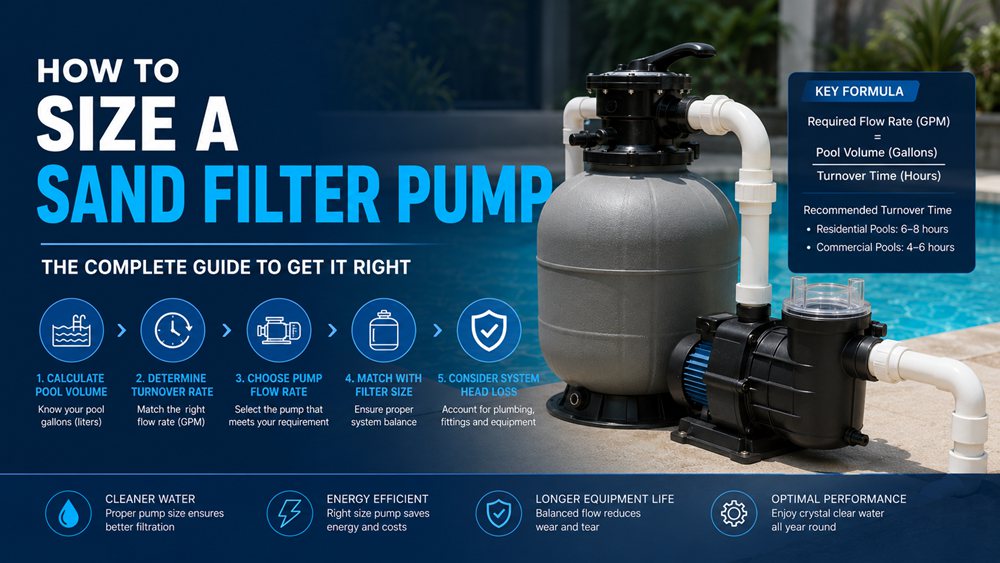
Sizing a commercial sand filter pump requires calculating three interdependent metrics: turnover rate, flow rate (GPM or m³/h), and total dynamic head (TDH). Incorrect sizing—whether oversizing or undersizing—leads to filtration failure, equipment damage, and elevated energy costs. A certified pump engineer should validate all calculations before final selection.
Sizing a commercial sand filter pump is an exercise in precision engineering, not estimation. Get it wrong, and the consequences compound quickly: cloudy water, clogged filter beds, premature mechanical failure, and energy bills that spiral out of control. Get it right, and you have a system that maintains water clarity continuously, runs efficiently around the clock, and protects every component in the circuit.
This guide walks engineers and facility managers through the three core calculations required for accurate sand filter pump sizing—turnover rate, flow rate, and total dynamic head—and explains how the relationship between these variables determines system performance. It also addresses the two most costly sizing errors in practice: oversizing and undersizing. Throughout, the technical standards referenced apply to commercial pools, aquaculture systems, industrial water treatment, and other high-volume continuous-filtration environments.
Stream Pumps, a pump manufacturer with over two decades of experience supplying heavy-duty filtration systems to more than 150 countries, has contributed the engineering principles underlying this guide.
Turnover rate refers to the time required for a pump to cycle the entire volume of a water system through the filter once. Industry standards vary by application:
Commercial swimming pools: Most regulatory bodies require a full turnover every 4–8 hours, depending on bather load and pool type.
Aquaculture systems: Turnover requirements are typically more aggressive—often 1–2 hours—due to biological oxygen demand and waste concentration.
Industrial process water: Turnover intervals depend on contamination load and process sensitivity, and must be specified per application.
To calculate the required turnover, determine the total water volume of the system in gallons (or cubic meters) and divide it by the target turnover time in hours. This produces the minimum volumetric throughput your pump must achieve.
Flow rate is the direct output of your turnover calculation. Once you know how much water must be processed per hour, converting to Gallons Per Minute (GPM) or Cubic Meters Per Hour (m³/h) gives you the pump's minimum required delivery capacity.
Example: A commercial pool holding 200,000 gallons with a 6-hour turnover requirement needs a minimum flow rate of:
200,000 ÷ 6 = 33,333 gallons/hour ÷ 60 = ~556 GPM
This figure becomes the baseline specification for pump selection—but it is not sufficient on its own.
Total dynamic head (TDH) quantifies the total resistance a pump must overcome to move water through the system at the required flow rate. Flow rate without TDH is an incomplete specification. A pump selected on flow alone will almost certainly underperform in real operating conditions.
TDH is the sum of three resistance components:
Pipe friction losses: Caused by water traveling through pipes, fittings, valves, and bends. Longer pipe runs, smaller diameters, and more directional changes all increase friction loss.
Elevation (static head): The vertical height the pump must lift water from the source to the discharge point.
Filter media resistance: Sand filter beds create significant back-pressure, particularly as they accumulate particulate matter between backwash cycles. A clean sand bed typically adds 5–10 PSI (0.35–0.69 bar) of resistance; a loaded bed can reach 15–20 PSI before triggering a backwash cycle.
TDH is calculated by summing all friction losses and static head across the full system circuit. The resulting figure, expressed in feet or meters of head, is plotted against the pump's hydraulic performance curve to identify the true operating point. Only at this intersection—where the system curve meets the pump curve—can you confirm whether the pump will deliver the required GPM at real-world conditions.
Oversizing is more damaging to filtration quality than most operators expect. When a pump delivers flow rates that exceed the design capacity of the sand filter bed, the high velocity forces water through the media too rapidly. Rather than distributing evenly across the bed, the flow carves preferential pathways through the sand—a phenomenon known as channeling .
Channeled flow bypasses a significant portion of the filtration media entirely. Particulate contaminants pass through unchallenged, and water quality deteriorates despite the filter technically being 【in operation.】 Worse, the sand bed itself becomes unevenly compacted and degraded, shortening its service life.
The hydraulic performance curve of an oversized pump also tends to operate far left of its best efficiency point (BEP), increasing the risk of cavitation, vibration, and impeller wear.
An undersized pump creates a different but equally serious failure mode: inadequate backwashing capacity.
Backwashing is the process of reversing flow through the sand bed to lift, agitate, and flush accumulated particulate matter out of the filter. For backwashing to be effective, upward flow velocity through the sand must reach a threshold sufficient to fluidize the bed—typically between 12–15 GPM per square foot of filter area, depending on sand grade and bed depth.
An undersized pump cannot generate this velocity. The sand bed does not fully expand during backwash, trapped debris remains embedded, and the bed gradually compacts and clogs. System pressure rises, flow rate drops, and the pump works harder against increasing resistance—accelerating mechanical wear and eventually leading to failure.
In continuous-operation environments such as aquaculture or industrial water treatment, a failed backwash cycle can compromise water quality within hours.
Commercial sand filter pumps frequently run 24 hours a day, 7 days a week. Over a system lifecycle of 10–15 years, electrical consumption often exceeds the initial capital cost of the pump itself. Efficiency at the design operating point is therefore a primary selection criterion, not a secondary consideration.
Key efficiency factors include:
Motor efficiency class: IE3 and IE4 premium-efficiency motors reduce electrical draw under continuous load. The difference between an IE2 and IE4 motor at 15 kW running 8,760 hours per year can represent thousands of dollars annually.
Hydraulic curve stability: A pump with a flat, stable hydraulic curve maintains consistent flow across a range of system pressures. This is especially valuable in sand filtration, where back-pressure increases incrementally as the filter loads between backwash cycles.
Impeller design: Closed impellers generally deliver higher hydraulic efficiency than semi-open designs in clear-water filtration applications.
Stream Pumps engineers its commercial sand filter pump range to maintain a stable hydraulic curve across variable head conditions, ensuring maximum volumetric delivery with minimal electrical draw over extended operational lifecycles—a specification that directly reduces total cost of ownership in high-duty-cycle installations.
Accurate sand filter pump sizing protects the filtration media, ensures consistent water clarity, and minimizes energy consumption over the full operational life of the system. Every one of these outcomes depends on three calculations being performed correctly and in sequence: turnover rate, flow rate, and total dynamic head.
No two water systems are identical. Pipe layouts, elevation profiles, filter bed dimensions, and water chemistry all influence the final pump specification. A pump that performs flawlessly in one installation can fail systematically in another with similar nominal parameters but different hydraulic characteristics.
The Stream Pumps technical sales team conducts preliminary system evaluations for commercial and industrial clients. During this assessment, Stream Pumps engineers ask targeted questions about total water volume, required turnover time, existing pipe diameters, system elevation, and filter specifications—gathering the data needed to recommend the correct pump model with confidence.
To request a technical evaluation for your application, contact the Stream Pumps engineering team directly. Provide your system volume, turnover requirement, and pipe layout, and a sales engineer will respond with a precise pump recommendation and supporting hydraulic analysis.
What is the correct flow rate for a commercial sand filter pump?
The correct flow rate depends on your system's total water volume and required turnover time. Divide total volume by turnover time to get hourly flow, then convert to GPM or m³/h. This baseline must then be validated against the system's total dynamic head before selecting a pump model.
How does total dynamic head affect sand filter pump selection?
Total dynamic head (TDH) represents the total resistance the pump must overcome—including pipe friction, elevation change, and filter media back-pressure. A pump must be selected based on both its flow rate capacity and its ability to overcome TDH at the design operating point. Ignoring TDH leads to underperformance in real operating conditions.
What causes channeling in a sand filter, and how is it prevented?
Channeling occurs when flow velocity through the sand bed exceeds the filter's design capacity, typically due to an oversized pump. Water carves direct pathways through the media, bypassing filtration. Prevention requires correctly sizing the pump to the filter's rated flow capacity and verifying the operating point on the pump's hydraulic curve.
How often should a commercial sand filter be backwashed?
Backwash frequency depends on system load and contamination rate, but is typically triggered by a pressure differential increase of 8–10 PSI above the clean-bed baseline. In high-load commercial environments, this may occur daily. The pump must be capable of generating sufficient upward flow velocity—typically 12–15 GPM per square foot of filter area—to fluidize and clean the bed effectively.
What motor efficiency class should a continuous-duty sand filter pump use?
For pumps operating 24/7, IE3 premium-efficiency motors are the minimum recommended standard. IE4 super-premium motors offer additional savings at higher horsepower ratings. Over a 10-year lifecycle, the energy cost differential between efficiency classes can significantly exceed the upfront price difference.
Address
No.17 XeDa Jimei Ind. Park, Xiqing Economic Development Area, Tianjin, China
Telephone
+86 13816508465
QUICK LINKS