+86 13816508465
Pump Knowledge
Mar. 23, 2026
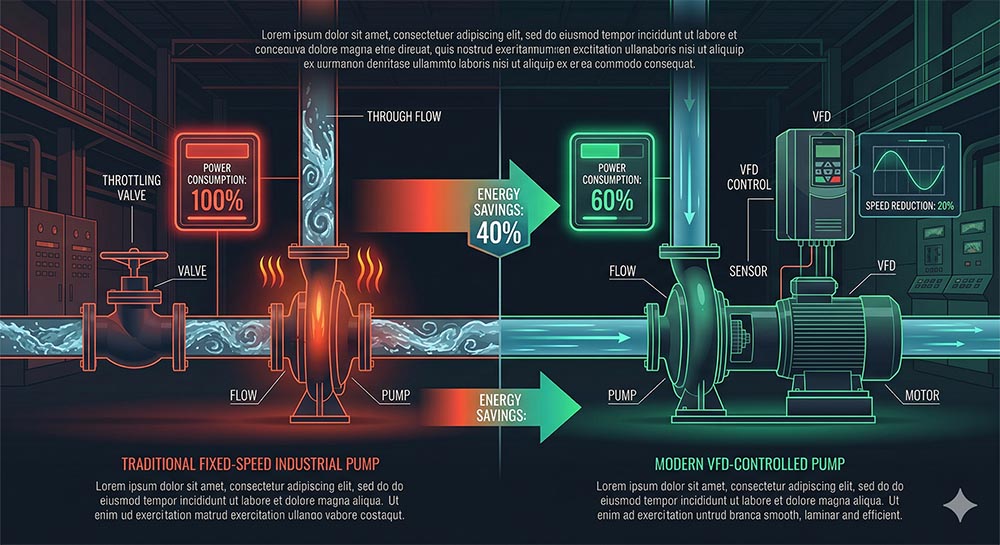
Did you know that the initial purchase price of an industrial pump accounts for a mere fraction of its total lifetime cost? Industry data consistently demonstrates that capital expenditure represents approximately 15% to 25% of the overall financial commitment. The remaining majority—often exceeding 75%—is consumed entirely by electricity and routine maintenance.
With global energy costs steadily escalating and industrial carbon emission regulations tightening ahead of the 2026 pump efficiency standards, operating a traditional fixed-speed pump system at maximum capacity around the clock is no longer a financially viable strategy. Facility directors and plant managers are under immense pressure to identify substantial cost-saving measures without compromising operational output.
The solution lies in precision control. By integrating Variable Frequency Drive (VFD) technology into your fluid management infrastructure, a VFD water pump system continuously matches your operational demand rather than forcing a constant maximum output. Discover how Stream Pumps utilizes this technology to help industrial facilities reduce pump electricity costs and save thousands of dollars annually.
Running a fixed-speed pump and using a control valve to reduce flow is fundamentally inefficient. This outdated methodology is identical to keeping a car's accelerator fully depressed while simultaneously applying maximum force to the brakes. The motor continues to draw full power from the electrical grid, but the desired output is artificially restricted through physical resistance.
This persistent resistance creates massive energy waste and significant mechanical stress throughout the entire system. Because the motor is constantly working against artificial backpressure, the electricity consumed does not translate into productive fluid movement. Instead, it converts into excess heat, vibration, and wasted capital.
The financial and operational consequences are severe. Facilities employing this method experience consistently high electricity bills and extreme wear on critical internal components. The excessive pressure buildup frequently leads to premature impeller degradation and regular mechanical seal failures, ultimately resulting in unscheduled downtime and expensive emergency repairs.
A Variable Frequency Drive (VFD) is a specialized electronic controller that directly adjusts the frequency and voltage supplied to the electric motor. This precise electronic adjustment allows the motor's speed (RPM) to continuously match the exact flow and pressure requirements of the system at any given second.
Instead of generating maximum pressure and choking it back with a valve, the motor simply slows down or speeds up to provide precisely what the facility requires.
The true power and exponential savings potential of an industrial water pump VFD reside within the centrifugal pump affinity laws. These physical principles govern the relationship between a pump's rotational speed, volumetric flow, pressure head, and power consumption.
According to the affinity laws, power required by a pump is proportional to the cube of its rotational speed. If you reduce the pump motor speed by a mere 20%, your energy consumption drops by an astonishing 50%. This is not an incremental gain but a massive, exponential reduction in overall energy expenditure.
This relationship demonstrates why utilizing a Stream Pumps energy audit to identify oversized pumps and inefficient systems is a crucial first step for maximizing your facility's operational budget ahead of upcoming 2026 pump efficiency standards
Address
No.17 XeDa Jimei Ind. Park, Xiqing Economic Development Area, Tianjin, China
Telephone
+86 13816508465
QUICK LINKS