+86 13816508465
Pump Knowledge
Apr. 28, 2026
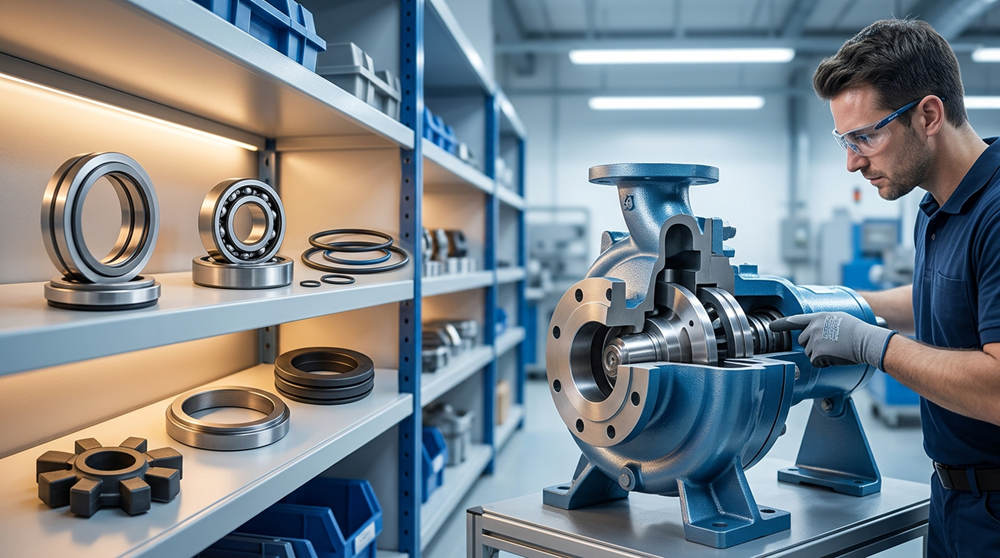
Heavy industry relies on water pumps to keep the entire production line moving. When a critical pump fails and the replacement part is nowhere to be found, the financial hit of unplanned downtime easily exceeds the price of the pump itself in mere hours.
Industrial pumps endure intense mechanical stress and continuous wear and tear. Waiting for a component to break before ordering a replacement guarantees an operational disaster. Plant managers and reliability engineers know that hope is not a valid maintenance strategy. You need a solid plan and a well-stocked inventory to protect your bottom line.
To help you achieve total reliability, Stream Pumps outlines the essential pump spare parts you must keep on your shelf. We also provide a bulletproof centrifugal pump maintenance schedule to keep your operations running smoothly around the clock.
Maintaining a stockpile of essential pump spare parts is the cheapest insurance policy your plant can buy. When a failure occurs, having these items on hand means the difference between a one-hour fix and a three-day shutdown. Here is your must-stock checklist for industrial pump spare parts and maintenance:
·Mechanical Seals (or Packing Rings): This is the most common failure point in any pumping system. Seals wear down continuously under normal operation. You must schedule a mechanical seal replacement immediately when leaking starts to prevent catastrophic shaft damage.
·Bearings: These components handle the entire rotational load of the machine. When a bearing starts to hum, vibrate, or generate excess heat, you are facing an imminent pump bearing failure. Its remaining lifespan is measured in days, if not hours. Always keep a matching set of bearings ready to go.
·O-Rings & Gaskets (Elastomers): Every time you open a pump casing for an internal inspection, the old rubber gaskets deform and lose their elasticity. You must have fresh O-rings available to ensure a perfectly watertight seal upon reassembly.
·Wear Rings: These rings protect the expensive impeller and heavy casing from rubbing directly against each other. Keeping fresh wear rings in stock allows you to restore pump efficiency instantly during a rebuild.
·Coupling Inserts (Spiders): The flexible rubber or polyurethane piece connecting the motor to the pump absorbs severe mechanical shock. They wear out regularly and require frequent replacement to protect the motor shaft.
You do not always need complex diagnostic tools to catch a problem early. A routine pump inspection relies heavily on the 【Look, Listen, Feel】 approach.
Walk the pump line and look for fluid leaks. A few drops per minute is acceptable for traditional packing, but mechanical seals should remain completely dry. Check all oil gauges to ensure lubricants sit at the correct levels.
Listen closely to the casing and motor. You might hear the distinct 【marbles in a blender】 sound, which indicates destructive cavitation. Alternatively, a high-pitched whine signals an early-stage bearing issue.
Carefully check the bearing housing temperature using a thermal gun or a cautious touch. The housing should be warm, never burning hot. Excessive heat points directly to friction issues or lubrication failure.
A proactive centrifugal pump maintenance schedule prevents minor wear from escalating into major damage. Focus on these critical areas every few months.
Greasing bearings and changing the oil in the bearing housing keeps metal components moving freely. Be highly precise with your grease application. Over-greasing is incredibly dangerous because the excess pressure blows out the mechanical seals, leading to immediate leaks.
Thermal expansion and pipe strain shift the pump and motor out of alignment over time. Use laser alignment tools to verify the connection between the pump and the motor. Poor alignment causes severe vibration, which destroys couplings and bearings rapidly.
Heavy vibration causes baseplate anchor bolts to back out. Take a wrench and tighten all bolts on the foundation to prevent vibration creeping, keeping the entire unit anchored solidly to the floor.
Once a year, your preventative maintenance program requires a deeper look into the health of your equipment.
Check the pump's current flow and head metrics against its original factory performance curve. If hydraulic efficiency has dropped by 10% or more, internal clearances have widened. It is time to open the casing and investigate.
Remove the casing to inspect the impeller for pitting caused by cavitation or chemical corrosion. Measure the clearance on the wear rings with feeler gauges to determine if they need replacing.
When buying replacement components, counterfeit parts actively destroy pumps. Cheap, third-party aftermarket seals or impellers might save a few dollars upfront, but a single millimeter difference in manufacturing tolerance ruins hydraulic efficiency. Always source Stream Pumps OEM parts to guarantee exact fits and original material specifications.
Furthermore, Stream Pumps designs industrial units specifically for ease of maintenance. Our pumps feature 【Back-Pull-Out】 structures, allowing your maintenance team to safely remove the rotating element and swap spare parts without disconnecting the main suction or discharge piping.
Preventative maintenance transforms unpredictable, late-night emergencies into planned, highly manageable tasks. Stocking the correct Stream Pumps OEM parts keeps your production line moving and protects your overall return on investment.
Is your spare parts shelf looking completely empty? Do not wait for a catastrophic failure to take action. Contact the Stream Pumps aftermarket support team today to order an OEM Recommended Spares Kit customized for your specific pump models.
Address
No.17 XeDa Jimei Ind. Park, Xiqing Economic Development Area, Tianjin, China
Telephone
+86 13816508465
QUICK LINKS