+86 13816508465
Pump Knowledge
Mar. 23, 2026
A failed water pump during a dry spell does not just cost you the price of a replacement part. A stalled irrigation system can easily cost you an entire season's yield. When the sun is beating down on your fields and the soil is drying out, every passing hour without water damages your bottom line. Water is the undisputed lifeblood of your harvest, and the equipment you use to move it must be entirely bulletproof.
Looking ahead to the reality of farming in 2026, relying on natural rainfall is no longer a viable business strategy. Weather patterns are shifting, and dry seasons are stretching longer than they have in previous decades. Precision irrigation has transitioned from a helpful luxury to an absolute mandate for commercial survival. Farmers and agricultural engineers must take total control of their water supply to guarantee consistent, high-quality crop production year after year.
That is exactly where Stream Pumps agriculture solutions come into play. We provide rugged, high-efficiency Agricultural Irrigation Water Pumps designed to deliver the exact pressure and volume your crops require. By matching the right equipment to your specific field conditions, you can minimize energy costs, reduce maintenance downtime, and secure your harvest against unpredictable weather.
Before you can think about the type of irrigation you want to use, you have to look at where your water is coming from. The source dictates the physical design of the pump you will need.
If your farm pulls water from a surface source like a nearby river, a retention pond, or an irrigation canal, you will primarily look at Surface irrigation pumps. Self-priming centrifugal pumps are often the go-to choice for these applications because they sit safely on the bank and draw water up through a suction hose. They are accessible, easy to maintain, and can handle a fair amount of debris if equipped with the right strainer.
Alternatively, pontoon-mounted floating pumps offer a brilliant solution for fluctuating water levels. As the pond or river rises and falls throughout the season, the floating pump adjusts automatically. This prevents the pump from running dry or losing suction, ensuring a steady flow of water to your fields regardless of the water level.
Many farms do not have the luxury of surface water and must rely on underground aquifers. When the water table sits far below the surface, centrifugal pumps simply cannot pull the water up. This scenario dictates the use of Deep well submersible pumps. Also known as borehole pumps, these cylindrical units are lowered directly into the well casing. Because they push water up from the bottom rather than pulling it from the top, they are incredibly efficient at lifting water from hundreds of feet below the ground.
Groundwater often carries fine sand and grit that acts like sandpaper on internal pump components. Standard impellers will degrade rapidly under these conditions, leading to a massive loss of pressure and eventual pump failure. Stream Pumps utilizes specialized sand-resistant impellers for all our well pumps. This critical feature allows the pump to easily pass abrasive materials without chewing up the internals, guaranteeing agricultural longevity and uninterrupted flow.
Once you know how you are getting the water out of the source, you have to determine how you are applying it to the crops. Different irrigation methods require vastly different flow rates (Gallons Per Minute, or GPM) and pressure levels (Total Dynamic Head).
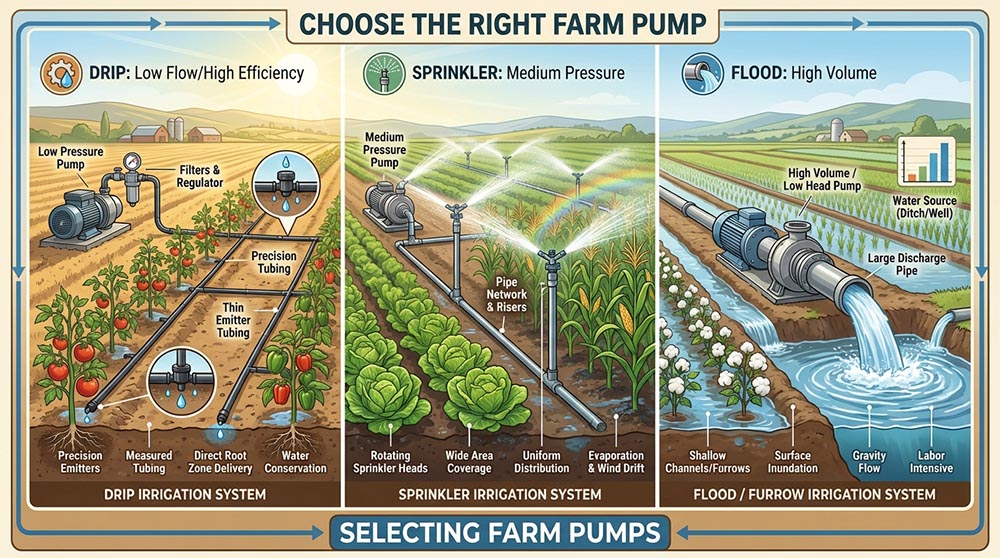
Drip irrigation is highly efficient, delivering water directly to the base of the plant to minimize evaporation. However, this method requires a very specific type of pump performance. You need relatively low flow, but you must maintain consistent, precise Drip irrigation pressure. The pump has to generate enough force to push water through miles of tiny plastic tubing and thousands of micro-emitters. If the pressure is too low, the plants at the end of the line will die of thirst. If the pressure spikes too high, the delicate emitters will burst. Your pump must hit that performance sweet spot perfectly.
Overhead sprinklers, impact rotors, and massive center pivot systems operate on a completely different principle. They are designed to throw water over large distances to cover massive acreage quickly. To achieve this throw distance, the system requires extremely high pressure, commonly referred to as high head. The pump selected for a center pivot must be robust enough to maintain high PSI across the entire length of the pivot arm, ensuring the outermost nozzles spray just as effectively as the nozzles closest to the center hub.
Flood irrigation is the oldest and simplest method of watering crops. Instead of relying on pressure to spray or drip water, you simply flood the field or trenches and let gravity do the work. This method requires moving massive amounts of water in a very short amount of time. Therefore, the ideal pump for flood irrigation needs an extremely high GPM capacity, but very low pressure. You are not trying to push water through tiny nozzles; you just need a massive volume of water poured onto the field as quickly as possible.
The best pump in the world is useless without a reliable power source. The layout of your farm and the availability of utilities will dictate how you drive your irrigation system.
If you have access to a reliable electrical grid at the pump site, electric motors are generally the most cost-effective and dependable option. Three-phase power is ideal for large Agricultural Irrigation Water Pumps, offering smooth, efficient operation with minimal maintenance. Electric pumps can easily be integrated into automated smart-farming systems, allowing you to turn your irrigation on and off remotely from a smartphone or control panel.
Farms often span thousands of acres, and running high-voltage power lines to a remote retention pond is prohibitively expensive. In these off-grid scenarios, diesel-driven pumps are the traditional workhorses. They provide massive power and can run continuously for days.
For maximum mobility and versatility, PTO tractor pumps are an incredible asset. Instead of maintaining a dedicated standalone diesel engine that sits idle for half the year, you simply back your tractor up to the pump, connect the Power Take-Off shaft, and use the tractor's engine to drive the water. This is an highly economical solution for farmers who need to move water across several different locations throughout the growing season.
The most exciting advancement in modern farming is the rapid adoption of Solar water pumps. As solar panel efficiency skyrockets and costs drop, off-grid farming has become much more accessible. A solar pump system completely eliminates daily fuel costs and protects your farm from volatile diesel prices. These systems pull energy directly from the sun during the hottest parts of the day—exactly when your crops need water the most. While the initial setup cost is higher, the return on investment is incredibly fast due to the zero-dollar fuel bills.
Selecting a pump that is 【close enough】 is a dangerous game. An improperly sized or poorly built pump will quietly drain your farm's profitability day after day.
If you install an oversized pump for your system, you are paying for electricity or diesel that you simply do not need. The pump will constantly fight against the system's backpressure, wasting massive amounts of energy. Conversely, an undersized pump will have to run twice as long to deliver the necessary water, wearing out the motor prematurely and driving up utility bills. Proper sizing is non-negotiable for agricultural efficiency.
Agricultural environments are unforgiving. Dust, mud, extreme heat, and freezing temperatures take a heavy toll on mechanical equipment. If your pump is built with cheap plastics or thin stamped metals, it will eventually crack under the pressure of commercial farming. Furthermore, agricultural pumps must be easy to service in the field with basic hand tools. You cannot afford to wait two weeks for a specialized technician to arrive when your crops are wilting.
We understand the brutal realities of commercial agriculture. That is why Stream Pumps agriculture solutions prioritize heavy-duty cast iron construction. Cast iron resists warping, dampens damaging vibrations, and stands up to the physical abuse of farm life. We also apply advanced corrosion-resistant coatings to our pumps, preventing rust from eating away at the casing during the damp off-season. Combined with our high-efficiency motors designed specifically for continuous agricultural duty, our pumps deliver reliable performance season after season.
To determine your necessary Gallons Per Minute, you must calculate the total water requirement of your specific crop, factoring in the soil type and average daily evaporation rates. You then multiply that requirement by the total acreage you intend to water simultaneously. Our Stream Pumps technicians can help you run these exact calculations based on your field dimensions.
Yes, modern solar systems are highly capable. While early solar pumps were only suitable for low-pressure drip or livestock tanks, today's advanced solar controllers and high-efficiency motors can easily generate the high head pressure required for commercial sprinkler systems.
While stainless steel offers excellent rust resistance, heavy-duty cast iron provides superior structural rigidity and vibration dampening. For massive, high-flow surface pumps that operate under heavy torque, cast iron ensures the pump casing will not flex, keeping internal bearings and seals perfectly aligned for a longer lifespan.
You should inspect the PTO shaft, universal joints, and safety shields before every single use. The pump's gearbox should have its oil checked monthly during the watering season, and the main pump seals should be inspected for leaks weekly. Always drain the pump casing completely before the first winter freeze to prevent cracked housings.
Do not let your irrigation system become the weak link in your farm's productivity. Water management is the single most critical factor in agricultural success, and your equipment must be up to the task. Matching your water source, your specific application method, and your available power supply is the key to unlocking maximum crop yield while minimizing overhead costs.
Gearing up for the next planting season? Let our agricultural experts help you size the perfect system. Contact Stream Pumps today with your field dimensions and water source, and we will engineer a custom irrigation solution tailored specifically to your farm.
Address
No.17 XeDa Jimei Ind. Park, Xiqing Economic Development Area, Tianjin, China
Telephone
+86 13816508465
QUICK LINKS