+86 13816508465
Pump Knowledge
Mar. 18, 2026
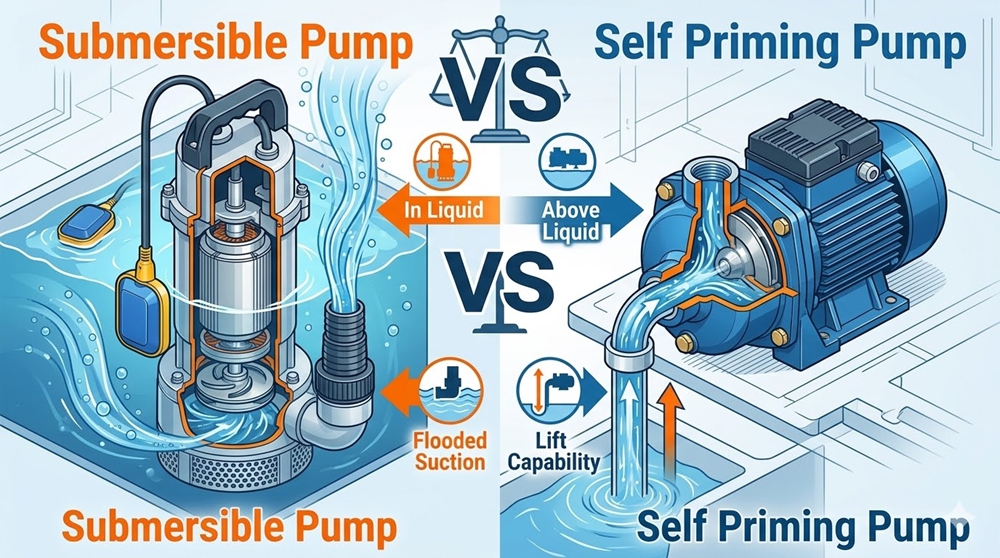
You need to move a massive volume of water to keep your facility operational. The engineering challenge immediately presents a fundamental choice: should you drop the pump directly into the fluid, or place the pump above ground and pull the water up to it? This decision dictates system design, energy consumption, and maintenance protocols for years to come.
At the core of this engineering dilemma is how each technology interacts with the fluid. A submersible pump operates underwater, pushing the liquid upward through the discharge piping. Conversely, a self-priming surface pump sits above the fluid source, utilizing an internal reservoir to evacuate air from the suction line and atmospheric pressure to push water up into the pump casing.
Selecting the correct equipment requires a careful analysis of site conditions, fluid properties, and long-term operational costs. Municipal engineers, plant managers, and procurement officers must weigh physical limitations against maintenance accessibility.
This pump selection guide outlines the mechanics, advantages, and limitations of both configurations. By examining key operational factors, you can determine the exact requirements for your application and secure the ideal Stream Pumps industrial solutions for your facility.
A submersible pump is designed to operate completely submerged in the fluid it is moving. The motor is hermetically sealed and close-coupled to the pump body. Because the entire unit sits below the fluid level, the system operates by pushing the fluid directly toward the discharge point, entirely eliminating the need for a suction line.
High Operational Efficiency
Submersible systems achieve exceptionally high energy efficiency. Pushing a fluid requires significantly less energy than drawing it upward against gravity. Because the pump is submerged, fluid naturally flows into the impeller eye under positive pressure. The motor dedicates its power exclusively to generating discharge head, reducing overall energy consumption.
Zero Priming Requirements
By definition, a submerged pump is always filled with fluid. It never requires manual priming, nor does it rely on internal recirculation chambers to evacuate air. The system is instantly ready to operate the moment the motor is energized, making it highly reliable for automated start-stop applications.
Cavitation Prevention and NPSH
One of the most critical factors in fluid dynamics is Net Positive Suction Head (NPSH). Cavitation occurs when the absolute pressure of the fluid at the pump inlet drops below its vapor pressure, causing localized boiling. The resulting vapor bubbles collapse violently against the impeller, causing severe erosion and vibration.
A submersible pump virtually eliminates this risk. Because the unit is submerged, the static weight of the fluid provides a constant, positive inlet pressure. The NPSH Available (NPSHa) remains consistently higher than the NPSH Required (NPSHr), ensuring smooth, cavitation-free operation even during heavy continuous use.
Quiet Operation and Security
Water is an excellent sound insulator. Operating a heavy-duty motor underwater drastically reduces acoustic noise, which is a vital consideration for installations near residential areas or inside enclosed facilities. Furthermore, a submerged pump is safely hidden below ground level, protecting it from vandalism, tampering, and extreme weather events.
Submersible Pump Maintenance Challenges
The primary drawback of a submerged system is accessibility. Submersible pump maintenance requires specialized lifting equipment to pull the heavy unit out of the wet pit. This process demands careful safety protocols, and any routine inspection requires bringing the equipment to the surface.
Furthermore, because the motor operates underwater, mechanical seal failure can allow fluid to enter the motor housing, leading to catastrophic electrical shorts.
A self-priming centrifugal pump is positioned above ground, adjacent to the fluid source. While standard centrifugal pumps become air-bound and cease to function if air enters the suction line, a self-priming model contains a built-in fluid reservoir. During the initial startup cycle, the pump mixes this retained fluid with the air in the suction line, creating a pumpable mixture. It discharges the air, retains the liquid, and gradually creates a vacuum until atmospheric pressure forces the fluid up the suction pipe and normal pumping begins.
Easy Access for Maintenance
The most significant advantage of a self-priming pump is surface-level accessibility. Maintenance teams can inspect the pump, clear blockages, adjust clearances, and replace wear parts without confined space entry or heavy lifting equipment. This drastically reduces downtime and lowers routine maintenance costs.
Safer Electrical Access
Because the pump and motor are installed safely above the wet pit, operators do not have to worry about submerged electrical cables or motor flooding. Routine electrical testing and motor maintenance occur in a dry, controlled environment.
Surface Pump Disadvantages and Limitations
Despite the convenience of surface installation, self-priming pumps face strict limitations dictated by the laws of physics.
A pump does not technically pull water. It creates a low-pressure zone at the impeller eye, and atmospheric pressure pushes the fluid up the suction pipe. At sea level, atmospheric pressure can only support a theoretical column of water 34 feet high. Factoring in friction losses, fluid temperature, and mechanical inefficiencies, the practical suction lift limit for any self-priming pump is approximately 7 to 8 meters (25 feet). Attempting to exceed this lift results in immediate cavitation and loss of flow.
Additionally, self-priming units are highly susceptible to air leaks. The suction piping operates under negative pressure. If a pipe joint develops a pinhole leak, or if the system relies on a faulty foot valve that allows fluid to drain back into the sump, the pump will lose prime. Running a pump dry while attempting to re-prime will quickly generate excess heat, destroying the mechanical seals and internal components.
Finally, operators must account for freezing risks. Because self-priming pumps must retain water in their casing to function, plunging winter temperatures can cause the trapped water to freeze. The expanding ice generates immense force, which will easily crack the cast iron pump casing. Proper winterization and casing drainage are mandatory in cold climates.
To simplify your pump selection process, evaluate how each technology aligns with these four operational parameters.
Energy Efficiency: Submersible wins. Pushing fluid upward from a submerged position utilizes motor energy far more efficiently than attempting to lift fluid via suction. Submersible units experience lower friction losses and generally consume less electricity over their operational lifespan.
Maintenance Costs: Self-priming wins. Surface installation allows technicians to access the pump housing, motor, and internal components immediately. There is no need to deploy a crane or expose workers to hazardous wet-pit environments to perform routine checks.
Space Requirements: Submersible wins. A fully submerged unit requires zero above-ground footprint. This makes it the ideal choice for retrofitting tight urban spaces or expanding facilities where surface real estate is unavailable.
Versatility: Tie. Both pump types are available with varying impeller designs to handle different specific gravities, viscosities, and solid sizes. The right choice depends entirely on the layout of your pumping station rather than the fluid itself.
Choosing the right equipment means aligning the pump's strengths with your specific environmental constraints.
Choose Submersible Pumps When:
Deep Sewage Pits and Lift Station Pumps: When the vertical distance from the fluid surface to the ground exceeds 25 feet, suction lift is impossible. Submersibles easily handle deep municipal lift stations.
Noise-Sensitive Areas: Submerged pumps are acoustically isolated, making them necessary for hospital grounds, residential developments, and commercial architectural fountains.
High-Volume Continuous Duty: Applications requiring maximum energy efficiency over long continuous runs benefit from the direct pushing power of a submerged impeller.
Choose Self-Priming Pumps When:
Shallow Ponds and Sumps: If the vertical lift is comfortably under 20 feet, surface pumps provide a highly economical and accessible solution for fluid transfer.
Mobile Dewatering: Construction sites and agricultural operations require portable skid-mounted or trailer-mounted pumps that can be quickly moved, connected to a suction hose, and operated.
Chemical Processing: Pumping caustic or highly corrosive fluids requires frequent monitoring. Keeping the motor and housing above ground protects operators and allows for immediate visual inspection of mechanical seals.
Strict Safety Environments: Facilities that prohibit wet-pit entry or lack the overhead infrastructure for hoists rely on surface pumps to keep maintenance personnel out of danger.
What happens if a self-priming pump loses prime?
If a self-priming pump loses prime due to a suction line leak or foot valve failure, it will run dry. Without the cooling and lubricating properties of the fluid, the friction on the mechanical seals will rapidly generate heat, leading to premature seal failure and potential shaft damage.
Can a submersible pump run dry?
Most submersible pumps rely on the surrounding fluid to cool the motor. Extended dry running will cause the motor to overheat and trip its thermal overload protection. However, some advanced models are designed with internal cooling jackets that allow them to operate partially submerged for extended periods.
How do I calculate Net Positive Suction Head Available (NPSHa)?
NPSHa is calculated by adding the atmospheric pressure and the static head (if the fluid level is above the pump), then subtracting the fluid's vapor pressure and the friction losses in the suction piping. To prevent cavitation, your calculated NPSHa must always be greater than the manufacturer's specified NPSHr.
There is no inherently flawed pump design, only the wrong application of technology. Choosing between a submersible setup and a self-priming surface unit directly dictates your facility's energy bills, maintenance schedules, and system reliability for the next decade.
Submersible units offer unbeatable efficiency, eliminate suction lift limits, and operate quietly out of sight. Self-priming surface pumps grant unparalleled maintenance access and keep electrical components away from submerged hazards. By accurately measuring your required lift, evaluating your maintenance capabilities, and understanding NPSH requirements, you can secure a system that performs optimally under stress.
Still torn between a submersible and a self-priming setup? Let the experts do the math. Contact the Stream Pumps engineering team for a free application assessment and get the perfect match for your fluid system.
Address
No.17 XeDa Jimei Ind. Park, Xiqing Economic Development Area, Tianjin, China
Telephone
+86 13816508465
QUICK LINKS