+86 13816508465
Pump Knowledge
Apr. 27, 2026
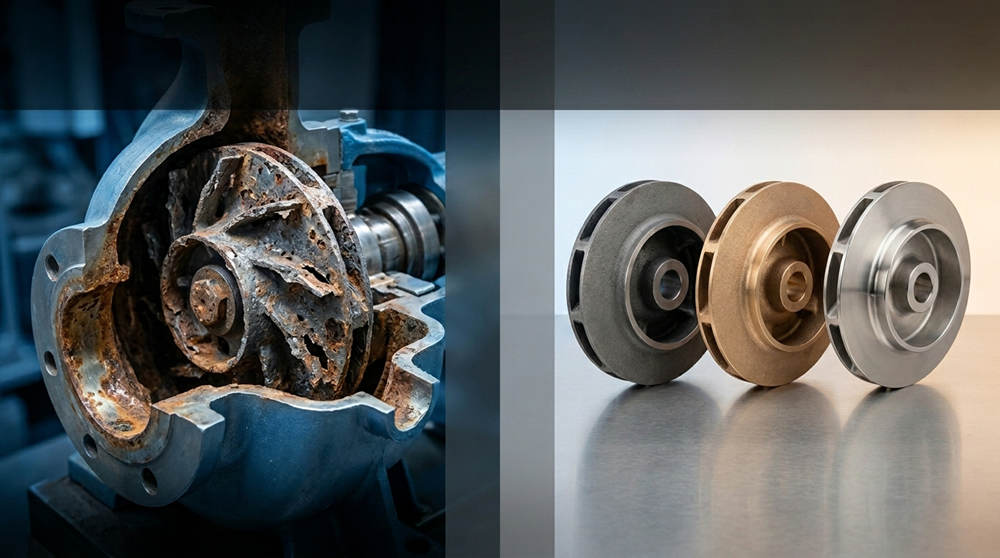
The impeller is the only moving part of a centrifugal pump that constantly makes high-velocity contact with your fluid. If you select the wrong metal for this critical component, the fluid will literally eat the impeller alive through corrosion or abrasion. This metallurgical mismatch is a frequent and costly engineering failure in industrial fluid management.
A dissolved impeller leads to a catastrophic loss of pressure, unexpected system downtime, and potential contamination of your entire product batch. When an impeller fails, the entire processing line comes to a halt. Procurement engineers and plant managers must evaluate chemical fluid compatibility long before the pump is installed to avoid these highly expensive disruptions.
Stream Pumps breaks down the metallurgy of the three most common impeller materials—Cast Iron, Bronze, and Stainless Steel—to help you match the exact right metal to your specific fluid dynamic needs. By understanding the core properties of each material, you can optimize your pump impeller material selection and ensure long-term reliability for your facility.
Cast iron remains one of the most widely used materials in industrial pump manufacturing. It provides an excellent baseline for standard fluid transfer applications where chemical aggressiveness is low.
Cast iron impellers are best suited for clean municipal water, standard agricultural irrigation, and heavy industrial wastewater with neutral pH levels. Facilities moving large volumes of non-corrosive liquids frequently rely on cast iron for its predictability and strength.
This material is extremely cost-effective, making it a budget-friendly option for large-scale operations. It is highly durable against general physical impact and features an excellent capacity for dampening vibration. This vibration resistance helps extend the life of the pump bearings and mechanical seals during heavy-duty operations.
The primary weakness of cast iron is that it rusts. It cannot be used for drinking water under many modern building codes, nor can it handle highly acidic fluids or seawater. Furthermore, cast iron is significantly heavier than other alloys. This added mass requires more starting torque from the motor, which can increase electrical consumption over the pump's lifecycle.
When evaluating a cast iron vs bronze impeller, engineers must look at the specific environmental conditions of the installation. Bronze offers distinct metallurgical advantages for specific industries, particularly those dealing with saltwater or temperature-controlled loops.
Bronze is the standard choice for a marine water pump. It is highly effective for seawater circulation, ship engine cooling systems, and commercial HVAC chilled or hot water loops.
Bronze provides exceptional resistance to saltwater corrosion and brine. Unlike cast iron, bronze naturally develops a protective patina when exposed to seawater, preventing deep structural corrosion. Additionally, bronze is a "non-sparking" metal. This characteristic makes it a much safer choice in explosive or flammable environments, such as oil rigs or chemical processing plants where safety protocols are strict.
Bronze is a relatively soft metal. If your fluid contains abrasive particles, such as heavy sand, silt, or grit, the abrasive material will quickly wear down the impeller vanes. Once the vanes lose their precise engineered shape, the pump loses its efficiency, requiring premature replacement.
For environments demanding absolute purity and maximum chemical resistance, stainless steel is the undisputed champion. It is the metal of choice for engineers who cannot compromise on fluid integrity.
A 316L stainless steel pump is essential for Reverse Osmosis (RO) systems, Food & Beverage processing, Pharmaceuticals, and aggressive chemical processing. Whenever a sanitary pump impeller is required by regulatory agencies, stainless steel is the default specification.
Stainless steel offers ultimate corrosion and chemical resistance. Stream Pumps uses 316L stainless steel for its sanitary and CDLF multistage lines because this specific alloy effortlessly handles caustic cleaning chemicals utilized in Clean-In-Place (CIP) processes. It completely prevents rust from contaminating the fluid, ensuring total batch purity. Furthermore, stainless steel is incredibly strong yet lightweight. This high strength-to-weight ratio reduces motor strain and improves overall mechanical efficiency.
The main drawback of a corrosion resistant impeller made from high-grade stainless steel is the higher initial upfront cost. However, it consistently delivers the best long-term return on investment in harsh environments by eliminating the need for frequent replacements and preventing costly system shutdowns.
While metals dominate the industrial sector, engineered plastics deserve an honorable mention for their unique chemical properties.
Thermoplastics and composites are highly effective for swimming pools, commercial spas, and specific highly corrosive chemical transfers where even high-grade metals might degrade.
Glass-reinforced plastics are entirely immune to chlorine and saltwater. This total chemical immunity is exactly why Stream Pumps utilizes advanced composites for premium aquatic pump applications. They are lightweight, completely rust-proof, and highly cost-effective for the right low-pressure applications.
To simplify your pump impeller material selection, use this quick engineering checklist before finalizing your procurement order:
What is the fluid's pH and salinity?
Determine the exact chemical makeup of your fluid. High salinity or acidity mandates the use of Bronze or Stainless Steel, ruling out standard Cast Iron immediately.
Are there abrasive solids in the fluid?
Evaluate the particulate content. Abrasive grit eliminates soft Bronze from consideration and heavily favors hardened Stainless Steel or robust Cast Iron.
Are there FDA or sanitary requirements?
Check your regulatory compliance standards. Food, beverage, and pharmaceutical applications mandate a sanitary environment, strictly requiring 316L Stainless Steel.
High temperatures can alter the structural integrity and chemical resistance of certain materials. For example, thermoplastics may deform under extreme heat, whereas metals like stainless steel maintain their strength and corrosion resistance at much higher temperature thresholds.
In many cases, yes. If you are experiencing rapid wear or corrosion with a cast iron impeller, you can often work with the manufacturer to retrofit the pump with a bronze or stainless steel impeller, provided the housing and motor specifications align.
While 304 stainless steel is highly durable, 316L contains molybdenum. This addition drastically increases the metal's resistance to chlorides and harsh industrial solvents, making it significantly more reliable for sanitary and chemical applications.
There is no universal [best] material in pump manufacturing—there is only the best material for your specific fluid dynamics. A highly expensive stainless steel impeller might be overkill for standard irrigation, while a cheap cast iron impeller will rapidly ruin a million-dollar piping system if exposed to acidic chemicals. Accurate Stream Pumps materials selection is the definitive key to a reliable, efficient processing facility.
Pumping harsh chemicals, seawater, or sanitary food products? Ensure your pump is armored with the right metallurgy. Contact the Stream Pumps engineering team for a fluid compatibility analysis and custom pump quote today.
Address
No.17 XeDa Jimei Ind. Park, Xiqing Economic Development Area, Tianjin, China
Telephone
+86 13816508465
QUICK LINKS