+86 13816508465
Pump Knowledge
Apr. 27, 2026
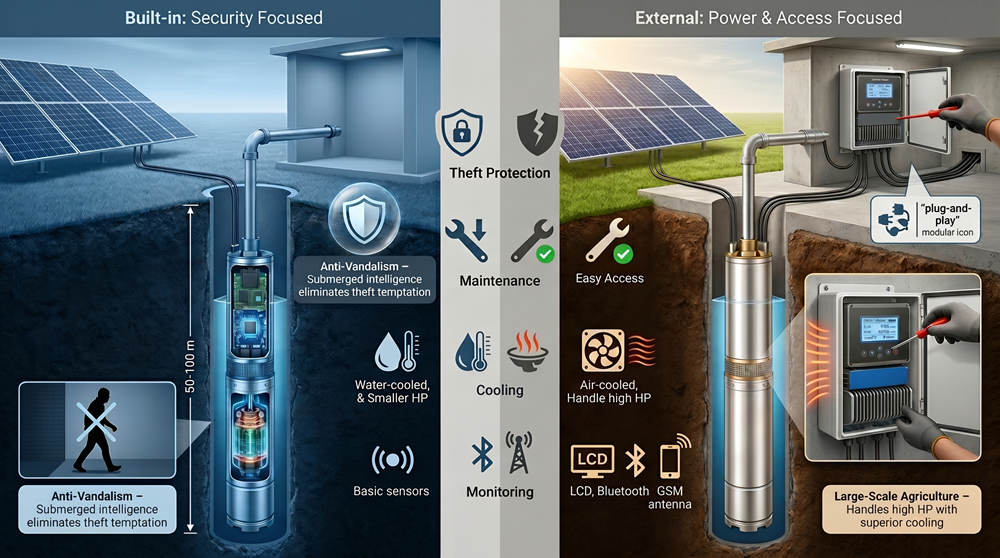
You can buy the best solar panels on the market and the most rugged water pump in the world, but without a high-quality controller, your off-grid system is practically useless. The controller acts as the [brain] of the entire operation. It translates raw, fluctuating sunlight into smooth, reliable pumping power.
As solar technology advances rapidly, manufacturers now offer two distinct architectural designs for off-grid irrigation 2026 projects. You can place the MPPT controller inside the submersible motor, known as a built-in or integrated design. Alternatively, you can mount it in a metal box above ground, known as an external or surface mounted pump controller.
Deciding between a built-in vs external solar pump controller is a critical choice for any project manager. Stream Pumps renewable energy experts break down the pros, cons, and real-world scenarios for both designs. We want to help you specify the most reliable system for your remote agricultural site or community water project.
Before comparing the two designs, it helps to understand what an MPPT solar inverter actually accomplishes out in the field. The controller is far more than a simple on-and-off switch. It is a highly sophisticated piece of power management technology designed to keep your water flowing under highly variable environmental conditions.
MPPT stands for Maximum Power Point Tracking. As clouds pass overhead, or as the sun changes angles throughout the long day, the energy output from your solar panels fluctuates constantly. An MPPT controller monitors this changing energy continuously. It instantly adjusts the voltage and current to keep the pump running at peak efficiency.
This ensures the motor does not stall when a shadow falls across the solar array. Without an MPPT solar inverter, a slight drop in sunlight could cause the pump motor to stop completely. With MPPT technology, the system simply slows down gracefully, continuing to deliver whatever water volume the available sunlight allows.
Beyond maximizing power, the controller acts as the ultimate bodyguard for your pump investment. It provides dry-run protection, instantly shutting down the motor if the borehole runs out of water. This prevents the motor from spinning dry, overheating, and permanently burning out.
It also offers over-voltage defense to protect the sensitive internal electronics from sudden power spikes caused by grid fluctuations or static buildup. Furthermore, phase-loss protection ensures the motor receives a perfectly balanced electrical supply. By acting as a shield against these common electrical and environmental hazards, the controller extends the lifespan of your entire pumping system.
For many years, the standard approach was to keep all electronics above ground. However, modern engineering has made it possible to shrink the required circuitry significantly.
In this specific design, the micro-inverter is sealed directly inside or just above the submersible pump motor. The entire electronic control unit sits deep underwater inside the borehole, right alongside the mechanical pumping components.
For NGO project managers and agricultural engineers working in Africa, the Middle East, and Latin America, solar borehole pump theft prevention is a massive, daily challenge. Above-ground solar equipment is highly vulnerable to theft and vandalism. When a surface controller is stolen, a community loses its access to drinking water, and a farmer loses their entire crop to drought.
A controller sitting 200 feet underwater is virtually impossible to steal. Thieves routinely target surface boxes because they can be removed quickly with basic hand tools. However, they cannot easily pull a heavy, water-filled pump out of a deep well without specialized lifting equipment and hours of labor.
Stream Pumps understands this local challenge perfectly. We recognize that laboratory engineering means absolutely nothing if the equipment gets stolen on the first night of deployment. An integrated solar pump eliminates the most vulnerable, high-value target on your site, providing incredible peace of mind for off-grid farmers and global project managers.
These systems are incredibly easy to install, making them highly favored by contractors working in remote locations. You simply connect the solar panel wires directly to the pump cable at the surface. There are no complex wiring boxes, no delicate surface connections to configure, and no lengthy programming sequences required before you can start pumping water.
Because the controller is submerged in cool well water, it remains completely immune to harsh surface environments. It does not suffer from extreme desert heat, destructive sandstorms, or torrential monsoon rains. The surrounding well water naturally regulates the temperature of the internal electronics, providing a stable operating environment year-round.
The primary drawback becomes apparent during solar pump troubleshooting. If the electronic controller experiences a failure, a technician must pull the entire heavy pump out of the well to repair or replace the unit. This often requires a heavy-duty winch, a tripod, and a dedicated crew of workers.
Additionally, because the electronics are confined to a very small, tightly sealed space, this design is generally limited to lower horsepower models. You will typically find built-in controllers on pumps under 3 HP. Pushing higher wattages through a tiny underground space creates excessive heat that the surrounding water cannot dissipate fast enough.
While built-in designs offer incredible security, traditional surface-mounted controllers remain the backbone of large-scale agricultural operations worldwide.
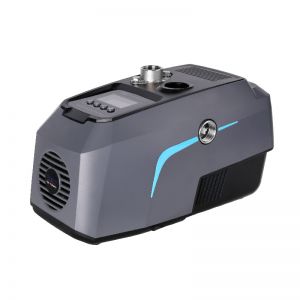
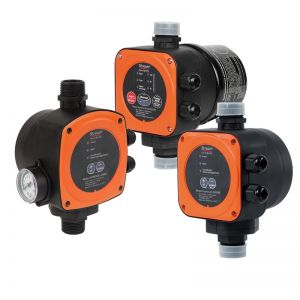
In this traditional architecture, the inverter is housed in a rugged, IP65-rated metal or plastic enclosure. This weather-resistant box is securely mounted on a pole, a frame, or a wall near the solar panel array, safely above ground.
When a system stops pumping water, rapid accessibility is critical. If a fuse blows, a wire comes loose, or the MPPT solar inverter experiences a fault, a technician can fix it on the surface in five minutes. They simply open the box, diagnose the error code, and swap out the necessary component. They do not need a crane, a winch, or a crew of workers to pull the pump out of the borehole.
Surface mounted pump controllers are absolutely essential for massive agricultural pumps ranging from 5 HP up to 50 HP and beyond. High-horsepower pumping generates a massive amount of electrical heat. Surface boxes can utilize large aluminum heat sinks, internal ventilation spacing, and high-speed cooling fans to manage this heat effectively. If you need to move massive volumes of water for commercial farming, you must use an external controller.
Modern external controllers often feature bright LCD screens, Bluetooth connectivity, and GSM modules for cellular communication. Operators can walk directly up to the box and see exact RPM, voltage, amperage, and water flow data in real-time. This makes system optimization incredibly straightforward and allows for advanced remote monitoring from a smartphone or central control room.
External controllers are highly vulnerable to their immediate environment. They constantly face extreme surface temperatures, direct ultraviolet radiation, lightning strikes, and dust accumulation.
Most critically, they are a prime target for vandalism and theft. If you install a surface controller in a remote area, you must house it inside a heavily secured, locked compound. You must also build robust steel cages around the enclosures, which adds significant time and cost to your initial installation budget.
To make specifying your next project easier, here is a quick-reference guide comparing the built-in vs external solar pump controller architectures across four critical project metrics:
Built-in wins this category easily. With fewer components and no complex surface wiring enclosures to assemble, contractors can get water flowing much faster. You simply splice the drop cable, lower the pump, and connect it to your solar array.
External wins this category. All electronic components are immediately accessible for testing and replacement. You can perform complex solar pump troubleshooting with a standard multimeter without ever touching the heavy plumbing infrastructure hidden underground.
Built-in wins hands down. Submerging the [brain] deep underground provides unbeatable solar borehole pump theft prevention. It removes the temptation for opportunistic thieves and protects your most valuable electronic assets from local vandalism.
External wins this category. The advanced surface cooling capabilities allow these controllers to handle the massive electrical loads required for deep well irrigation and commercial crop management.
Choosing the right system requires analyzing your specific local environment, your water volume requirements, and your security realities.
You should opt for an integrated solar pump when working on remote community drinking water wells or unattended livestock watering stations in open pastures. If you operate in a region with high equipment theft rates, the built-in design is your absolute best defense. Stream Pumps highly recommends this architecture for remote NGO projects where round-the-clock security cannot be guaranteed. It provides the highest likelihood of long-term project survival in challenging socio-economic environments.
You should select a surface mounted pump controller for heavily guarded commercial farms and large-scale deep well irrigation systems. If your project demands high horsepower (above 3 HP) or requires complex sensors and remote digital monitoring, the external architecture provides the necessary capacity and accessibility. This is the optimal choice when your site has high fences, security guards, and dedicated maintenance staff ready to perform routine surface repairs.
The best controller design depends entirely on your local environment, your specific security situation, and your total power requirements. There is no single correct answer, only the right answer for your unique borehole. Both architectures play a vital role in the future of off-grid irrigation 2026 initiatives, and understanding their strengths allows you to build highly resilient water infrastructure.
Planning a solar water project and unsure which architecture fits your local conditions? Stream Pumps renewable energy experts offer premium options in both Built-in and External designs. Contact our team today for a free project consultation.
Address
No.17 XeDa Jimei Ind. Park, Xiqing Economic Development Area, Tianjin, China
Telephone
+86 13816508465
QUICK LINKS