+86 13816508465
Pump Knowledge
Apr. 27, 2026
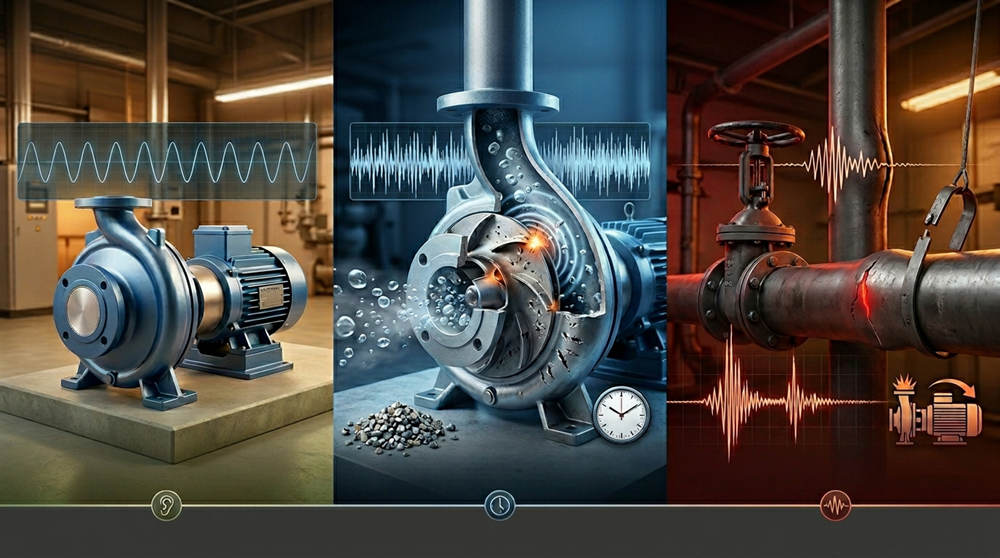
A healthy centrifugal pump should produce a smooth, consistent hum. It acts as the steady heartbeat of your facility, quietly moving fluids exactly where they need to go. But if your pump room sounds like someone is shaking a coffee can full of gravel, or violently hitting the pipes with a sledgehammer, you are facing a critical fluid dynamics emergency. These are not just annoying noises to ignore or cover up with earplugs. They are the acoustic signatures of immense physical forces actively destroying your expensive metal equipment.
Facility managers, maintenance technicians, and plant engineers often confuse the two most destructive forces in commercial plumbing: water hammer vs cavitation. Because they both produce terrifying sounds and intense vibrations, diagnosing the root cause can feel like guesswork. However, treating one specific issue will not fix the other. If you misdiagnose the problem, you will waste thousands of dollars replacing parts while the underlying physics continue to tear your system apart.
This guide will teach you exactly how to identify these terrifying noises through pump noise troubleshooting. You will understand the brutal physical mechanics behind the destruction. Most importantly, you will discover how Stream Pumps reliability and engineering solutions can safeguard your entire pipe network from catastrophic failure.
If you stand near your pump and hear a continuous, loud crackling noise echoing directly inside the pump casing, you are dealing with cavitation. It literally sounds like the machine is trying to chew up marbles, gravel, or crushed ice.
Many technicians mistakenly believe this sound is caused by air getting into the lines. It is not air. It is the water actually boiling at room temperature.
When the pressure at the pump's suction drops dangerously low, the liquid reaches its vapor pressure and instantly turns into tiny vapor bubbles. As these microscopic bubbles travel through the pump and hit the high-pressure side of the spinning impeller, they collapse. They do not just pop gently; they implode violently. The force of this implosion generates microscopic shockwaves that strike the metal surfaces of your pump with devastating power.
These micro-explosions are strong enough to blast microscopic chunks of metal directly off the impeller. Over a few short months, a brand-new, expensive impeller will look like it was eaten by corrosive acid or shot at close range with a shotgun. This phenomenon causes massive NPSH pump damage, destroying the hydraulic efficiency of the pump and severely compromising mechanical seals due to the intense, high-frequency vibration.
While cavitation sounds like chewing gravel, water hammer sounds like a gunshot. You will hear a sudden, violent [BANG] or a series of massive, heavy thuds that forcefully shake the entire piping system. This terrifying noise almost always happens right when the pump turns off or when a valve suddenly snaps shut.
Water is incredibly heavy, and unlike gas, it cannot be compressed. Imagine a fast-moving freight train made entirely of solid liquid rushing through a pipe. If a valve snaps shut suddenly, all that kinetic energy has nowhere to go. It crashes violently against the closed valve, sending a high-pressure shockwave backward through the pipes at the speed of sound. This massive spike in pressure is called hydraulic shock.
Loud banging pipes are a symptom of a system under immense mechanical stress. Water hammer will easily cause burst pipes, blow out heavy-duty gaskets, snap sturdy pipe hangers right off the walls, and even crack solid cast-iron pump casings. A single severe instance of check valve water hammer can permanently disable a critical facility system.
When the pump room is vibrating and noises are echoing off the walls, you need to diagnose the problem quickly. Use this matrix to instantly tell water hammer vs cavitation apart:
Timing: Cavitation happens continuously the entire time the pump is running. Water hammer happens suddenly and violently during a system change (starting the pump, stopping the pump, or a valve closing).
Location: Cavitation noise is highly localized. It sounds like gravel shaking directly inside the pump casing (the volute). Water hammer shakes the entire length of the piping system, with bangs echoing far down the line.
Vibration: Cavitation causes a high-frequency, buzzing vibration that quickly destroys mechanical seals and bearings. Water hammer causes aggressive, violent physical movement of the pipes themselves.
To stop a pump from sounding like gravel, you must address the fluid dynamics at the suction side.
Fixing cavitation is entirely about correcting your Net Positive Suction Head (NPSH). In plain terms: you must feed the pump more water. The pump is starving, causing the pressure to drop and the water to boil. You can correct this by thoroughly cleaning blocked suction strainers, increasing the suction pipe diameter to reduce friction loss, or physically moving the pump closer to the water source to increase the flooded suction.
Sometimes, facility layouts make perfect suction piping impossible. This is where Stream Pumps reliability shines. Stream Pumps specifically designs impellers with extremely low NPSHr (Net Positive Suction Head required). By upgrading to a Stream Pumps impeller, you make your system highly resistant to cavitation, even in older facilities with poor piping installations.
To stop pump vibration and silence loud banging pipes, you must control the momentum of the moving water.
The most effective way to eliminate hydraulic shock is by pairing your system with a Stream Pumps Variable Frequency Drive (VFD). A VFD gives you absolute control over the motor's speed. Instead of the pump violently cutting off and slamming the water column to a halt, the VFD programs a [soft stop.] It slowly ramps down the motor over 10 to 15 seconds. This allows the heavy water column to lose its momentum gently, completely eliminating the conditions that cause water hammer.
If a VFD upgrade is not immediately possible, you must rely on mechanical dampening. This includes installing slow-closing actuated valves that prevent sudden stops, sizing and placing water hammer arrestors to absorb the shockwaves, and utilizing high-quality silent check valves that close smoothly before the flow can forcefully reverse.
Ignoring these terrifying sounds is a guaranteed recipe for a catastrophic system failure and a flooded facility. Your equipment is actively communicating with you. A sound like chewing gravel means your pump is starving and destroying its impeller. A sound like a gunshot means a massive hydraulic shockwave is testing the physical limits of your pipes. Listen to your pump—it is telling you exactly what is wrong.
Are you battling mysterious pump noises or constantly repairing blown gaskets? Let the fluid dynamics experts diagnose your system before a pipe bursts. Contact the Stream Pumps engineering team for elite troubleshooting support and advanced system upgrades today.
Address
No.17 XeDa Jimei Ind. Park, Xiqing Economic Development Area, Tianjin, China
Telephone
+86 13816508465
QUICK LINKS