+86 13816508465
Jul. 23, 2026
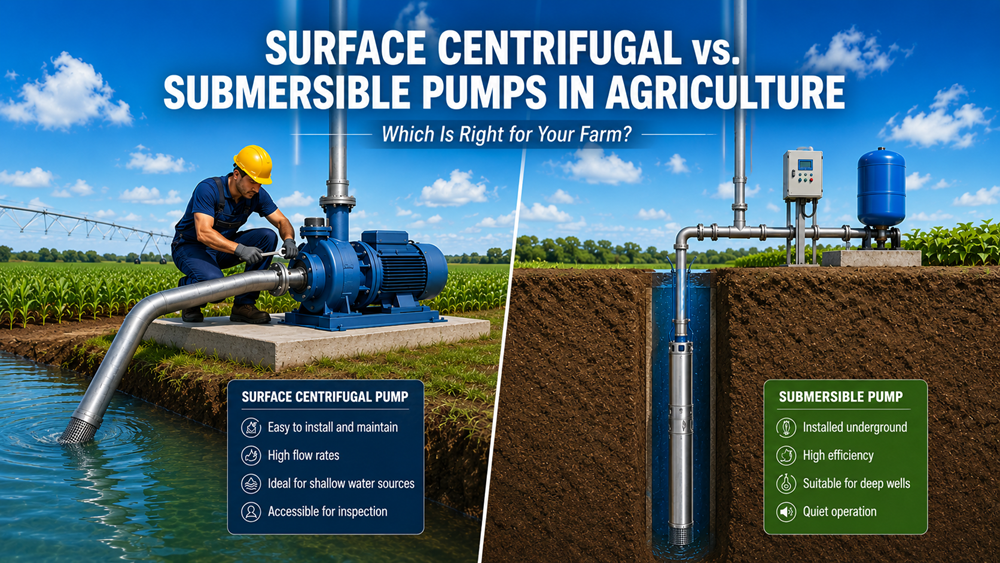
Surface centrifugal pumps are best for farms drawing from shallow water sources such as ponds, rivers, or canals, offering easy maintenance and lower upfront costs. Submersible pumps are the correct choice for deep groundwater and borehole applications, delivering superior energy efficiency and reliable performance at depth. The right choice depends primarily on your water source.
Water is agriculture's most critical resource. Without a reliable, efficient supply, even the most fertile land underperforms. Yet for many farm owners and irrigation engineers, the decision between a surface centrifugal pump and a submersible pump receives far less attention than it deserves—often resulting in equipment mismatches that drive up energy costs, reduce crop yields, and create unnecessary maintenance burdens.
These two pump types are not interchangeable. Each is engineered to serve a specific set of conditions, and selecting the wrong one for your water source or irrigation method can have measurable consequences for operational efficiency and long-term return on investment.
This article provides a detailed, objective comparison of surface centrifugal pumps and submersible pumps as applied to agricultural irrigation. The analysis covers operating principles, key advantages and limitations, suitability by water source, and compatibility with different irrigation methods. Tianjin Streampumps Industry Co., Ltd—an agricultural pump manufacturer with over two decades of global engineering experience—manufactures both pump types and has helped irrigation professionals across 150+ countries make precisely this decision. The goal here is to equip you with the technical foundation to do the same.
Before evaluating pump specifications, there is one question that determines the answer almost entirely: Where is your water, and how deep is it?
This single variable governs the physics of what is possible. Two fundamental concepts define the boundary between surface and submersible pump territory.
Suction lift refers to a pump's ability to pull water upward from a source located below the pump itself. All surface pumps rely on suction lift to draw water into the system. However, atmospheric pressure—the physical force that enables this process—places a hard ceiling on how effective suction can be. Under standard conditions, the theoretical maximum suction lift is approximately 10.3 meters (33.8 feet). In real-world agricultural conditions, accounting for friction losses and elevation, surface centrifugal pumps reliably operate up to 7 to 8 meters (approximately 25 feet) of suction lift.
Discharge head, by contrast, describes a pump's ability to push water upward from the pump itself toward the irrigation system. Submersible pumps operate entirely on this principle. Because the motor and impeller are positioned within the water source, the pump pushes fluid upward rather than pulling it—a fundamentally more energy-efficient mechanism with no suction lift ceiling.
The practical implication is direct: if your water source is a surface pond, a river, an open canal, or a shallow well with a static water level within 7 to 8 meters of the surface, a surface centrifugal pump can perform effectively. If your farm depends on a deep borehole or a groundwater well with a water table below that threshold, a submersible pump is the only technically sound solution.
Surface centrifugal pumps are mounted above ground, positioned near the water source, and draw water upward through an inlet pipe connected to the source below. A rotating impeller creates centrifugal force, converting mechanical energy into fluid velocity and pressure.
This above-ground configuration is the defining characteristic of the surface centrifugal pump category—and it carries both significant advantages and inherent limitations.
Key advantages for agricultural use:
Ease of maintenance: Because the pump is fully accessible above ground, routine inspections, seal replacements, and mechanical repairs require no extraction equipment. A farm technician can service the unit without specialized lifting tools or downtime associated with retrieval from a deep well.
Lower initial capital cost: Surface centrifugal pumps generally carry a lower purchase and installation price compared to submersible configurations of equivalent output, making them a cost-effective entry point for farms with appropriate water sources.
High-volume water transfer: Surface centrifugal pumps are well-suited to high-flow applications on flat or moderately sloped terrain, particularly where large volumes of water need to be moved with moderate head pressure—conditions common in flood and furrow irrigation systems.
Straightforward installation: Above-ground units can typically be repositioned or reconfigured as irrigation layouts change, providing operational flexibility across seasons.
Limitations to consider:
Suction lift restriction: The 7-to-8-meter suction limit is non-negotiable. If the static water level in a well drops below this depth during dry seasons, pump performance degrades significantly, and cavitation risk increases.
Priming requirement: Standard surface centrifugal pumps must be primed before operation—meaning the inlet pipe and pump housing must be filled with water to initiate the pumping cycle. Failure to prime results in no flow and potential motor damage. Self-priming models eliminate this step but carry a higher unit cost.
Environmental exposure: Surface-mounted pumps require weather protection. Exposure to rain, dust, temperature extremes, and sunlight accelerates component wear. Pump houses or protective enclosures are generally recommended in field deployments.
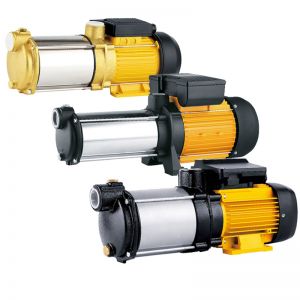
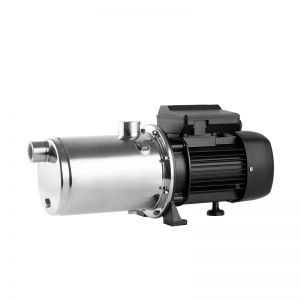
Streampumps' surface centrifugal pump range includes cast iron, stainless steel, open impeller, two-stage, and high-flow configurations, designed to cover the full spectrum of agricultural surface water pumping requirements. Detailed product specifications are available at www.streampumps.com.
A submersible pump operates on a fundamentally different principle. The entire unit—motor, pump body, and impeller assembly—is sealed and designed to function while fully submerged in the water source. Rather than pulling water upward, the submerged impeller pushes fluid upward through the discharge pipe to the surface. This eliminates the suction lift problem entirely.
Key advantages for agricultural use:
No depth limitation from suction: Submersible pumps can draw water from deep boreholes and groundwater wells at depths of tens or even hundreds of meters, depending on motor size and pump configuration. This makes them the only viable solution for farms dependent on deep aquifers.
Superior energy efficiency: Pushing water upward is mechanically more efficient than pulling it. Submersible pumps consistently deliver better hydraulic efficiency than surface pumps handling equivalent flow rates and heads, translating into lower electricity consumption per cubic meter of water pumped.
No priming required: Because the pump is permanently submerged, it operates immediately upon startup without any priming procedure. This simplifies operation and eliminates a common failure point.
Silent operation: The water surrounding the submerged motor acts as a natural sound dampener. Submersible pump installations produce minimal surface noise—a relevant consideration in proximity to residential areas or livestock facilities.
Natural motor cooling: The surrounding water continuously cools the motor, reducing thermal stress and extending operational lifespan under continuous-duty conditions common in large-scale irrigation.
Limitations to consider:
Higher installation cost: Submersible pumps, particularly 4-inch, 6-inch, and 8-inch stainless steel deep-well models, carry a higher unit price than comparable surface pumps. Installation into a borehole also requires professional setup.
Maintenance complexity: Servicing a submersible pump requires extracting it from the well, which involves specialized equipment and, in deep installations, significant labor. As a result, preventive maintenance schedules and high-quality construction materials become even more important for managing lifecycle costs.
Streampumps' submersible deep-well pump lineup includes 2-inch to 8-inch models in stainless steel and mixed material construction, covering borehole diameters and depth requirements across a wide range of agricultural well conditions.
The following table summarizes the critical operational differences between surface centrifugal pumps and submersible pumps across the metrics most relevant to agricultural procurement decisions:
Feature | Surface Centrifugal Pumps | Submersible Pumps |
|---|---|---|
Location | Above ground, near the water source | Fully submerged in the well or reservoir |
Max Suction Depth | ~7 to 8 meters (25 feet) | Unlimited (depends on motor size) |
Efficiency | Good (energy spent pulling water) | Excellent (more efficient pushing water) |
Maintenance | Highly accessible and easier to repair | Requires lifting the pump from the well |
Priming Required | Yes (unless self-priming model) | No (always submerged) |
Best Water Source | Ponds, rivers, lakes, shallow wells | Deep boreholes, deep groundwater wells |
For distributors and procurement teams, this table provides a quick reference during specification reviews. However, the final selection should always account for site-specific well data, seasonal water table fluctuations, and system head calculations.
Water source depth is the primary selection criterion, but irrigation method is the second variable that shapes the optimal pump specification.
Drip irrigation systems require precise, steady pressure delivered to emitters throughout the field. Pressure consistency matters more than raw flow rate. Submersible pumps are frequently specified for drip systems supplied by deep wells because their hydraulic characteristics deliver stable output with minimal pressure variation. When combined with a pressure tank and controller, a submersible pump provides the regulated, clean flow that drip emitters require for uniform crop water distribution.
Flood and furrow irrigation prioritizes volume over precision. Large quantities of water must be moved quickly across flat field sections, often at relatively low heads. Surface centrifugal pumps—particularly high-flow models—excel in these conditions. Their ability to move large volumes of water from surface sources like canals or ponds at high flow rates makes them the standard specification for traditional flood irrigation infrastructure.
Sprinkler irrigation occupies a middle ground. Moderate-to-high flow rates and consistent working pressure are both required. The appropriate pump type depends on the water source. A shallow pond or river-fed sprinkler system may be well served by a surface centrifugal pump; a system fed from a deep borehole requires a submersible unit of appropriate capacity.
Streampumps engineers its pump curves to match these varied irrigation system requirements precisely. Working with an experienced manufacturer ensures that the pump selected not only fits the water source but also delivers the flow and pressure profile that the downstream irrigation system demands.
There is no universal answer to the surface centrifugal vs. submersible pump question. The correct pump is determined by the specific conditions of each farm—not by general preference or unit price alone.
If your operation draws from a pond, river, canal, or shallow well with a static water level within 7 to 8 meters of the surface, a surface centrifugal pump is the practical and cost-effective choice. Maintenance is simple, installation is straightforward, and high-flow models handle large irrigation volumes efficiently.
If your farm relies on deep groundwater accessed through a borehole or deep well, a submersible pump is the technically necessary and more energy-efficient solution. The higher initial cost is offset by lower energy consumption per unit of water delivered and reliable operation under the extreme conditions of deep-well pumping.
For agricultural engineers and irrigation system distributors, the decision framework is clear: confirm the water source depth, verify the irrigation system's flow and pressure requirements, and match the pump specification accordingly.
Streampumps manufactures both surface centrifugal pumps and submersible deep-well pumps to industrial quality standards, with CE certification and a product range covering the full scope of agricultural irrigation requirements. Whether your project calls for high-flow surface units or deep borehole submersibles, the engineering team at Streampumps can provide specification support and custom-matched pump solutions.
Under standard atmospheric conditions, surface centrifugal pumps are practically limited to a suction lift of approximately 7 to 8 meters (around 25 feet). This is a physical constraint imposed by atmospheric pressure and real-world friction losses in the suction pipe. Sources deeper than this threshold require a submersible pump.
Yes. Submersible pumps push water upward from within the water source, which is mechanically more efficient than a surface pump pulling water upward against atmospheric pressure. For farms drawing from deep wells, submersible pumps typically deliver a lower energy cost per cubic meter of water pumped compared to surface alternatives handling the same head conditions.
No. Because submersible pumps are fully submerged during operation, they do not require priming. The pump is already surrounded by water and begins moving fluid immediately upon startup. Standard surface centrifugal pumps do require priming—unless a self-priming model is specified.
Drip irrigation systems benefit from steady, consistent pressure delivery. Submersible pumps—particularly those connected to pressure tanks and control systems—are well-suited for drip systems supplied from deep wells. For drip systems fed from surface water sources within the suction lift range, a surface centrifugal pump with appropriate pressure management equipment can also perform reliably.
Submersible pump maintenance requires extracting the unit from the well, which involves lifting equipment and downtime. This is more complex than servicing an above-ground surface pump. Selecting a submersible pump built with high-quality, corrosion-resistant materials—such as full stainless steel construction—and adhering to a preventive maintenance schedule are the primary strategies for minimizing the frequency and cost of servicing.
Address
No.17 XeDa Jimei Ind. Park, Xiqing Economic Development Area, Tianjin, China
Telephone
+86 13816508465
QUICK LINKS