+86 13816508465
Pump Knowledge
Oct. 16, 2026
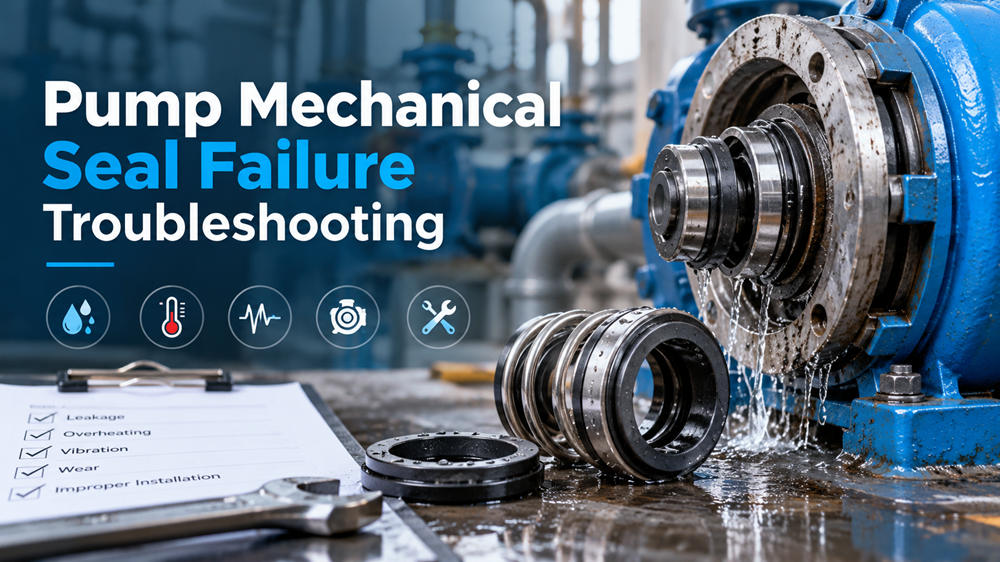
Mechanical seal failure in centrifugal pumps is often caused by installation errors, cooling or flushing system problems, or abrasive contamination rather than the seal itself. The timing and pattern of leakage provide important clues for identifying the root cause.
Based on three industrial troubleshooting cases published by the China General Machinery Industry Association (CGMIA), this guide explains how to diagnose mechanical seal leakage and prevent recurring failures.
Case: A centrifugal pump at a chemical plant experienced severe leakage immediately after a new mechanical seal was installed.
Inspection revealed that the stationary ring's anti-rotation pin had not engaged properly. As the shaft rotated, the stationary ring moved with it, causing damage to the secondary sealing element.
Check whether excessive compression is restricting movement of the rotating seal ring.
Verify that the stationary ring's anti-rotation pin is correctly positioned.
Measure axial shaft movement. The referenced case specifies a maximum of 0.5 mm; always confirm the applicable pump manufacturer's limit.
Root Cause: Incorrect mechanical seal installation.
Recommended Solution: Reinstall the seal according to the manufacturer's instructions, replace damaged components, and verify shaft movement before restarting.
Case: A high-pressure hot-water pump developed severe mechanical seal leakage after only three days of operation.
Inspection identified thermal cracks on the sealing faces. Although the pump was equipped with an API Plan 23 cooling and flushing arrangement, the cooler's inlet and outlet connections had been reversed.
Consequently, the circulating fluid was not adequately cooled, allowing excessive heat to accumulate at the seal faces.
Verify cooling and flushing fluid flow rates.
Measure flushing fluid temperature.
Check cooling circuit connections and flow direction.
Evaluate suction pressure and operating conditions for possible cavitation.
Root Cause: Failure of the auxiliary cooling and flushing arrangement.
Recommended Solution: Correct the cooling circuit connections, restore proper circulation, and replace the damaged seal components.
Engineering Insight: Replacing the mechanical seal without correcting the cooling problem may result in repeated failures.
Case: A water pump operated normally for approximately six months before its mechanical seal leakage gradually increased.
Leakage initially measured approximately five drops per minute but eventually developed into a continuous stream.
Inspection revealed approximately 2 mm of wear on the carbon stationary ring, along with visible grooves on the sealing surface. The investigation traced the problem to small abrasive particles entering through a damaged upstream filter.
Monitor leakage rate changes over time.
Inspect seal faces for grooves and abrasive wear.
Check the pumped medium for suspended solids or crystallization.
Inspect the spring or elastic elements for fatigue.
Root Cause: Abrasive contamination of the pumped medium.
Recommended Solution: Repair the upstream filtration system and consider suitable wear-resistant seal face materials, such as silicon carbide or hard-metal combinations, depending on operating requirements.
| Leakage Pattern | Likely Cause | Inspection Priority |
|---|---|---|
| Immediately after installation | Installation error | Seal assembly and shaft movement |
| Sudden leakage during operation | Cooling or flushing failure | Auxiliary piping and operating conditions |
| Gradually increasing leakage | Abrasive wear or material deterioration | Fluid contamination and seal face condition |
Immediate leakage is often associated with incorrect installation, excessive compression, improperly engaged anti-rotation components, or excessive shaft movement.
Yes. Inadequate cooling, abrasive contamination, and unsuitable operating conditions can damage sealing surfaces before major leakage becomes visible.
Maintain proper filtration, verify cooling and flushing arrangements, operate within specified pump limits, and select seal materials compatible with the pumped liquid.
Mechanical seal troubleshooting should begin with the leakage pattern: immediate leakage points to installation, sudden leakage suggests system problems, and gradual leakage often indicates contamination or wear.
Before inspection, isolate the pump, relieve pressure, and follow appropriate lockout/tagout procedures. Never force-start a pump with a seized shaft.
Identifying the underlying cause before replacing a mechanical seal helps reduce recurring failures, maintenance costs, and unplanned downtime.
Technical Reference
Adapted from "Mechanical Seal Troubleshooting Essentials," published on September 2, 2026, by the Pump Branch of the China General Machinery Industry Association (CGMIA). The three troubleshooting cases are sourced from the association's publication. Additional recommendations are provided as general engineering guidance. View Original Technical Article.
Address
No.17 XeDa Jimei Ind. Park, Xiqing Economic Development Area, Tianjin, China
Telephone
+86 13816508465
QUICK LINKS