+86 13816508465
Pump Knowledge
Mar. 24, 2026
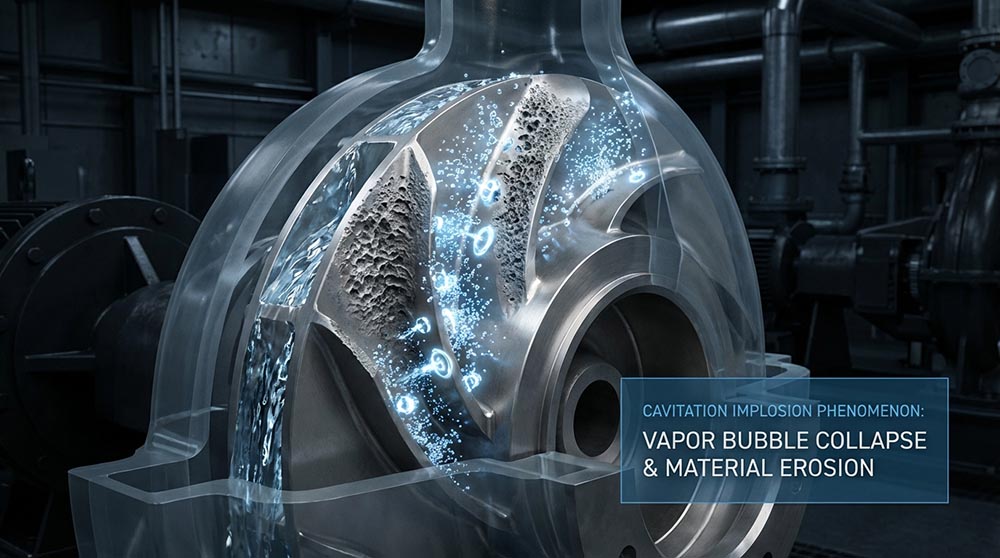
Does your centrifugal pump sound like it is pumping marbles, gravel, or crushed ice, even though it is moving perfectly clean water? If you hear this distinct, aggressive crackling noise, you need to turn the equipment off immediately. That sound is not a minor mechanical quirk. It is the sound of your equipment destroying itself from the inside out.
Many plant operators and maintenance technicians mistakenly assume this noise means air is leaking into the system. They tighten flanges, check seals, and look for suction leaks, only to find the noise persists. The reality is far more destructive. You are not dealing with trapped air. You are dealing with vaporized liquid imploding with enough force to shatter solid metal.
Understanding the root cause of this phenomenon is critical for plant reliability and equipment longevity. Stream Pumps has spent years analyzing the physics behind these failures. In this comprehensive guide, our engineering team explains the mechanics of centrifugal pump cavitation, the devastating damage it causes, and exactly how to fix your system before you have to replace another ruined impeller.
To stop a pump sounding like gravel, you first need to understand the physical phase changes happening inside the volute. The process comes down to pressure, temperature, and the liquid's boiling point.
Water does not only boil at 100°C (212°F). The boiling point of any liquid is directly tied to the pressure surrounding it. If you lower the pressure enough, water will boil at room temperature. This is the core mechanism behind centrifugal pump cavitation.
It is vital to distinguish between air bubbles and vapor bubbles. Air bubbles occur when atmospheric air gets sucked into the piping through a leak. When air bubbles pass through a pump, they compress, causing a drop in efficiency and flow, but they remain a gas.
Vapor bubbles are entirely different. When fluid enters the suction eye of an impeller, it accelerates rapidly. According to Bernoulli’s principle, as velocity increases, pressure drops. If the pressure inside the pump drops below the liquid's vapor pressure, the liquid instantly boils. It turns into vapor bubbles. These are not pockets of outside air; they are pockets of vaporized fluid.
These vapor bubbles do not stay in the low-pressure zone for long. As the impeller spins, it throws the fluid outward into the high-pressure area of the pump casing. When the vapor bubbles hit this high-pressure wall, they cannot survive as a gas. They instantly phase-change back into a liquid.
This collapse is not a gentle transition. It is a violent implosion. As the bubble collapses, surrounding liquid rushes in to fill the void at supersonic speeds, creating a microscopic shockwave or [micro-jet.] When thousands of these implosions happen every second against the metal surface of the impeller, they blast away microscopic pieces of metal. This is the source of the gravel sound, and it is highly destructive. Stream Pumps engineers excel at solving these complex fluid dynamics problems to prevent this exact scenario.
Cavitation leaves behind a distinct trail of evidence. If you know what to look and listen for, you can diagnose the issue before catastrophic failure occurs.
The most obvious symptom is the noise. The crackling, popping sound of imploding vapor bubbles sounds exactly like rocks or gravel rattling inside the casing. Accompanying this noise is severe vibration. The chaotic implosions create unbalanced hydraulic forces that shake the entire pump assembly. This vibration quickly destroys bearings, wears out mechanical seals, and can even fatigue the pump shaft.
If you open a pump that has suffered from this issue, the physical evidence is undeniable. The impeller will display severe [pitting.] The metal looks as though it has been eaten away by aggressive acid or blasted with a tiny shotgun. This pitting weakens the impeller blades, throws the rotating assembly out of balance, and eventually destroys the pump internals completely.
Operators will also notice a sudden, unexplainable drop in pump performance. The flow rate will decrease, and the discharge pressure will fluctuate or plummet. The vapor bubbles take up physical space inside the impeller vanes, blocking the actual liquid from passing through.
Suction cavitation occurs when the pump is starved for liquid. In technical terms, it happens when the Net Positive Suction Head Available (NPSHa) is less than the Net Positive Suction Head Required (NPSHr).
Think of NPSH like drinking a thick milkshake through a straw. The pump (your mouth) requires a certain amount of energy to pull the liquid upward (NPSHr). The atmosphere pushing down on the milkshake provides the energy to push the liquid up the straw (NPSHa). If the straw is too thin, or the milkshake is too thick, the friction is too high. The atmospheric pressure cannot push the liquid fast enough to keep up with your suction. The pressure inside your mouth drops, your cheeks collapse inward, and you get no milkshake.
In a piping system, if the available pressure pushing fluid into the pump (NPSHa) is lower than what the pump physically needs to prevent the fluid from boiling (NPSHr), vapor bubbles form. Stream Pumps engineering teams calculate these exact variables to ensure your system always has a healthy margin of available pressure.
Several system design flaws lead to suction starvation:
Clogged suction strainers or filters creating excessive friction.
Suction piping that is too narrow or features too many sharp elbows.
Drawing fluid from a pit that is too deep, causing excessive suction lift.
Operating the pump significantly to the right of its Best Efficiency Point (BEP) on the pump curve.
While suction starvation is the most common cause, discharge issues can also cause a pump to sound like it is processing gravel. This occurs when the pump's discharge pressure is excessively high, forcing it to operate at the far left of its performance curve.
Discharge cavitation happens when the pump is pushing against too much resistance, a condition known as [dead-heading.] Because the fluid cannot easily exit the discharge nozzle, it is forced to recirculate violently inside the pump casing.
This extreme internal recirculation forces fluid to slip back between the impeller and the casing wall at extremely high velocities. This high-speed slippage creates localized low-pressure zones that drop below the vapor pressure of the fluid. Vapor bubbles form and then rapidly implode as they get pushed back into the main flow.
This type of failure is typically caused by severe flow restrictions on the discharge side:
Operating with a partially closed or incorrectly throttled discharge valve.
Pushing fluid through heavily clogged downstream filters or heat exchangers.
Installing a pump that is drastically oversized for the current pipe network, meaning it constantly fights against system resistance.
When a facility experiences impeller pitting damage and extreme noise, replacing the broken parts will not solve the problem. The replacement impeller will suffer the exact same fate. To truly prevent pump cavitation, you must fix the system.
If your NPSHa is too low, you must increase the pressure at the pump inlet. You can achieve this by:
Increasing the diameter of the suction piping to reduce friction loss.
Cleaning out suction strainers and removing unnecessary elbows or valves before the pump inlet.
Raising the level of the supply tank or moving the pump closer to the fluid source to reduce suction lift.
Because vapor pressure is tied to fluid temperature, cooling the liquid can prevent it from boiling inside the pump. This is especially critical in boiler feed applications or hot water systems. Lowering the fluid temperature gives you a wider margin of safety regarding the liquid's vapor pressure.
Sometimes, the existing piping simply cannot be altered, and the fluid properties cannot be changed. In these situations, the pump itself is the limiting factor. Upgrading to a specialized Stream Pumps model designed with a lower NPSHr might be the ultimate cure for your problematic installation. Our engineers can assess your specific flow requirements and specify an impeller geometry that requires less inlet pressure to operate smoothly.
Cavitation is almost always a system issue, not just a pump issue. Ignoring that terrifying gravel sound will guarantee a catastrophic, expensive, and unexpected failure. By understanding the physics of vapor bubbles, monitoring for vibration, and ensuring your available suction head always exceeds your required suction head, you can protect your equipment.
Is your pump currently suffering from cavitation damage? Do not just buy another replacement impeller only to watch it get destroyed. Fix the root cause of the failure. Contact the Stream Pumps engineering team for a comprehensive NPSH calculation and expert system redesign today.
Address
No.17 XeDa Jimei Ind. Park, Xiqing Economic Development Area, Tianjin, China
Telephone
+86 13816508465
QUICK LINKS