+86 13816508465
Jul. 23, 2026
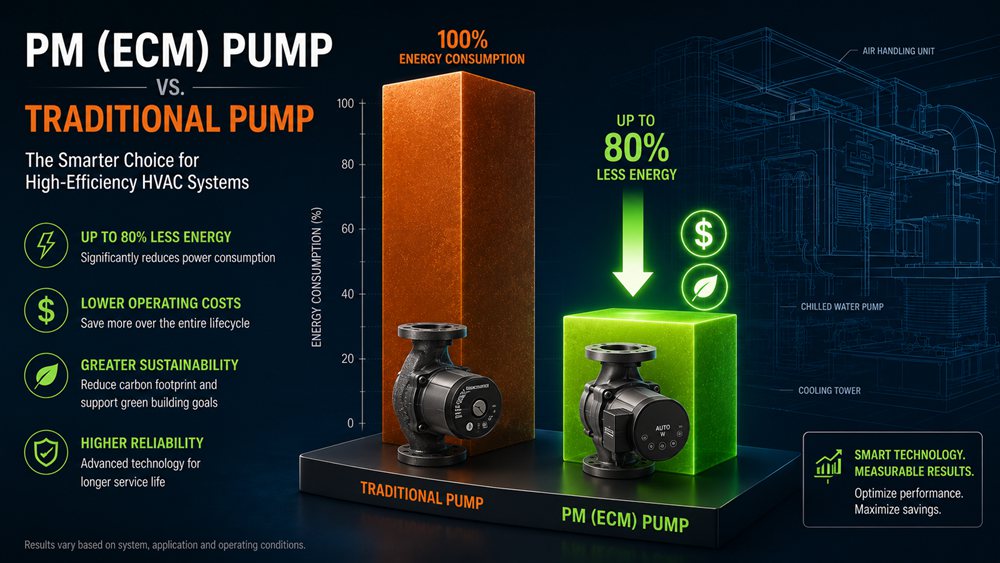
Permanent Magnet (ECM) circulator pumps outperform traditional variable speed pumps in energy efficiency, regulatory compliance, and long-term cost savings. PM pumps can reduce energy consumption by up to 80% compared to conventional models, meet global ErP standards, and deliver a measurable ROI that makes them significantly easier to sell to end-users. For B2B buyers, transitioning your inventory is no longer optional—it is a procurement imperative.
The HVAC and plumbing industries are undergoing a fundamental shift. Rising energy costs, tightening government efficiency mandates, and growing demand for sustainable building infrastructure have forced distributors, contractors, and facility managers to rethink what they stock, specify, and install. At the center of this shift is the circulator pump—a component so embedded in heating and cooling systems that its technology choice ripples across every metric that matters in a B2B purchase: lifecycle cost, regulatory risk, and end-user satisfaction.
For years, traditional variable speed pumps dominated the market. They were affordable, widely available, and familiar. But familiarity is not the same as fitness for purpose. As energy efficiency standards have raised the bar globally, a new generation of Permanent Magnet (PM) circulator pumps—driven by Electronically Commutated Motors (ECM)—has emerged as the clear technical and commercial superior.
This guide breaks down the core differences between these two technologies, explains why B2B buyers are actively phasing out traditional variable speed models, and outlines what to look for in a manufacturing partner as you build a next-generation product lineup.
The distinction between these two pump categories starts at the motor level. Understanding the engineering difference is essential for any B2B buyer making a procurement argument to customers.
Traditional variable speed circulator pumps use asynchronous induction motors. In these motors, the stator generates a rotating magnetic field that induces current in the rotor. The rotor must always rotate slightly slower than the stator's magnetic field—a phenomenon known as 【slip】—to sustain the induced current that creates torque. This slip is not merely a mechanical inconvenience. It translates directly into energy dissipated as heat, reducing motor efficiency, increasing operating temperatures, and shortening component lifespan.
Permanent Magnet motors eliminate slip entirely. The rotor in a PM motor carries its own magnetic field, generated by high-strength permanent magnets embedded in the rotor core. An electronic controller—hence the designation Electronically Commutated Motor—precisely commutates the stator windings, synchronizing the rotating field with the rotor's position in real time. The result is a motor that converts electrical input into hydraulic output with far greater precision. Less waste heat. Lower bearing stress. Tighter performance curves at partial loads.
This is not a marginal improvement. It is a structural architectural advantage.
Traditional variable speed circulator pumps carry one primary advantage in a procurement conversation: a lower purchase price. For volume-sensitive distributors operating on thin margins, that lower unit cost has historically been compelling. But the economics shift dramatically once total system cost enters the equation.
The drawbacks of traditional variable speed pumps compound over time:
Higher energy consumption: Asynchronous motors operating under partial load conditions—which describes the majority of real-world operating hours in heating and cooling applications—lose a significant portion of their electrical input to heat and slip losses. Over a pump's typical 15–20-year operational lifespan, this energy waste accumulates into substantial costs for building owners.
Thermal degradation: Excess heat shortens insulation life, accelerates bearing wear, and increases the probability of unplanned failure. Higher maintenance frequency translates directly into higher total cost of ownership for facility managers.
Regulatory exposure: Perhaps most critically for distributors, traditional variable speed pumps are increasingly failing to meet modern efficiency mandates. The European Union's Energy-related Products (ErP) Directive, implemented under Regulation (EU) No. 641/2009 and subsequently updated, sets minimum Energy Efficiency Index (EEI) thresholds that many traditional asynchronous-motor pumps cannot meet. Markets in the Middle East, Asia-Pacific, and the Americas are adopting equivalent standards at an accelerating pace. Distributors holding large inventories of non-compliant pumps face significant dead-stock risk.
Permanent Magnet circulator pumps deliver measurable performance advantages across every dimension relevant to a B2B buyer.
The most cited figure—and one that consistently holds up under real-world testing—is energy reduction of up to 80% compared to traditional fixed or variable speed models. This figure is not a theoretical maximum. It reflects the performance gap between an ECM-driven PM pump operating with Auto-Adapt intelligence and a conventional asynchronous pump running at fixed or crudely stepped speed settings.
Key performance characteristics of PM circulator pumps include:
Auto-Adapt functionality: Advanced PM circulator pumps continuously monitor system pressure and flow demand, adjusting motor speed in real time to match actual hydraulic requirements. During overnight low-demand periods, the pump reduces output proportionally, consuming only the electricity that the system actually needs.
ErP and global compliance: PM circulator pumps designed for current market requirements achieve Energy Efficiency Index (EEI) values well below the thresholds mandated by EU ErP regulations. This compliance is not a checkbox—it is a market access requirement in the EU and an increasingly common specification criterion in global public procurement.
Reduced lifecycle cost: Lower electricity consumption, reduced maintenance intervals, and longer operational lifespan combine to dramatically improve the total cost of ownership calculation. For end-users in commercial buildings, district heating networks, or large residential complexes, the savings justify the initial price premium within a short payback period.
Quieter operation: The elimination of slip and the precise speed control enabled by ECM technology means PM pumps operate with significantly lower vibration and noise output—an increasingly specified requirement in residential and mixed-use building applications.
The business case for transitioning to PM circulator pumps rests on two pillars that are difficult to argue against in any boardroom or procurement meeting.
Government efficiency standards are eliminating low-performance products from the market—not gradually, but on defined legislative timelines. The EU's ErP Directive has set binding EEI limits for standalone circulators and circulators integrated into products. Pumps that fail to meet these thresholds cannot legally be sold in covered markets.
For distributors, this creates an inventory risk that goes beyond slow-moving stock. Products that are ErP non-compliant face potential market withdrawal. The financial and reputational consequences of stocking obsolete technology outweigh any short-term margin advantage from lower unit acquisition costs.
Equally important: specifiers and contractors are increasingly mandating ErP-compliant products in their project documentation. Distributors unable to supply compliant pumps lose bid opportunities. The regulatory signal is unambiguous, and the smart procurement response is to align inventory with where standards are heading, not where they were five years ago.
The TCO argument is the most powerful tool in a distributor's sales conversation. It reframes the purchase decision from a unit-price comparison to a lifecycle value analysis—one that consistently favors PM circulator pumps.
Consider a typical residential or commercial heating circuit pump operating 8,000 hours per year. A traditional variable speed pump with a 100W average consumption draws 800 kWh annually. A comparable PM circulator pump operating at 20–30W average consumption draws 160–240 kWh annually. Across a 15-year operational life, and at average commercial electricity rates, the energy cost difference is substantial—often exceeding the entire purchase price differential within the first two to three years of operation.
This ROI argument resonates strongly with facility managers, building developers, and ESCO (Energy Service Company) contractors. For distributors, it transforms a higher-priced product into a differentiated value proposition rather than a harder sell.
Selecting the right manufacturing partner is as important as selecting the right technology. For B2B buyers seeking a reliable, compliance-focused supplier of high-efficiency PM circulator pumps, Tianjin Streampumps Industry Co., Ltd offers a supply chain and product capability profile worth serious consideration.
Established in 1997 and operating under the STREAM brand since 2004, Streampumps has built a two-decade track record in precision pump manufacturing. The company's products are distributed across more than 150 countries and regions, supported by 25+ international agents and three dedicated manufacturing bases with a combined annual production capacity exceeding 1.5 million units.
Streampumps' variable speed circulation pump lineup—including the SXR-E (Economical High Efficiency), SXR-A (Advanced High Efficiency), and SXR-EA (Variable Speed High Efficiency) series—reflects a product development philosophy centered on ErP compliance, intelligent motor control, and reliable hydraulic performance. The company's quality management system encompasses strict inspection protocols across raw materials, production processes, and finished goods, with certifications including CE, ROHS, and EMC.
For distributors evaluating OEM, ODM, or branded supply arrangements, Streampumps offers comprehensive flexibility. The company's R&D capability supports continuous product iteration, ensuring that the efficiency benchmarks of today do not become the compliance failures of tomorrow. B2B partners benefit from a supply chain structured to keep product specifications ahead of regulatory curve—a meaningful operational advantage in markets where efficiency standards are tightening on defined timelines.
Streampumps also maintains an active presence at the Canton Fair twice annually, providing direct access for international buyers seeking technical consultation and supply chain discussions.
The transition from traditional variable speed circulator pumps to Permanent Magnet ECM pumps is not a future trend—it is a current market reality. Regulatory compliance timelines are set. End-user demand for energy-efficient HVAC components is measurable and growing. The TCO data consistently supports PM pump adoption across residential, commercial, and industrial applications.
For HVAC distributors, plumbing contractors, and facility procurement teams, the strategic question is not whether to transition, but how quickly and with which manufacturing partner. Distributors who align their inventory with high-efficiency PM technology today position themselves as preferred suppliers to specifiers and contractors who increasingly require ErP compliance as a baseline criterion.
Tianjin Streampumps Industry Co., Ltd provides the manufacturing depth, quality systems, and product range to support that transition at scale. Upgrade your product lineup with high-efficiency PM circulator pump solutions. Visit www.streampumps.com to explore the full range of variable speed and Permanent Magnet circulator pumps and secure your competitive position in an efficiency-driven market.
A Permanent Magnet (PM) circulator pump uses an Electronically Commutated Motor (ECM) with a permanently magnetized rotor, which eliminates motor 【slip】 and reduces energy losses significantly. Traditional variable speed pumps use asynchronous induction motors, which require slip to generate torque and lose energy as heat. PM pumps are more efficient, run cooler, and achieve lower Energy Efficiency Index (EEI) values.
PM circulator pumps can reduce energy consumption by up to 80% compared to conventional fixed or traditional variable speed models. Actual savings depend on system design, operating hours, and load profile, but even conservative estimates show significant electricity cost reductions over the pump's operational lifespan.
Many traditional asynchronous-motor circulator pumps do not meet the Energy Efficiency Index thresholds required by the EU's ErP Directive (Regulation (EU) No. 641/2009). Distributors operating in EU markets or markets adopting equivalent standards should verify compliance status before procuring traditional variable speed models.
Payback period varies based on electricity tariffs, operating hours, and the efficiency gap between the replaced pump and the new PM unit. In many commercial and multi-residential applications, energy savings alone recover the price premium within two to four years—well within the pump's 15–20-year operational lifespan.
Key criteria include ErP compliance certification, Auto-Adapt or variable speed intelligence capability, manufacturing quality certifications (CE, ROHS, EMC), OEM/ODM flexibility, production capacity, and supply chain reliability. Tianjin Streampumps Industry Co., Ltd, at www.streampumps.com, meets these criteria with a proven global distribution track record across 150+ countries.
Yes. Distributors holding large inventories of non-compliant traditional pumps face dead-stock risk if regulatory changes restrict their sale in key markets. Aligning inventory with PM circulator pump technology reduces this risk and positions distributors to meet the compliance requirements increasingly specified in commercial and public procurement.
Address
No.17 XeDa Jimei Ind. Park, Xiqing Economic Development Area, Tianjin, China
Telephone
+86 13816508465
QUICK LINKS