+86 13816508465
Jul. 23, 2026
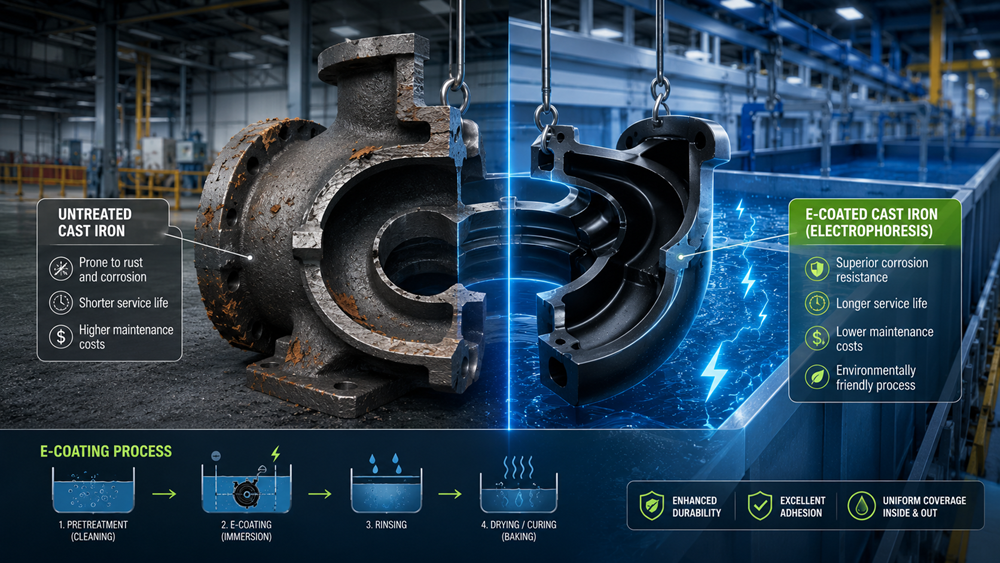
Electrophoresis coating (E-coating) is a cathodic electrodeposition process that bonds a uniform, chemically resistant protective layer to every surface of a cast iron pump—including internal cavities that conventional spray painting cannot reach. For B2B buyers sourcing industrial and submersible pumps, E-coating directly translates to lower maintenance costs, longer service life, and sustained hydraulic performance. Tianjin Streampumps Industry Co., Ltd applies this process as a standard manufacturing step across its heavy-duty pump range.
Corrosion is the single greatest enemy of cast iron water pumps operating in industrial, wastewater, and agricultural environments. It doesn't announce itself. It starts quietly—a thin film of iron oxide forming inside a volute chamber, a rust spot developing on an impeller passage—and then accelerates until hydraulic performance degrades and mechanical failure follows.
The challenge for procurement officers and facility managers is that many pumps look entirely acceptable on the outside. The real damage happens where you cannot see it: inside the hydraulic passages, along the inner casing walls, and within the tightly confined impeller chambers that standard spray guns simply cannot reach. By the time external rust signals a problem, the internal damage is often severe.
Electrophoresis coating—commonly called E-coating or Cathodic Electrodeposition (CED)—resolves this problem at the manufacturing stage. Applied before assembly, E-coating delivers a chemically bonded, perfectly uniform protective film to every surface of the casting, regardless of how complex or confined the geometry. The result is a pump that is protected from the inside out, from day one of operation.
Tianjin Streampumps Industry Co., Ltd, a pump manufacturer established in 1997 and supplying to more than 150 countries, integrates electrophoresis coating as a standard finishing step in the production of its heavy-duty cast iron pumps. This article explains why that decision matters for distributors, facility managers, and procurement officers making long-term sourcing decisions.
Electrophoresis coating, or Cathodic Electrodeposition (CED), is an electrochemical surface finishing process widely used in demanding industrial manufacturing environments. Understanding the mechanics helps B2B buyers evaluate its significance against other coating claims.
The process works as follows:
Pre-treatment: Cast iron pump components are thoroughly cleaned, degreased, and phosphate-treated to remove surface contaminants and mill scale that would otherwise compromise adhesion.
Submersion: The cleaned parts are fully immersed in a large tank containing a water-based paint emulsion carrying suspended resin and pigment particles.
Electrodeposition: A direct electrical current is applied. The cast iron component acts as the cathode. The electrical charge causes the resin and pigment particles to migrate through the solution and deposit uniformly onto every exposed metal surface.
Chemical bonding: Rather than simply sitting on the surface, the deposited coating undergoes a cross-linking reaction with the metal substrate, forming a highly adherent, chemically resistant film.
Curing: Components pass through a curing oven, where the coating is baked to its final hardness and adhesion strength.
The defining characteristic of this process is total surface coverage. Because deposition is driven by electrical attraction rather than physical spray pressure, paint reaches into every recess, cavity, and internal channel of the casting—areas that are geometrically inaccessible to conventional spray application. Film thickness is self-limiting: as the coating builds up on a given area, that area's electrical resistance increases, and further deposition shifts automatically to less-coated regions. This self-regulating mechanism produces an exceptionally uniform layer across the entire part, with typical coating thicknesses in the range of 15 to 25 microns.
To appreciate the advantage of E-coating, it is worth examining why conventional spray painting is inadequate for cast iron pump internals.
Spray painting is a line-of-sight process. Paint particles travel in relatively straight trajectories from the spray nozzle to the target surface. This works reasonably well for flat or simply curved external surfaces. Inside a centrifugal pump casing, however, the geometry is anything but simple. Volute channels curve tightly. Impeller chambers narrow to small clearances. Passages branch and change direction. A spray gun positioned at the inlet simply cannot propel paint around internal corners and into blind passages with any consistency.
The practical consequences are significant:
Bare metal exposure: Internal surfaces that receive little or no paint coverage are left as raw cast iron, directly exposed to water from the first moment the pump operates.
Rust initiation: Cast iron in contact with water begins to oxidize immediately. Iron oxide (rust) is porous and non-protective—unlike the passive oxide layers that form on stainless steel. Once started, rust propagates aggressively into the base metal.
Hydraulic degradation: As rust develops on the inner walls of the volute and impeller passages, the internal surface roughens. Increased surface roughness raises fluid friction losses, elevates turbulence, and shifts the pump away from its Best Efficiency Point (BEP). The pump moves more water for more energy—and then less water for more energy still.
Structural weakening: In severe cases, corrosion pitting penetrates deep into the casting wall, compromising structural integrity and creating paths for leakage under operating pressure.
Accelerated failure in aggressive media: Pumps handling wastewater, agricultural chemicals, or mineralized groundwater face elevated chemical attack. Without adequate internal protection, service life in these applications can collapse from years to months.
The economic impact of premature pump failure extends beyond the unit itself. Factor in emergency maintenance labor, unplanned downtime, secondary damage to connected infrastructure, and warranty processing costs, and the true cost of an underprotected pump becomes clear.
For procurement officers and facility engineers evaluating pump specifications, three benefits of E-coated cast iron castings stand out as directly relevant to operational outcomes.
The submersion-and-electrodeposition mechanism ensures that every square millimeter of the pump casting—external housing, internal volute, impeller passages, ports, and blind recesses—receives a consistent coating layer. There are no shadowed zones, no thin spots, and no uncoated cavities.
This is not a minor technical distinction. For submersible sewage pumps operating in permanently submerged conditions, or for irrigation pumps circulating water with elevated mineral content, a single uncoated area inside the casing is a corrosion initiation point that will expand over time. E-coating eliminates that risk at the production stage.
The cross-linked resin matrix formed during cathodic electrodeposition creates a barrier with significantly higher resistance to corrosion and chemical attack than conventionally applied paints. The cross-linking process—driven by the curing oven—produces a dense, continuous polymer network that is highly resistant to water permeation, alkalinity, and weak acids.
For applications such as submersible sewage pumps handling biologically active wastewater, surface centrifugal pumps in agricultural irrigation systems, or industrial circulation pumps in process cooling circuits, this chemical resistance is operationally critical. The E-coat film acts as a stable barrier throughout the service life of the pump, maintaining its protective function across temperature cycling, pressure variation, and continuous fluid contact.
Hydraulic efficiency is a function of internal surface condition. Manufacturers specify pump performance curves—including flow rate, head, and efficiency—based on machined castings with smooth internal surfaces. Rust buildup is an uncontrolled surface roughness element that is not factored into those performance curves. As roughness increases, so does the hydraulic friction loss inside the pump, and performance degrades accordingly.
The ultra-smooth finish produced by E-coating—typically with a surface texture that is uniform and free from particulate contamination—preserves the internal hydraulic geometry as designed. Fluid moves through the pump with the turbulence characteristics that the engineering team modeled, not the elevated turbulence introduced by corroded surfaces. The result is a pump that operates closer to its rated BEP for a substantially longer period, delivering the flow and pressure performance that distributors and end users depend on.
Tianjin Streampumps Industry Co., Ltd has manufactured water pumps since 1997, launching its own brand in 2004 and growing to distribute products across more than 150 countries. The company operates three manufacturing bases with an annual production capacity exceeding 1,500,000 units, and carries CE, RoHS, and EMC certifications across its product lines.
Electrophoresis coating is embedded in Streampumps' standard production flowchart as part of the final finishing stage applied to cast iron components. Alongside anti-rust paint, polishing, and detailed painting, E-coating is treated not as an optional upgrade but as a baseline quality requirement—applied to heavy-duty cast iron submersible pumps, surface centrifugal pumps, and circulating pumps before final assembly.
This manufacturing standard reflects a deliberate engineering position: that internal corrosion protection is not a specification to be traded away in pursuit of lower unit costs. Streampumps' production process applies rigorous pre-treatment to cast iron surfaces before E-coating to ensure chemical adhesion quality, and all coated components pass through the full test protocol—including leakage testing of hydraulic parts and endurance testing—before leaving the production line.
For B2B distributors, this approach has direct commercial implications. Pumps that are adequately protected internally generate fewer warranty claims. They perform closer to rated specifications for longer periods, which protects the reputation of the distributor supplying them. They reduce the frequency of emergency service calls for facility managers, who operate on maintenance budgets that cannot absorb repeated unplanned failures. Procurement officers sourcing for long-term contracts can justify a premium-quality pump on total cost of ownership grounds rather than unit price alone.
Streampumps has participated in the Canton Fair twice annually since 2002, maintaining direct engagement with international distributors and maintaining the quality standards required to sustain a global supply relationship with more than 25 agents worldwide. The company's investment in E-coating as a standard process is consistent with its broader commitment to quality control from raw material selection through final packaging.
The procurement decision that looks most economical at the invoice stage frequently becomes the most expensive one over the operational lifecycle. A cast iron pump supplied without adequate internal corrosion protection may cost less upfront. The cost of replacing it after 18 months of service—including downtime, labor, secondary infrastructure impact, and the management overhead of the failure event—routinely exceeds the cost difference several times over.
Electrophoresis coating is, by its nature, invisible in the finished product. You cannot see it on the shelf or in a product photograph. It is an internal manufacturing decision that only becomes visible in operational performance data—sustained flow rates, reduced maintenance frequency, and extended service intervals. For procurement officers and facility managers who are accountable for long-term asset performance, these are the metrics that matter.
Sourcing from manufacturers who treat E-coating as a standard process—rather than a premium option or an omitted cost-saving measure—is a supply chain decision with measurable operational returns.
Ensure your next pumping system is built to last from the inside out. Visit www.streampumps.com to explore the full range of E-coated cast iron industrial and submersible pumps from Tianjin Streampumps Industry Co., Ltd.
E-coating (Cathodic Electrodeposition) is an electrochemical process in which cast iron components are submerged in a charged paint bath. Electrical current causes resin particles to bond directly to the metal surface, including internal cavities that spray painting cannot reach. Standard spray paint is a line-of-sight process that leaves internal pump passages poorly coated or bare, creating corrosion initiation points from the first day of operation.
External pump surfaces are generally accessible for inspection and repainting during maintenance. Internal surfaces—volute chambers, impeller passages, and hydraulic ports—are not. Rust forming inside the pump roughens the hydraulic surfaces, raises fluid friction losses, degrades energy efficiency, and accelerates mechanical wear. By the time internal corrosion is diagnosed, performance has typically already deteriorated significantly.
E-coating improves long-term hydraulic performance by preserving the smooth internal surface finish of the casting. The coating itself is applied in a controlled, uniform thickness (typically 15–25 microns) that does not meaningfully alter hydraulic geometry. Over time, the smooth E-coat surface prevents the surface roughness increases caused by corrosion, helping the pump maintain its rated Best Efficiency Point for longer.
E-coating delivers the greatest operational value in pumps exposed to continuous water contact, aggressive media, or harsh environments. Submersible sewage pumps, agricultural irrigation pumps, industrial circulation pumps, and surface centrifugal pumps handling mineralized or chemically active water all benefit directly. Any cast iron pump where internal surfaces are in sustained contact with fluid is a candidate for E-coat protection.
Request manufacturing process documentation from the supplier, including surface treatment specifications and production flow records. Reputable manufacturers such as Tianjin Streampumps Industry Co., Ltd document E-coating as a standard step in the production flowchart, and this documentation can be provided on request. Additionally, quality certifications such as CE mark compliance require documented and traceable manufacturing processes.
E-coating is cost-effective when evaluated against total cost of ownership. The process involves capital investment in electrodeposition tanks, rectifiers, and curing ovens, but the per-unit coating cost is distributed across high-volume production runs. Compared to the cost of premature pump replacement, emergency maintenance, and downtime caused by internal corrosion failure, the incremental cost of E-coating at the manufacturing stage represents a favorable investment for both the manufacturer and the end user.
Address
No.17 XeDa Jimei Ind. Park, Xiqing Economic Development Area, Tianjin, China
Telephone
+86 13816508465
QUICK LINKS