+86 13816508465
Jul. 23, 2026
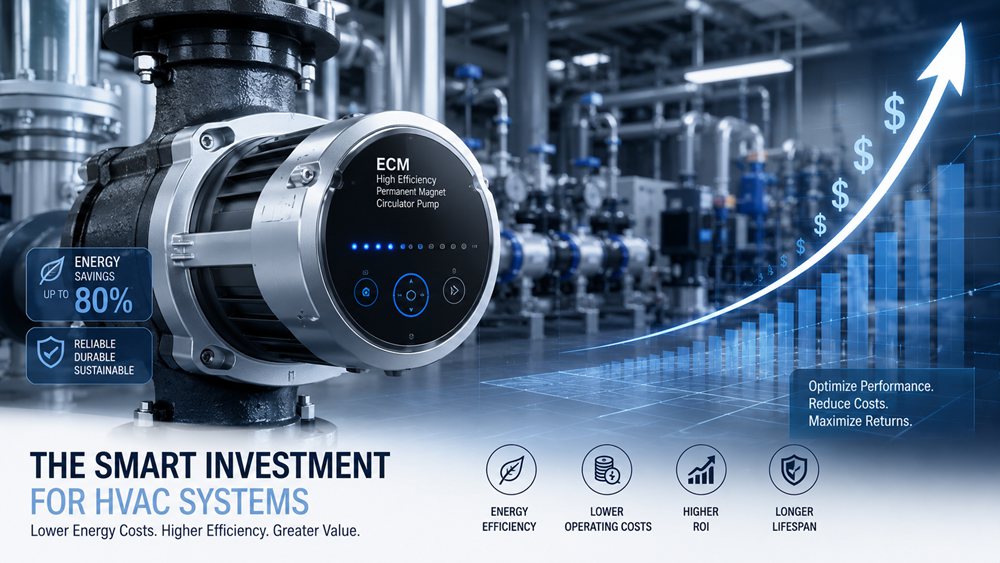
Upgrading from traditional asynchronous circulator pumps to Permanent Magnet (ECM) circulator pumps can reduce electricity consumption by up to 80%, with payback periods as short as one to two years. For HVAC contractors, distributors, and facility managers, this technology represents one of the most financially sound infrastructure upgrades available today.
Energy efficiency has moved well beyond corporate sustainability reports. For commercial heating, cooling, and HVAC operations, it is now a direct line to profitability. Facility managers and procurement officers are under increasing pressure to reduce operating expenditures without compromising system performance. Circulators—the pumps that keep hot and chilled water moving through heating and cooling systems—are often the single largest source of avoidable energy waste in a building's mechanical infrastructure.
The technology that addresses this problem most effectively is the Permanent Magnet (ECM) circulator pump. Driven by electronically commutated motors, these high-efficiency units consume dramatically less electricity than their traditional counterparts and adapt intelligently to real-time system demand. The financial case for upgrading is compelling: lower monthly utility bills, reduced maintenance costs, and a payback period that frequently falls within one to two years.
Tianjin Streampumps Industry Co., Ltd—manufacturer of ErP-compliant variable speed circulator pumps sold across more than 150 countries—engineers these solutions specifically for B2B partners who need to offer measurable, documentable ROI to their end-user clients. This analysis breaks down exactly where the financial returns come from, how to calculate the payback period, and how sourcing directly from a qualified manufacturer like Streampumps maximizes margin at every stage of the supply chain.
Traditional asynchronous circulator pumps operate on a straightforward but financially inefficient principle: they run at a single, fixed speed at all times. Full speed in the early morning. Full speed overnight. Full speed on a mild spring afternoon when the building's heating demand is a fraction of peak requirements.
The core problem is structural. Asynchronous motors are inherently inefficient because of a phenomenon called 【rotor slip】—the difference between the speed of the rotating magnetic field and the actual rotor speed. This slip generates heat and waste energy as a mechanical constant, meaning the motor is always losing a percentage of its input power before it even begins moving water. The result: facilities pay for electricity that produces no useful hydraulic output.
Compound this with continuous full-load operation and the financial picture becomes stark. A pump that runs 8,760 hours per year at maximum speed—regardless of whether the system needs that flow—generates utility costs that accumulate silently and consistently. For commercial facilities running multiple circulators across large HVAC systems, these costs can represent tens of thousands of dollars annually in pure, avoidable electrical waste.
From a procurement standpoint, this is a liability hidden in plain sight. The pump's purchase price is visible; the ten-year electricity cost is not calculated at point of purchase. This is the gap that ECM technology closes.
The financial returns from ECM circulators arrive through three distinct mechanisms. Each operates independently, but together they create an ROI profile that is difficult to match with any other single infrastructure upgrade.
Permanent Magnet motors eliminate rotor slip by design. The rotor contains permanent magnets that lock into synchrony with the rotating magnetic field, removing the energy loss that defines asynchronous motor operation. The practical result is a dramatic increase in motor efficiency—and a corresponding reduction in the electricity required to perform the same pumping work.
The energy reduction enabled by ECM technology can reach up to 80% compared to a traditional fixed-speed pump performing equivalent duty. Streampumps' SXR-A series, for example, is A-rated for energy efficiency and can operate at a minimum power draw of just 5W—a figure that would be unachievable with conventional motor technology. The Energy Efficiency Index (EEI) of the SXR-A reaches as low as 0.23, well within ErP Directive compliance thresholds.
To translate this into operational financial terms: a facility currently running a traditional 80W circulator pump continuously for one year consumes approximately 700 kWh. An ECM replacement operating at equivalent duty cycles may consume as little as 140–200 kWh over the same period. At a commercial electricity rate of $0.12 per kWh, that single pump substitution saves between $60 and $67 annually. Scale this across a facility with 10, 20, or 50 circulators, and the annual savings become a material budget line.
Fixed-speed pumps cannot distinguish between peak demand and partial load. An ECM pump can. Modern variable speed ECM circulators incorporate smart controllers that monitor differential pressure across the system in real time and automatically adjust motor speed to deliver only the flow rate the system currently requires.
This matters financially because of the affinity laws governing centrifugal pump performance: power consumption is proportional to the cube of the speed reduction. Reducing pump speed by just 20% does not reduce power consumption by 20%—it reduces it by approximately 49%. A 30% speed reduction delivers close to a 66% reduction in power draw. This is the mathematical engine behind the headline energy savings figures.
For facilities with variable occupancy patterns—office buildings, hotels, hospitals, residential complexes—the financial benefit of automatic load-matching is compounded. During off-peak hours, partial load, or seasonal low-demand periods, the pump consumes a fraction of its rated power while maintaining adequate system pressure. The electricity meter reflects actual hydraulic need rather than maximum theoretical capacity.
For HVAC contractors and distributors, this feature is a concrete, quantifiable selling point. The energy savings are not theoretical—they are calculable using basic load profile data from the facility, making the ROI case straightforward to present to procurement decision-makers.
The financial case for ECM pumps extends beyond the electricity bill. Traditional asynchronous motors run at full speed continuously, generating significant thermal stress on windings, bearings, and seals. This heat accumulation accelerates component wear, shortens service intervals, and increases the probability of unplanned system failures.
ECM motors operate cooler. By matching speed to demand rather than running at constant maximum output, the motor's thermal load is lower under typical operating conditions. Reduced thermal stress translates directly into longer bearing life, extended seal integrity, and fewer breakdowns. The Streampumps SXR-A series, for instance, achieves a noise level of ≤42 dB—a result of mechanical smoothness that reflects the reduced vibrational stress on internal components.
For facility managers, reduced maintenance frequency means lower service contract costs, fewer emergency callout fees, and less system downtime. For contractors selling service agreements alongside equipment, ECM pumps represent lower warranty claim exposure. Both translate into improved margins and stronger client relationships over the equipment's operational life.
The payback period calculation for ECM circulator pump upgrades follows a straightforward formula:
Payback Period = (Premium Cost of ECM Pump over Traditional Pump) ÷ (Annual Energy Cost Savings)
The premium cost—the difference between an ECM pump and a comparable traditional unit—varies by pump size and application, but typically falls in the range of $100 to $300 USD per unit for commercial circulator applications. Annual energy savings, based on the electricity consumption reductions outlined above, consistently offset this premium within one to two years of operation.
Consider a practical scenario: a commercial building upgrades 15 circulator pumps, each with a $200 premium over the traditional alternative. Total premium investment: $3,000. If each pump saves $150 per year in electricity costs, total annual savings equal $2,250. Payback period: approximately 16 months. From month 17 onward, the facility generates net savings with no additional capital outlay.
This compressed payback window is the primary B2B selling argument. For distributors pitching ECM upgrades to facility managers and building owners, the ability to demonstrate sub-two-year payback periods converts the conversation from a capital expenditure discussion into a financial optimization discussion. The decision becomes less about budget approval and more about how quickly the client wants to begin generating savings.
After payback, assuming a pump operational lifespan of 8–12 years, the remaining service life produces uninterrupted financial returns—pure cost reduction that flows directly to the facility's bottom line.
The ROI case for permanent magnet circulators is only as commercially viable as the supply chain that delivers them. For distributors and HVAC contractors sourcing these products, the manufacturer relationship determines whether the financial advantages of the technology translate into sustainable margin.
Tianjin Streampumps Industry Co., Ltd has operated from its manufacturing base in Tianjin, China since 1997, building OEM and OBM capability across a product range that now serves more than 150 countries and generates annual sales exceeding $50 million USD. The company maintains three manufacturing facilities with an annual production capacity exceeding 1,500,000 units, and holds CE, RoHS, and EMC certifications across its product lines.
For B2B procurement, this manufacturing scale has direct financial implications. Factory-direct sourcing eliminates intermediary margins, giving distributors access to ErP-compliant, A-rated ECM circulators at wholesale pricing that preserves competitive flexibility in end-user markets. The Streampumps SXR series—including the SXR-E (economical), SXR-A (advanced), and SXR-EA (variable speed)—covers the primary commercial application segments, allowing distributors to serve multiple market tiers from a single supplier relationship.
Quality control is embedded at the raw material, production, and finished goods stages, reducing warranty claim risk and protecting distributor margins post-sale. OEM and ODM service availability means that regional distributors requiring customized specifications or private labeling can access these capabilities without sourcing from multiple manufacturers.
The combination of competitive factory pricing, ErP compliance, documented energy performance, and multi-tier product availability makes Streampumps a structurally sound supply partner for distributors building an ECM circulator product line.
Permanent magnet ECM circulator pumps are not a premium product category with a marginal financial benefit. They are a financially superior infrastructure choice with documented, calculable returns that materialize within one to two years of installation and continue generating value for the remaining operational life of the equipment.
For facility managers, the upgrade reduces the single largest source of avoidable electrical waste in building mechanical systems. For HVAC contractors and distributors, the technology provides a high-ROI product that closes faster, generates fewer warranty claims, and builds stronger long-term client relationships. For procurement officers, the sub-two-year payback period and multi-year savings horizon make the capital justification straightforward.
The supply chain that makes this financially viable starts at the manufacturing level. Ready to deliver high-ROI heating solutions to your market? Visit www.streampumps.com to partner with a leading manufacturer of permanent magnet circulator pumps.
A Permanent Magnet circulator pump uses an electronically commutated motor (ECM) with permanent magnets in the rotor, eliminating rotor slip and dramatically increasing electrical efficiency. Traditional asynchronous pumps run at fixed speed regardless of demand. ECM pumps adjust speed to match actual system requirements, consuming only the energy necessary for current conditions.
ECM circulator pumps can reduce electricity consumption by up to 80% compared to equivalent traditional fixed-speed pumps. The exact savings depend on the pump's duty cycle, system load profile, and operating hours. Streampumps' SXR-A series achieves an Energy Efficiency Index (EEI) of ≤0.23 and can operate at a minimum of 5W.
The payback period for ECM pump upgrades is typically one to two years. The exact timeline depends on the cost premium over the replaced unit, local electricity rates, and annual operating hours. After the payback period is reached, the pump generates net financial savings for the remainder of its service life.
Yes. Streampumps' variable speed circulation pumps, including the SXR series, meet ErP Directive requirements with an EEI of ≤0.23. Products also carry CE and RoHS certifications. ErP compliance is increasingly mandated for commercial HVAC installations in regulated markets.
Tianjin Streampumps Industry Co., Ltd has manufactured water pumps since 1997, with annual production capacity exceeding 1,500,000 units across three manufacturing bases. The company offers OEM, ODM, and OBM services, holds CE, RoHS, and EMC certifications, and distributes to more than 150 countries. Factory-direct sourcing provides distributors with competitive wholesale pricing without compromising product quality or compliance standards.
ECM pumps deliver the strongest ROI in facilities with variable heating and cooling loads—commercial office buildings, hotels, hospitals, multi-family residential complexes, and industrial facilities with seasonal demand variation. The greater the variance between peak and off-peak demand, the larger the energy savings from variable speed operation.
Address
No.17 XeDa Jimei Ind. Park, Xiqing Economic Development Area, Tianjin, China
Telephone
+86 13816508465
QUICK LINKS