+86 13816508465
Pump Introductions
Sep. 07, 2026
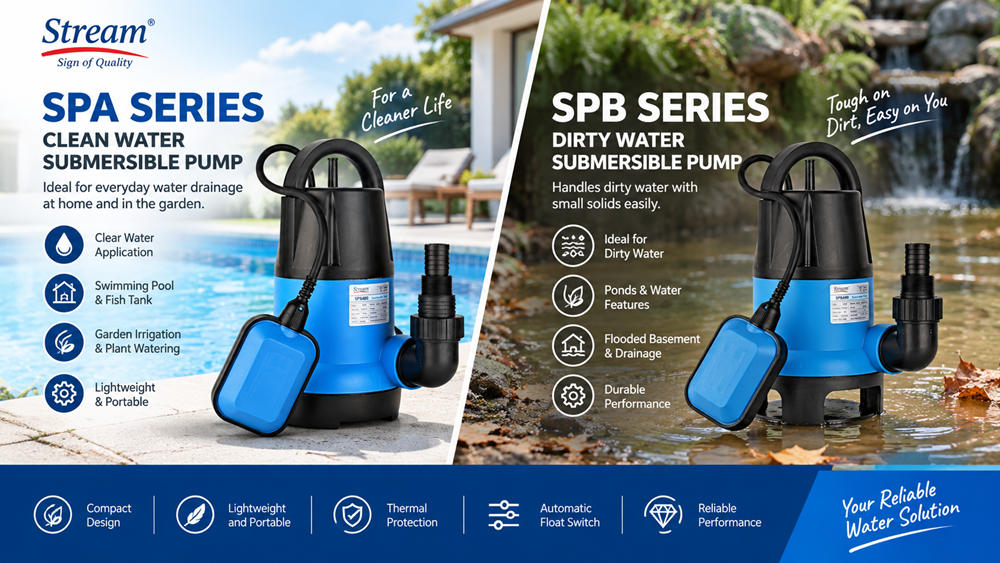
A portable submersible pump is one of the most useful water-handling tools a homeowner can keep in the garage, garden shed or utility room.
Whether you need to empty a swimming pool, drain a hot tub, remove rainwater from a basement or clean out a garden pond, placing a lightweight pump directly into the water is often the fastest and simplest solution.
The Stream SPA and SPB series are designed for exactly these everyday household and garden drainage tasks.
Both are compact plastic submersible pumps with automatic float switches, simple hose connections and lightweight construction, but they are designed for different water conditions.
The SPA series is the clean-water version, intended for relatively clear water such as swimming pools, hot tubs, water tanks and similar applications.
The SPB series is the dirty-water version, using a vortex impeller and a larger solids passage to handle water containing leaves, small debris and other suspended contaminants.
This guide explains the difference between clean-water and dirty-water submersible pumps, where the Stream SPA and SPB are best used, and how to choose the correct pump for common household and garden drainage jobs.
The SPA and SPB are lightweight electric submersible drainage pumps designed primarily for household and garden use.
A submersible pump operates while fully immersed in the water being pumped.
Instead of pulling water through a suction pipe from above, the pump sits directly inside the liquid and pushes the water through the discharge hose.
This makes the design simple to use:
Connect a suitable discharge hose
Place the pump into the water
Allow the float switch to move freely
Connect the electrical supply safely
Let the pump remove the water
Because no surface suction priming is required, small submersible pumps are particularly convenient for temporary drainage and emergency household use.
The most important difference is the type of water each pump is designed to handle.
| Feature | Stream SPA | Stream SPB |
|---|---|---|
| Pump Type | Clean Water Submersible Pump | Dirty Water Submersible Pump |
| Typical Water | Clear or relatively clean water | Water containing leaves and small debris |
| Max. Particle Size | Up to 5 mm | Up to 35 mm |
| Impeller Concept | Clean-water impeller design | Vortex impeller |
| Float Switch | Automatic | Automatic |
| Typical Applications | Pools, spas, tanks and clean-water areas | Ponds, flooded areas, pits and dirty-water drainage |
A clean-water submersible pump is designed for water containing very little suspended debris.
Examples include:
Swimming pool water
Hot tub and SPA water
Water storage tanks
Hydroponic nutrient solutions
Relatively clean basement floodwater
General household water transfer
Clean-water pumps normally use narrower hydraulic passages than dirty-water pumps because they do not need to pass large solids.
This allows a compact design and efficient water transfer, but it also means the pump should not be used in water containing large leaves, gravel, sludge or other debris.
The Stream SPA series is designed for household and garden applications where the pumped water is relatively clean.
Typical uses include draining swimming pools, spas, hot tubs, tanks and flooded areas where large solid contamination is not present.
The SPA can handle suspended particles up to approximately 5 mm under the specified conditions.
This makes it suitable for normal clean-water drainage while still allowing a small amount of fine contamination.
Swimming pools periodically need to be partially or fully emptied for maintenance, cleaning or seasonal storage.
A submersible pump can be placed directly into the pool and connected to a discharge hose.
Because pool water is usually relatively clear, the SPA clean-water version is well suited to this task.
Hot tubs and spas contain a large volume of relatively clean water that can take a long time to remove through a small drain plug.
A portable submersible pump can speed up the process significantly.
This is one reason SPA-type clean-water pumps are popular with homeowners.
Storage tanks sometimes need to be emptied for cleaning, inspection or maintenance.
The SPA can be lowered directly into a suitable clean-water tank and removed again after the work is complete.
For sufficiently large aquariums or holding tanks, a small submersible clean-water pump can make water removal faster than siphoning or carrying buckets.
Care should be taken to prevent fish, gravel or other aquarium materials from entering the pump inlet.
The pump is best used after livestock has been safely separated and where the water condition is compatible with the pump.
Stream also lists hydroponic nutrient solutions among the suitable SPA applications.
The pump can be used for appropriate nutrient-solution transfer where the liquid remains compatible with the pump materials and working conditions.
Rainwater or plumbing leaks can leave standing water in a basement.
If the water is relatively clean and does not contain significant debris, a portable clean-water submersible pump can provide a simple emergency drainage solution.
A dirty-water submersible pump is designed with larger hydraulic passages so it can pump water containing suspended solid material.
This can include:
Leaves
Small twigs
Plant material
Organic debris
Small solid particles
Contaminated rainwater
The goal is not to grind these contaminants into small pieces.
Instead, the pump is designed to let compatible solids pass through the hydraulic system without immediately blocking the impeller.
The Stream SPB is the dirty-water version of this lightweight garden drainage pump concept.
It uses a vortex impeller designed to provide a large solids passage.
The SPB can handle particles up to approximately 35 mm under the specified conditions.
This makes it much more suitable than the SPA for garden ponds, outdoor pits, flooded areas and other locations where leaves or small debris may be present.
A vortex impeller creates a rotating mass of water inside the pump casing.
This hydraulic vortex helps carry suspended solids through the pump while reducing the need for every particle to pass directly through narrow impeller passages.
The result is better resistance to clogging when pumping water containing compatible debris.
This is why vortex impellers are widely used in dirty-water and wastewater pumps.
Garden ponds often contain leaves, algae, plant fragments and other organic material.
A clean-water pump can clog quickly in this environment.
The SPB's larger solids passage makes it better suited to this type of drainage.
Rainwater collecting in yards, patios or low-lying outdoor areas may contain leaves and other debris.
A dirty-water pump provides more tolerance to these contaminants than a clean-water pump.
The SPB can also be used for appropriate light-duty building-pit drainage where water contains small suspended debris.
However, large quantities of sand, gravel or highly abrasive slurry may require a heavier construction drainage pump.
If a pool or pond has been neglected and contains leaves, plant matter or other debris, the SPB may be more appropriate than the SPA.
Pump selection should always be based on the actual water condition rather than the name of the application alone.
The SPB can also transfer water for suitable irrigation and garden applications where the water contains small suspended contaminants.
One of the most common mistakes when selecting a portable submersible pump is focusing only on power or maximum flow.
The condition of the water is equally important.
A clean-water pump placed in dirty pond water can quickly become blocked by leaves or debris.
If the impeller cannot rotate freely, motor load can increase and the pump may overheat.
Choosing a dirty-water pump for debris-containing water helps reduce this risk.
The SPA and SPB provide a clear example of why solids passage is such an important specification.
The SPA is designed for particles up to approximately 5 mm.
The SPB can pass particles up to approximately 35 mm.
That difference changes the type of water each pump can safely handle.
| Water Condition | Recommended Pump |
|---|---|
| Clear pool water | SPA |
| Hot tub water | SPA |
| Tank water | SPA |
| Pond water with leaves | SPB |
| Floodwater with small debris | SPB |
| Water with heavy sand or gravel | Use a suitable heavy-duty drainage pump |
Automatic Float Switch for Hands-Free Operation
Both the SPA and SPB series use an automatic float switch.
The float rises as the water level increases.
When it reaches the pump's switching point, the pump starts automatically.
As the water level falls, the float moves downward and eventually stops the pump.
This is useful in areas where water may accumulate gradually, such as basements, pits, ponds or tanks.
Without a float switch, the user must manually monitor the pump and switch it off before the water level becomes too low.
Automatic water-level control reduces the need for constant supervision.
It also helps reduce unnecessary dry running when the installation and float movement are suitable.
SPA and SPB are designed primarily as portable household and garden pumps rather than permanently installed heavy-duty industrial equipment.
The plastic construction provides several practical advantages:
Low overall weight
Easy carrying
Simple storage
Good resistance to normal clean-water corrosion
Convenient temporary installation
A homeowner can store the pump when it is not needed and quickly deploy it when flooding, pool maintenance or pond cleaning becomes necessary.
Both product families are designed with multiple hose adapter options.
This makes it easier to connect different common hose diameters depending on the drainage application.
Using an appropriately sized hose is important because an undersized discharge hose increases friction and can reduce actual pump flow.
The SPA and SPB include thermal motor protection.
If abnormal operating conditions cause excessive motor temperature, the protector provides an additional layer of protection.
Thermal protection should not be treated as a substitute for correct operation.
Blocked inlets, unsuitable solids and dry running should still be avoided.
| Parameter | SPA | SPB |
|---|---|---|
| Liquid Temperature | Up to 35°C | Up to 35°C |
| Max. Particle Size | 5 mm | 35 mm |
| Max. Submersion Depth | 7 m | 8 m |
| Protection Class | IPX8 | IPX8 |
| Insulation Class | Class B | Class B |
| Power Supply | 230V / 50Hz / Single Phase | 230V / 50Hz / Single Phase |
The easiest way to choose between SPA and SPB is to look at what is floating in the water.
If the water is clear and does not contain meaningful debris, use a clean-water pump.
If you can see leaves, plant material or other small solids, a dirty-water pump is usually more appropriate.
A simple rule is:
Clean water → SPA
Water with small debris → SPB
Yes.
A dirty-water pump can generally pump clean water because its larger hydraulic passage does not prevent normal water transfer.
However, if the water is consistently clean, the SPA may be the more appropriate and purpose-specific choice.
Only within its stated particle-handling limit.
The SPA is rated for particles up to approximately 5 mm.
It should not be placed into a pond or pit containing large leaves, sticks or other debris that may block the inlet or impeller.
No.
The SPB is a dirty-water drainage pump, but it should not be confused with a sewage pump.
Sewage pumps are specifically designed for wastewater containing fecal matter, fibers and larger or more difficult solids.
For sewage, septic tanks or wastewater containing fibrous contaminants, a dedicated sewage or grinder pump should be selected.
Dirty-water capability does not mean unlimited solids handling.
The SPB is suitable for water containing compatible debris such as leaves and small solids, but heavy sand, gravel and abrasive slurry can cause rapid wear.
Construction sites with large quantities of abrasive material should use pumps designed specifically for dewatering or slurry applications.
SPA and SPB belong to one of the most common domestic pump categories worldwide.
Their popularity comes from simplicity rather than advanced technology.
Homeowners usually want a drainage pump that is:
Easy to carry
Easy to connect
Automatic
Affordable
Compact enough to store
Useful for several different household jobs
A lightweight plastic submersible pump meets these requirements very well.
A portable drainage pump may spend much of the year in storage.
That does not make it unnecessary.
When a basement floods, a tank needs cleaning or a pool has to be emptied, being able to deploy a pump immediately can save hours of manual work.
This makes compact submersible pumps useful as general household equipment rather than single-purpose machines.
For a normal pool containing clear treated water, the SPA clean-water pump is the natural choice.
If an abandoned or uncovered pool contains leaves and other debris, the SPB may be more suitable.
The correct decision depends on water condition rather than simply whether the application is called a swimming pool.
A clean ornamental pond with very little debris can sometimes be handled by a clean-water pump.
However, most garden ponds naturally accumulate leaves, algae and plant material.
For these conditions, the SPB dirty-water version is usually the safer choice because of its vortex impeller and larger solids passage.
If flooding comes from a clean plumbing leak or relatively clear rainwater, the SPA may be sufficient.
If the water contains outdoor debris, mud or small solids, the SPB provides greater solids-handling capability.
Electrical safety must always be considered before entering a flooded area or using electrical equipment.
A small hose increases hydraulic resistance and can significantly reduce the actual flow rate.
The float must have enough room to rise and fall without becoming trapped against a tank or pit wall.
Avoid positioning the pump directly in deep mud or loose sediment.
Use the pump handle or recommended lifting method.
Choosing between SPA and SPB before placing the pump in the water can prevent unnecessary clogging.
After using an SPB in pond water or other contaminated areas, rinse the pump with clean water before storage.
The SPA is a lightweight submersible clean-water drainage pump designed for pools, hot tubs, tanks, basements and other relatively clean-water applications.
The SPB is a plastic dirty-water submersible pump with a vortex impeller designed for ponds, flooded areas and other water containing compatible small solids.
The Stream SPA is specified for particles up to approximately 5 mm.
The Stream SPB is specified for particles up to approximately 35 mm.
Yes. The SPA uses a float switch for automatic start and stop according to water level.
Yes. The SPB also includes automatic float control.
Yes. Swimming pool drainage is one of its main intended applications.
Yes. SPAs and hot tubs are specifically listed among the applications of the SPA series.
Yes, provided the contaminants remain within the pump's specified solids-handling capability.
Yes. The SPB can also be used for clean-water transfer, although SPA is specifically optimized for clean-water applications.
They are not designed as sewage pumps. Wastewater containing fecal matter, heavy fibers or difficult solids should be handled by a dedicated sewage or grinder pump.
Yes. Their lightweight plastic construction makes them particularly suitable for temporary household and garden use.
Both series specify liquid temperatures up to 35°C.
The SPA is specified for maximum submersion up to 7 m, while the SPB is specified up to 8 m.
The Stream SPA and SPB are good examples of why a water pump does not need to be complicated to be useful.
Both are lightweight, portable and easy to deploy around the home and garden.
The SPA is designed for relatively clean water and is well suited to swimming pools, hot tubs, water tanks and similar applications.
The SPB uses a vortex impeller and a larger 35 mm solids passage, making it more suitable for garden ponds, flooded areas and water containing leaves or small debris.
Both models include automatic float control, thermal motor protection and multiple hose connection options.
Address
No.17 XeDa Jimei Ind. Park, Xiqing Economic Development Area, Tianjin, China
Telephone
+86 13816508465
QUICK LINKS