+86 13816508465
Pump Knowledge
Oct. 26, 2026
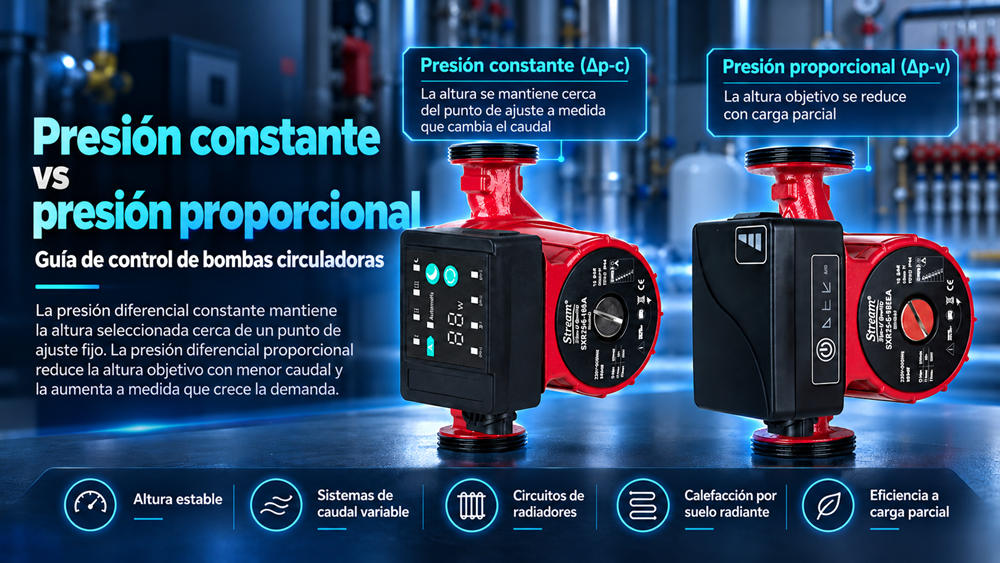
Constant differential-pressure control keeps the pump's selected pressure head approximately constant as flow changes. Proportional differential-pressure control reduces the target head at lower flow and raises it as demand increases. In closed-loop heating systems, constant pressure is often suitable where distribution pressure losses are low, while proportional pressure may be more suitable for variable-flow pipe networks with substantial friction losses. The best setting depends on the actual system, not simply the type of pump.
This practical guide explains the difference, where each mode works best, and what buyers should check before selecting a circulation pump.
In constant differential-pressure mode (often shown as &Δp-c), the circulator adjusts its speed to keep the selected differential head near a fixed setpoint over the operating range. When radiator or zone valves close and flow falls, the controller reduces pump speed as needed to maintain that head.
This mode can be appropriate when pressure losses in the supply and distribution pipework are relatively low, and a stable differential pressure is needed across the served circuits. Many underfloor heating manifolds are common examples, subject to system design and valve arrangement.
In proportional differential-pressure mode (often shown as &Δp-v), the controller lowers the target pump head as flow demand decreases and increases the target as flow rises. This better reflects systems where friction losses in pipes and fittings change significantly with flow.
It is frequently considered for variable-flow two-pipe radiator circuits with thermostatic radiator valves, particularly when pressure losses in distribution pipework are important. Lower head at part load can help reduce unnecessary differential pressure and valve noise; energy savings depend on the starting condition and system operation.
| Factor | Constant Pressure (Δp-c) | Proportional Pressure (Δp-v) |
|---|---|---|
| Target head as flow decreases | Remains near selected setpoint | Decreases along control curve |
| Often suitable where | Distribution pressure loss is relatively low | Distribution pressure loss varies substantially with flow |
| Typical example | Selected underfloor heating circuits | Variable-flow two-pipe radiator circuits |
| Main setup check | Avoid an unnecessarily high pressure setpoint | Ensure critical circuits still receive sufficient flow at part load |
| Energy savings | Possible compared with unsuitable fixed-speed operation | Potentially greater part-load reduction in suitable networks |
General engineering selection guidance; final settings depend on the designed hydraulic circuit and the selected pump's documented control curves.
| System situation | Initial mode to assess | What to verify |
|---|---|---|
| Underfloor heating with manifold zone controls | Constant pressure | Manifold flow rates, valve behavior and pipe losses |
| Two-pipe radiators with thermostatic valves | Proportional pressure | Remote radiator flow, valve noise and balancing |
| Nearly constant-flow circuit | Constant speed or other designed control | Minimum flow requirement of boiler or heat exchanger |
| Unknown or mixed hydronic circuit | Assess AUTO if supported, then verify | Actual duty point, system design and controller behavior |
Important: These are starting points, not universal commissioning instructions. The circuit design, balancing arrangement and minimum-flow requirements can override the typical choice. Neither control mode fixes undersized pipes, trapped air or incorrect hydraulic balancing.
Consider an illustrative closed-loop radiator system needing approximately 5 m pump head at full flow. Suppose 2 m is associated with the terminal/control-valve requirement and 3 m with flow-dependent distribution losses.
If demand falls to half of design flow, and the distribution friction loss is approximated as proportional to flow squared, its contribution becomes 3 × (0.5)2 = 0.75 m. An approximate required head would then be 2 + 0.75 = 2.75 m, rather than 5 m.
This simplified calculation illustrates why reducing the target head at part load may be useful in some networks. It does not represent a specific Stream pump control curve, measured energy saving or commissioning recommendation. Real valve pressure drops and system characteristics may differ.
According to Stream's published EA circulation pump series introduction, the control-mode options vary by series:
| Series | Published modes | Buyer note |
|---|---|---|
| EA | AUTO, constant speed, constant pressure, proportional pressure, PWM | PWM described as an available option; confirm exact variant |
| A | AUTO, constant speed, constant pressure, proportional pressure, night mode | Check display and control requirements |
| E | AUTO, constant speed | Do not specify independent constant/proportional modes without confirmation |
Consult the model-specific product documentation to confirm available head settings, control curves and application limits. Published series information is not a substitute for selecting a model at its required duty point.
Identify the circuit type: two-pipe radiator, underfloor heating, single-pipe or other.
Record the design flow rate and required pump head.
Determine how much of the system loss is due to distribution pipework.
Confirm whether valves change the flow during normal operation.
Check minimum-flow requirements of boilers and heat exchangers.
Select a model whose documented duty range and control modes match the system.
After commissioning, check heating performance, valve noise and operation at low demand.
Buying tip: A control mode cannot compensate for the wrong hydraulic size. When requesting a quotation, provide both the circuit design and the required operating point, not just the nominal pipe diameter or motor wattage.
No. Constant-pressure control can change the pump's rotational speed to maintain a differential-head setpoint. Constant speed uses a selected speed or pump curve, so differential pressure generally changes as flow changes.
No. It may reduce unnecessary pump head at part load in suitable variable-flow networks, but actual electricity use depends on system resistance, control settings, run time and pump efficiency.
No. It is a useful starting point for many variable-flow two-pipe radiator circuits, but special hydraulic arrangements, minimum-flow requirements and system design can call for a different mode.
Choose the circulation pump's differential-pressure mode to suit the network's pressure-loss behavior. Constant pressure can suit circuits with comparatively low and stable distribution losses; proportional pressure may suit variable-flow circuits where pipe friction changes appreciably with demand. Confirm the actual operating point, circuit arrangement and available pump controls before purchasing.
Explore the Stream EA / A / E circulation pump series or contact Stream Pumps with your circuit specifications for model information.
General control principles: ASHRAE Handbook — Centrifugal Pumps, Differential Pressure Control. Product-mode availability: Stream EA Series Introduction. Context on circulator scope: European Commission — Circulators.
The numerical example is an educational illustration, not a performance test of a Stream product. Regulatory references are provided for context and do not imply model certification or compliance in a particular market.
Address
No.17 XeDa Jimei Ind. Park, Xiqing Economic Development Area, Tianjin, China
Telephone
+86 13816508465
QUICK LINKS