+86 13816508465
Pump Knowledge
Nov. 20, 2026
Size a fixed-speed booster pump pressure tank by required drawdown, not by its nominal litre capacity alone. First identify pump flow at the actual operating pressure and the minimum motor run time. Then check pressure-switch cut-in, cut-out and tank precharge to determine how much usable water the tank delivers between starts. A 24 L vessel does not supply 24 L of drawdown.
| Parameter | Why It Matters |
|---|---|
| Pump flow at duty point (L/min) | Controls tank refilling rate; do not use maximum flow at zero head. |
| Minimum required pump run time | Helps limit starts and motor heating; verify manufacturer requirements. |
| Cut-in and cut-out pressures | Define pressure range over which stored water is delivered. |
| Air precharge | Changes usable water volume; check only with water pressure relieved. |
| Tank working pressure and material | Must suit installation, water quality and local requirements. |
Required drawdown (L) = pump delivery (L/min) × minimum required run time (min). For a hypothetical pump delivering 20 L/min during refill and a specified one-minute minimum run time, required drawdown is 20 L. The assumed one-minute target is an illustration, not a universal requirement for every Stream model.
Drawdown is different from nominal tank volume. The tank contains compressed air and water, so usable water between switching pressures is only a fraction of the vessel's rated size. The fraction varies with pressure settings; it is not always 30%.
Assume a diaphragm tank with pump cut-in at 2.0 bar(g), cut-out at 3.0 bar(g), and air precharge at 1.8 bar(g). Under a simplified ideal-gas model, convert all pressures to absolute values by adding approximately 1.013 bar.
Ideal drawdown fraction = precharge absolute pressure × (1/cut-in absolute pressure − 1/cut-out absolute pressure).
| Required drawdown | 20 L |
| Assumed pressure range | 2.0–3.0 bar(g) |
| Air precharge | 1.8 bar(g) |
| Idealized drawdown fraction | Approximately 23.3% |
| Calculated theoretical tank size | 20 ÷ 0.233 ≈ 86 L |
Interpretation: Look for a tank whose manufacturer-published drawdown at these actual pressure settings meets or exceeds 20 L. A nominal volume above 86 L may be considered for this hypothetical design, but never assume a specific model meets the target without its certified pressure rating, bladder limits and drawdown table. This is a teaching calculation, not a Stream product test.
Stream PS130 combines a pump, sealed pressure tank and pressure switch. Its published maximum pump flow is 36 L/min, but that is not necessarily its flow at the tank's operating pressures.
The Stream AUTO booster series shows why configuration matters: AUTOSCPM lists 24 L / 50 L tank options and 1.4 / 2.6 bar switch settings; AUTOSQB lists a 24 L tank and 1.1 / 1.8 bar switching. These are published package details, not independent tank-sizing recommendations. Compare drawdown under the actual settings before selecting equipment.
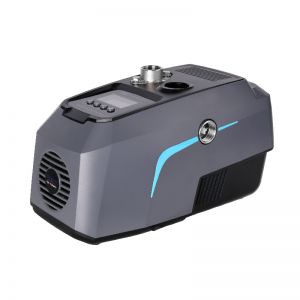
Hydrobox 900 uses variable-frequency constant-pressure control. The fixed-speed switch example here must not be applied to it without the specific controller's guidance.
Using maximum pump flow rather than the flow at the switching-pressure range.
Treating a 24 L tank as 24 L of usable stored water.
Assuming drawdown always equals 30% of tank volume.
Ignoring air precharge, leaks, faulty check valves or damaged diaphragms.
Applying fixed-speed pressure-switch rules to a VFD-controlled system.
Adjusting tank precharge without isolating power and relieving water pressure.
If the pump already starts and stops too frequently, first investigate the pressure system. See Stream's pressure tank cycling troubleshooting guide.
Before asking for a pressure tank quotation, provide: pump model and its flow at working pressure; required flow; desired motor run time or maximum starts per hour; cut-in/cut-out pressures; available precharge setting; tank orientation and installation space; maximum working pressure; water temperature; and applicable potable-water or material requirements. Ask for the drawdown chart at your exact settings.
No. The pump's performance and system conditions determine available head; a tank stores pressurized water and affects cycling.
It depends on real pump flow, switching pressures, precharge and permitted starts. Nominal capacity alone does not determine suitability.
Not without checking the controller. Variable-speed pumps may use different start/stop logic and smaller buffer tanks.
Choose tank drawdown first; select nominal capacity second. Check the working-point flow, switching pressures and manufacturer's drawdown chart to avoid short cycling and unsuitable equipment. Contact Stream Pumps with your booster system specifications for product information.
Address
No.17 XeDa Jimei Ind. Park, Xiqing Economic Development Area, Tianjin, China
Telephone
+86 13816508465
QUICK LINKS