+86 13816508465
Pump Troubleshooting
Jun. 25, 2026
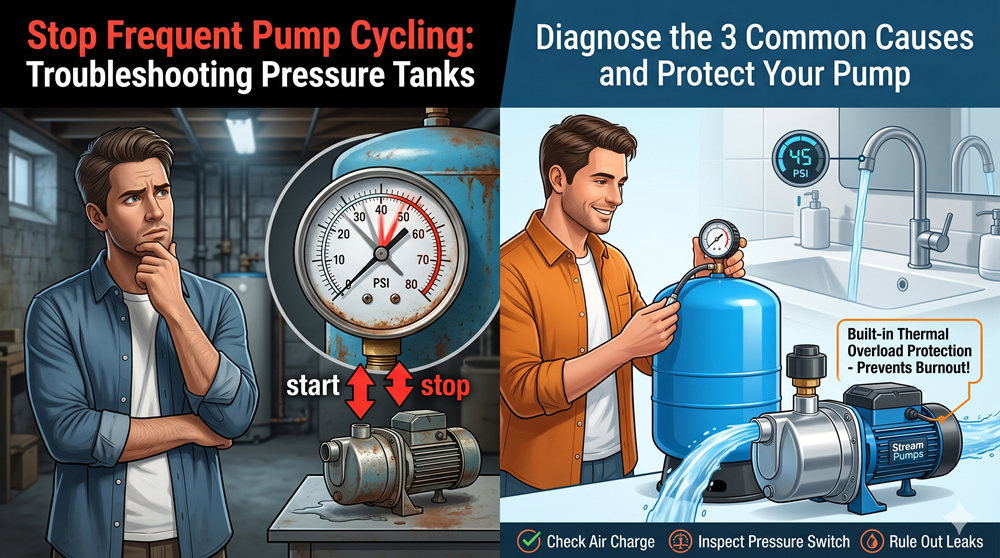
Frequent pump cycling and constant running are usually caused by three issues: a waterlogged pressure tank, a faulty pressure switch, or a system leak. Diagnosing each is straightforward—and a pump with thermal overload protection, like a Stream Pumps unit, survives these failures instead of burning out.
You turn on the faucet, and the water pressure surges, then drops, then surges again. Or worse, you can hear your water pump running constantly in the basement, even when no one is using a drop of water.
It's frustrating. And when a domestic water system starts acting up, most homeowners blame the pump right away. The truth is more nuanced. The problem almost always comes down to the delicate balance between three components: the pump, the pressure tank, and the pressure switch. When one piece falls out of sync, the whole system suffers—and ignoring the warning signs leads to burnt-out motors and expensive repair bills.
The good news? You can diagnose and fix the vast majority of these problems yourself with a few simple checks. This guide walks you through the three most common causes of pressure system failures, how to resolve each one, and why a resilient pump can save you from a costly motor burnout when things go wrong.
Think of your domestic water supply as a three-part system. Each component has a specific job, and they rely on each other to deliver steady pressure throughout your home.
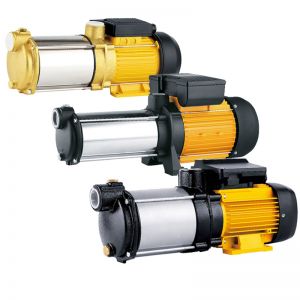
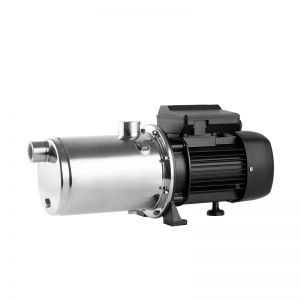
The pump (such as a Stream Pumps Jet Pump or submersible pump) moves water from your well or source into the system.
The pressure tank stores pressurized water using a cushion of compressed air, so the pump doesn't have to run every time you open a tap.
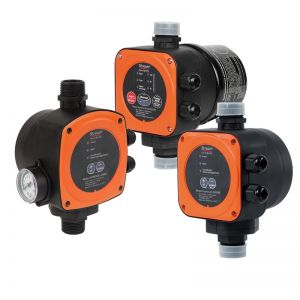
The pressure switch acts as the brain. It tells the pump when to switch on (the cut-in pressure) and when to shut off (the cut-out pressure), based on the pressure inside the tank.
Here's the rule of thumb worth remembering: if any one of these three components fails, the entire system suffers. A healthy pump can't compensate for a broken tank, and a perfect tank can't fix a faulty switch. Diagnosing your problem means figuring out which link in the chain has broken.
If your pump kicks on and off every few seconds—a problem known as pump short-cycling—the most likely culprit is a waterlogged pressure tank.
What happens inside a waterlogged tank
A pressure tank works because of the air trapped inside it. In most modern tanks, a rubber diaphragm or bladder separates the air charge from the water. Over time, that diaphragm can rupture, or the air charge can slowly leak out through the air valve. When the air is gone, the tank fills completely with water. With no compressed air to act as a buffer, the system loses its ability to store pressure, and the pump is forced to switch on and off constantly to keep up.
This rapid cycling is brutal on a pump motor. Every start draws a surge of current, and a motor that should cycle a few times an hour may now cycle several times a minute.
How to diagnose a waterlogged tank
You don't need special tools for the first test. Simply knock on the side of the tank with your knuckles. A healthy tank sounds hollow near the top (the air pocket) and solid near the bottom (the water). If the tank sounds solid and heavy all the way to the top, it's waterlogged.
For a more precise check, turn off power to the pump, drain the tank, and use a tire pressure gauge on the air valve. The reading should sit about 2 PSI below your pressure switch's cut-in setting.
How to fix a waterlogged pressure tank
If the air charge is simply low: Recharge the tank to the correct pressure using a standard tire compressor, then monitor it over the next few weeks.
If the bladder is torn: The tank needs to be replaced. A ruptured diaphragm can't be repaired, and a new tank is a far cheaper fix than a new motor.
A water pump constantly running points to one of two problems: a faulty pressure switch or a leak somewhere in your system.
Scenario A: A failing pressure switch
The pressure switch contains electrical contacts that open and close to control the motor. After years of use, those contacts can become fused shut from electrical wear, leaving the pump permanently powered on. Another common issue is a clogged sensing tube—when sediment blocks the small port that lets the switch [feel] the water pressure, the switch goes blind and never tells the pump to stop.
The fix is usually inexpensive. A replacement pressure switch is a low-cost part, and swapping it out (with power safely disconnected) restores normal operation. If the sensing tube is simply clogged, cleaning it may solve the problem entirely.
Scenario B: A hidden system leak
If the switch checks out, the pump may be running because it physically can't reach its cut-out pressure. A large leak in an underground supply line, or even a constantly running toilet, drains pressure as fast as the pump can build it. The motor keeps working, trying to hit a target it can never reach.
Walk through your home and check every fixture. Listen for running toilets, inspect visible piping, and watch your water meter when no fixtures are open—a moving meter confirms a hidden leak.
When your pressure is weak or swings up and down, two causes top the list.
The first is a mismatch between your tank's air charge and your pressure switch settings. As a rule, the air pressure in the tank should always sit about 2 PSI below the switch's cut-in pressure. When these two numbers drift apart, you get uneven, unpredictable pressure at the tap. Recalibrating the pump pressure switch and resetting the tank's air charge usually restores smooth delivery.
The second cause is mechanical wear. Over years of service, a pump's impellers gradually erode and lose the ability to build adequate pressure. If your tank and switch are both correct but pressure remains weak, a worn impeller—or an aging pump nearing the end of its life—is the likely answer.
Here's the part most troubleshooting guides skip over: what actually happens to your pump when the tank waterlogs or the switch fails?
The danger is real. When a pressure switch fuses shut or a tank loses its air charge, a standard pump may run continuously without enough water to cool it. The motor overheats. In the worst cases, a cheap pump will run until it melts its internal components—or, in extreme situations, becomes a fire risk.
This is where pump quality stops being a spec sheet detail and starts protecting your home and your wallet.
Built-in thermal overload protection
Stream Pumps Jet and submersible models feature advanced thermal overload protection. If a faulty switch forces the pump to run dry or overheat, the motor automatically shuts itself down before damage occurs. Instead of a catastrophic burnout, you get a pump that protects itself and waits for you to fix the underlying issue. For a homeowner, that single feature can be the difference between a $20 switch replacement and a full pump-and-motor replacement.
Heavy-duty continuous-running capability
Stream Pumps are built for demanding, sustained operation. Established in 1997 and now serving more than 110 countries, the company engineers its pumps for durability under real-world conditions—exactly the kind of resilience you want when your system is under stress.
Standardized, compatible threading
Repairs are easier when parts fit. Stream Pumps use standard threading (such as 1-inch NPT/BSP connections), making it simple to attach any brand of new pressure switch, gauge, or tank directly to the pump casing. You're never locked into a single supplier, and upgrades stay straightforward.
Choose a thermally protected pump if you live somewhere with frequent power fluctuations, run your system hard, or have already lost a motor to a switch or tank failure. The upfront investment pays for itself the first time a component fails and your pump shuts down safely instead of burning out.
Troubleshooting your pressure system doesn't have to be intimidating. By checking the tank's air charge with a simple knock test, confirming your pressure switch settings, and ruling out leaks, you can solve roughly 90% of common home water problems on your own. Start with the cheapest and easiest checks first—the switch and the tank air charge—before assuming the pump itself is to blame.
But if your old pump is struggling to keep up, or a bad tank has already caused a motor burnout, it's time for a reliable upgrade. Visit www.streampumps.com to explore heavy-duty, thermally protected domestic water pumps built to handle the toughest conditions—and engineered to survive the day your tank or switch finally fails.
How do I know if my pressure tank is waterlogged?
Knock on the side of the tank. A healthy tank sounds hollow near the top, where the air pocket sits, and solid near the bottom. If it sounds solid all the way up, the tank has lost its air charge and is waterlogged. Confirm it by checking the air valve pressure, which should be about 2 PSI below your pressure switch's cut-in setting.
How much does it cost to fix a short-cycling pump?
It depends on the cause. Recharging a low tank with a tire compressor costs almost nothing. A replacement pressure switch is a low-cost part. Replacing a tank with a torn bladder costs more but is far cheaper than replacing a burnt-out pump motor—which is why catching these issues early matters.
Can a faulty pressure switch damage my pump?
Yes. If the switch's contacts fuse shut, the pump runs continuously. Without enough water to cool it, the motor can overheat and burn out. Pumps with built-in thermal overload protection, like Stream Pumps models, automatically shut down in this situation to prevent permanent damage.
What should the air pressure in my pressure tank be?
The tank's air charge should be set approximately 2 PSI below your pressure switch's cut-in pressure. For example, if your switch cuts in at 30 PSI, set the tank air pressure to about 28 PSI. Always check this with power off and the tank drained.
Should I repair my old pump or replace it?
Repair when the issue is an inexpensive component like the pressure switch or a low tank charge. Consider replacement when the pump's impellers are worn, pressure stays weak after other fixes, or the motor has already overheated. A new, thermally protected pump offers better long-term reliability than repeatedly patching an aging unit.
Address
No.17 XeDa Jimei Ind. Park, Xiqing Economic Development Area, Tianjin, China
Telephone
+86 13816508465
QUICK LINKS