+86 13816508465
Sep. 09, 2026
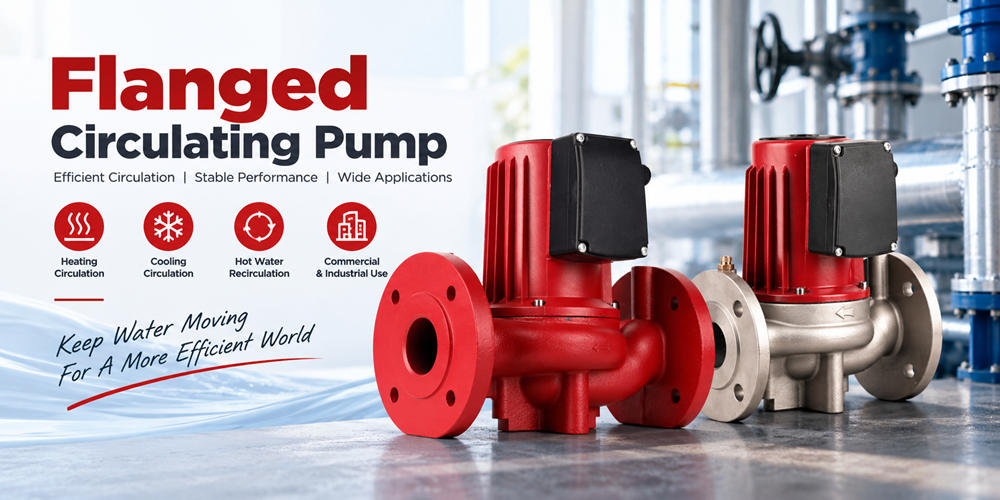
Circulation pumps are essential in heating, cooling and hot-water systems because they keep water moving through boilers, heat exchangers, radiators, underfloor loops, fan coils and long building pipe networks.
For small domestic systems, compact threaded circulators are often sufficient.
As system size increases, however, the required flow rate, pipe diameter and hydraulic resistance can increase significantly.
This is where a flanged circulation pump becomes more appropriate.
The Stream SXR Flanged Circulation Pump range is designed for heating, air-conditioning, domestic hot-water recirculation and solar water-heating systems where higher flow, higher head and larger pipe connections are required.
The series is available in multiple sizes and material configurations, including cast iron, stainless steel and optional bronze pump bodies, allowing the pump to be matched to different water qualities, applications and project requirements.
This guide explains the difference between flanged and threaded circulation pumps, how to choose the correct pump-body material, and how to select the right SXR model according to flow, head, pipe size and system type.
A flanged circulation pump is an in-line water circulator that connects to the piping system through flanges rather than threaded unions.
The pump is installed directly into the pipeline and keeps water moving continuously or intermittently through a closed or recirculating system.
Typical applications include:
Boiler and hydronic heating systems
Central heating
HVAC chilled-water and cooling systems
Domestic hot-water recirculation
Solar water-heating systems
Commercial building circulation
Larger residential heating systems
The Stream SXR flanged range is part of the Stream fixed-speed circulation pump family.
It uses wet-runner circulation-pump technology designed for low-noise water circulation.
Compared with smaller threaded circulators, the flanged series is designed to cover larger connection sizes and higher hydraulic requirements.
Stream specifically positions the flanged range for applications requiring higher flow rates and higher heads.
The series also offers multiple pump-body materials and different model configurations, allowing users to select a pump according to both hydraulic and water-quality requirements.
Flanged in-line connection
Multi-speed operation
Wet-runner circulation technology
Low-noise operation
Dry-running protection
Quick and simple electrical installation
Easy cleaning and lime resistance
Corrosion-resistant impeller and pump housing options
Cast iron, stainless steel and bronze pump-body configurations available depending on model
| Pump Type | Fixed-Speed Flanged Circulation Pump |
| Fluid Temperature Range | -10°C to +110°C |
| Maximum Ambient Temperature | 40°C |
| Protection Class | IP44 |
| Insulation Class | Class H |
| Power Supply | 1~230V / 50Hz |
| Control | Multi-Speed Operation |
Flow, head, connection size and hydraulic performance vary by model and should be selected using the individual performance curve and technical data.
One of the most common questions when selecting a circulator is whether to use a threaded pump or a flanged pump.
Both perform the same basic function: circulating water through the system.
The main differences are connection size, installation method, hydraulic capacity and typical application scale.
| Feature | Threaded Circulator | Flanged Circulator |
|---|---|---|
| Connection | Threaded union connection | Flanged connection |
| Typical Pipe Size | Small to medium | Medium to larger piping |
| Typical Flow | Lower to moderate | Moderate to higher |
| Typical Head | Lower to moderate | Often available with higher head |
| Common Application | Homes, small boilers, underfloor heating | Commercial heating, HVAC and larger hot-water systems |
A flanged circulator becomes more attractive when the system grows beyond the hydraulic range normally covered by small threaded circulation pumps.
Typical reasons include:
Larger pipe diameter
Higher required flow rate
Higher system pressure loss
Longer circulation loops
Multiple heating zones
Commercial building applications
Large boiler or HVAC systems
A threaded circulator is usually sufficient for smaller domestic systems where the pipe size, required flow and hydraulic resistance remain relatively low.
Examples include:
Single-family homes
Small radiator circuits
Small underfloor heating systems
Compact domestic hot-water loops
Small solar heating systems
Using a larger flanged pump in these systems does not automatically improve performance.
Correct sizing remains more important than connection type alone.
As pipe diameter increases, threaded connections become less convenient and less practical.
Flanged connections provide several advantages in larger piping systems:
Strong mechanical connection
Good alignment for larger pipes
Convenient removal during maintenance
Reliable sealing when installed correctly
Better suitability for commercial mechanical rooms
This is why flanged connections are commonly found on larger heating and HVAC circulators.
Not automatically.
Connection type itself does not create flow or pressure.
A pump's hydraulic performance depends on its impeller diameter, motor, hydraulic design and speed.
However, flanged circulation pump ranges are generally developed for larger systems, so manufacturers typically offer them in higher-flow and higher-head configurations than compact threaded circulators.
The individual pump curve should always be used for final selection.
Cast iron is one of the most common materials used for hydronic heating circulation pumps.
In a closed heating or cooling loop, the same water circulates repeatedly through the system.
Once dissolved oxygen is reduced, internal corrosion conditions are generally less severe than in an open potable-water system.
Cast iron therefore provides a durable and economical solution for many closed-loop applications.
Typical cast-iron applications include:
Boiler circulation
Radiator heating
Underfloor heating
Closed-loop HVAC circulation
Chilled-water systems
Stainless steel provides higher corrosion resistance and is suitable where greater material durability or cleaner water-contact surfaces are required.
Compared with cast iron, stainless steel offers:
Improved corrosion resistance
Reduced risk of rust on water-contact surfaces
Premium construction
Suitability for a wider range of clean-water conditions
Actual stainless-steel grade and water chemistry should still be considered when selecting the pump for a specific project.
Bronze is another traditional circulator material, especially where corrosion resistance is important.
Bronze or other approved non-ferrous pump bodies are commonly considered for suitable open-loop and domestic hot-water applications where cast iron may not be appropriate.
The exact pump material should always comply with local drinking-water regulations where the circulated water is potable.
| Material | Typical Strength | Typical Application |
|---|---|---|
| Cast Iron | Economical, rigid and durable | Closed-loop heating and HVAC |
| Stainless Steel | Higher corrosion resistance | Clean-water and corrosion-sensitive systems |
| Bronze | Corrosion-resistant non-ferrous construction | Suitable DHW/open-water applications where approved |
Domestic hot-water recirculation is different from closed-loop heating circulation.
Heating systems normally recirculate the same system water.
Domestic hot-water systems continuously receive fresh oxygenated water.
For this reason, pump-body material is especially important.
Where the pump is used in potable domestic hot water, the selected material must comply with local drinking-water and sanitary regulations.
Stainless steel, bronze or another approved corrosion-resistant material may be more appropriate than conventional cast iron depending on the market and installation.
The SXR flanged range uses wet-runner circulation-pump technology.
In a wet-runner pump, the rotor operates in contact with the circulating liquid rather than being completely isolated in a conventional dry motor arrangement.
The circulated water helps lubricate and cool the internal rotating components.
This design allows compact construction and low-noise operation.
Traditional pumps can produce noise through bearings, cooling fans and motor vibration.
Wet-runner circulators eliminate some of these noise sources.
Because the rotor is surrounded by water and the motor does not require a conventional external cooling fan, operation can be quieter.
This makes wet-runner circulators particularly suitable for residential buildings, hotels and other occupied spaces.
The Stream SXR flanged series uses multi-speed operation.
Different speed settings allow installers to adapt the pump output to the hydraulic resistance of the system.
A higher speed normally produces more flow and head.
A lower speed can reduce pump output where the system requires less circulation.
Selecting the highest speed does not automatically produce the best system performance.
Excessive circulation can cause:
Flow noise
Higher energy consumption
Unnecessary valve pressure drop
Unbalanced heating circuits
The selected speed should provide enough flow to meet the system demand without creating unnecessary excess circulation.
Hydronic heating systems transfer heat by circulating hot water from the boiler to radiators, fan coils or underfloor heating loops.
The circulator must overcome resistance in:
Pipes
Valves
Radiators
Heat exchangers
Manifolds
Larger heating systems often require more flow than a compact threaded pump can provide, making a flanged circulator a practical choice.
Flanged circulation pumps can also be used in cooling systems.
In a chilled-water HVAC loop, the pump circulates water between chillers, air-handling units, fan coils and other heat-exchange equipment.
As the building becomes larger, the required circulation flow normally increases.
This is one of the main reasons flanged pumps are common in commercial HVAC installations.
A domestic hot-water recirculation loop keeps hot water moving through the distribution network so users do not need to wait for hot water to travel from the heater to distant taps.
In larger hotels, apartments, hospitals and commercial buildings, the circulation flow requirement can be significantly higher than in a small home.
A flanged circulator can therefore be considered where the hydraulic duty and material requirements justify it.
Solar thermal systems rely on circulation to transfer heat between solar collectors, storage tanks and heat exchangers.
A circulation pump must provide sufficient flow through the collector circuit while operating within the required fluid-temperature range.
The SXR flanged series is specified for fluid temperatures from -10°C to +110°C, making it suitable for appropriate solar water-heating applications within its stated limits.
Pump selection should begin with the hydraulic requirements of the system, not with the motor size or flange diameter.
The required flow depends on how much heat must be transferred through the water system.
In heating and cooling applications, flow is related to the system heat load and the temperature difference between supply and return.
A larger building usually requires more circulation flow than a small residential system.
The circulation pump must overcome the pressure losses created by the complete circuit.
These losses include:
Pipe friction
Valves
Heat exchangers
Boilers
Radiators
Coils
Manifolds
The flange size should match the system piping and design flow.
Do not choose the pump only because its flange matches the pipe diameter.
Two pumps with the same flange size can have very different hydraulic performance.
Each SXR model has an individual pump curve showing the relationship between flow and head.
The required operating point should fall within the suitable region of the selected pump curve.
For closed-loop heating and cooling, cast iron is often a practical choice.
For systems requiring greater corrosion resistance, stainless steel may be preferred.
For potable hot-water service, select a material approved for the local sanitary and drinking-water requirements.
The SXR flanged series is specified for fluid temperatures from -10°C to +110°C.
The actual fluid must remain within the permitted operating range of the selected configuration.
The standard product page specifies 1~230V / 50Hz power.
The project electrical system should be checked before final pump selection.
A common selection mistake is to replace an existing circulator using only the pipe connection size.
For example, two pumps may both use the same flange diameter while producing very different flow and head.
The correct replacement should match:
Required flow
Required head
Connection size
Installation length
Fluid temperature
System pressure
Pump-body material
Pump head in a closed-loop heating system is often misunderstood.
The pump does not need to continuously lift the entire volume of water to the highest floor as if it were pumping from an open tank.
Water moving downward on the return side helps balance the static elevation on the supply side.
The circulator therefore mainly needs to overcome the friction and pressure losses of the loop.
A pump that is too large can create excessive flow.
Possible consequences include:
Pipe noise
Valve noise
High electricity consumption
Hydraulic imbalance
Unnecessary wear
Correct selection should match the actual system duty rather than choosing the largest available model.
If the pump cannot provide sufficient flow, heat or cooling may not be distributed correctly.
Possible symptoms include:
Cold radiators
Uneven floor heating
Poor cooling performance
Slow hot-water circulation
Traditional multi-speed circulators allow installers to manually select from several operating speeds.
Modern variable-speed circulators can automatically adjust pump output according to system demand.
| Feature | SXR Fixed-Speed / Multi-Speed | Variable-Speed Circulator |
|---|---|---|
| Control | Manual speed selection | Electronic automatic adjustment |
| System Complexity | Simple | More advanced electronics |
| Typical Positioning | Reliable traditional solution | Energy-optimized modern system |
Install the pump according to the flow arrow on the pump body.
Wet-runner circulators should be installed according to the manufacturer's required rotor orientation so the internal bearings remain properly lubricated.
The pump should not carry excessive pipe weight or compensate for badly aligned flanges.
Isolation valves on both sides of the pump simplify service and replacement.
Air trapped inside heating and cooling circuits can cause noise, poor circulation and abnormal pump operation.
Wet-runner circulation pumps rely on the pumped liquid for lubrication and cooling.
Stream specifies dry-running protection, but the pump should still be installed and operated with the system properly filled and vented.
A flanged circulation pump is an in-line circulator connected to the piping system using flanges rather than threaded unions. It is commonly used in larger heating, cooling and hot-water systems.
Threaded circulators are generally used in smaller pipe systems and lower hydraulic duties, while flanged circulators are commonly used with larger pipe sizes and higher-flow systems.
Not necessarily. The flange is a connection method. Actual hydraulic performance depends on the specific pump model, impeller and motor.
Stream lists boiler and hydronic heating, heating systems, cooling systems, domestic hot-water recirculation and solar water-heating systems.
The Stream product page specifies a fluid-temperature range from -10°C to +110°C.
The specified protection class is IP44.
The specified insulation class is Class H.
The standard product specification lists 1~230V / 50Hz.
The SXR range uses wet-runner technology designed for low-noise circulation.
Pump-body material for potable domestic hot water should comply with local water-quality and sanitary regulations. Stainless steel, bronze or another approved material may be more appropriate where fresh potable water is circulated.
Stainless steel is useful where increased corrosion resistance and cleaner water-contact materials are required.
Bronze can be considered for suitable hot-water and corrosion-sensitive applications where the specific alloy and pump are approved for the intended water system.
Determine the required system flow and head, then check the individual Stream performance curve. Connection size, installation length, pump-body material, fluid temperature and electrical supply should also be considered.
No. Flange diameter alone does not define hydraulic performance. The required flow and head should always be checked against the pump curve.
No. Oversizing can increase energy consumption, flow noise and hydraulic imbalance. The correct pump is the one that matches the actual system duty.
The Stream SXR flanged circulation pump series expands the traditional wet-runner circulator concept into larger heating, cooling and hot-water systems.
Compared with compact threaded circulation pumps, flanged models provide a more practical connection method for larger piping and are available across a wider hydraulic range for higher-flow and higher-head applications.
The series combines multi-speed operation, wet-runner low-noise technology, dry-running protection and broad fluid-temperature capability from -10°C to +110°C.
Multiple pump-body materials also allow the product to be adapted to different systems.
Cast iron provides a durable and economical option for many closed-loop heating and cooling systems.
Stainless steel provides enhanced corrosion resistance, while bronze can be considered for suitable hot-water or open-water applications where approved.
For installers, HVAC contractors, building-service engineers and distributors, the most important selection rule is simple:
Choose by required flow and head first, then confirm flange size, material, installation length and system conditions.
With a broad range of models and material configurations, the Stream SXR flanged circulation pump family provides a flexible solution for larger residential, commercial heating, HVAC and hot-water circulation systems.
Address
No.17 XeDa Jimei Ind. Park, Xiqing Economic Development Area, Tianjin, China
Telephone
+86 13816508465
QUICK LINKS