+86 13816508465
Pump Knowledge
Oct. 23, 2026
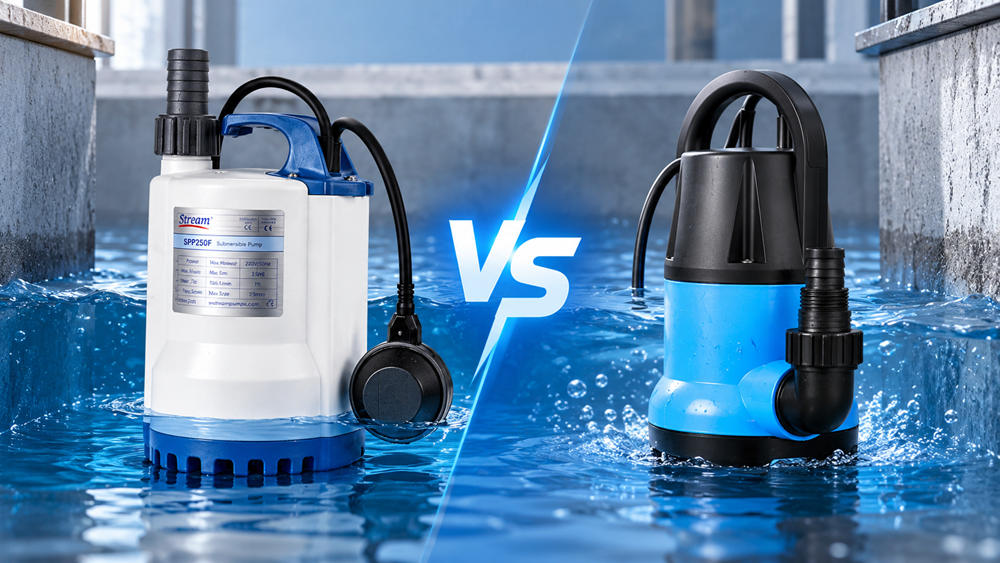
Choose an automatic submersible pump when the water level changes and the pump needs to start and stop without constant supervision. Choose a manual or manually controlled pump when drainage is occasional, the operator can monitor it, or removing shallow residual water is the priority. Neither control method determines how much dirt the pump can handle: liquid type, solids passage, flow and head must be checked separately.
The main buying decision is not simply “automatic is better.” It is whether the installation provides enough room and water depth for a float switch to move correctly, and whether the operator can safely supervise pumping.
| Factor | Automatic float-controlled pump | Manual / manually controlled pump |
|---|---|---|
| Starting and stopping | Float switch responds to water level | Operator switches the pump on/off or manages an approved manual control |
| Best use | Sump pits, tanks and recurring water ingress | Occasional transfer, maintenance and final floor drainage |
| Supervision | Less frequent attention; periodic checks still needed | Requires active monitoring |
| Space required | Float must move freely | Often easier to use in narrow areas |
| Low residual water | Float may stop before the floor is nearly dry | Purpose-built low-level models may remove a shallower layer |
| Dry-running risk | Properly working float reduces risk; not a guarantee | Greater risk if left running after water falls |
| Water quality | Depends on hydraulic design, not control mode | Depends on hydraulic design, not control mode |
Most conventional automatic drainage pumps use a float switch. As the water level rises, the float moves to its start position. When the level falls to the stop position, the switch interrupts pump operation. Actual switching levels depend on the model and the float’s movement.
A float switch needs physical clearance. In a narrow sump, the float can catch on the wall or discharge hose, causing unreliable switching. Measure the usable pit width and the required start/stop levels rather than assuming any automatic pump will fit.
Sump pits where rainwater or groundwater accumulates unpredictably.
Tanks that need periodic emptying as water level rises.
Drainage locations where constant operator attention is impractical.
Manual control suits tasks where someone can observe the water level and stop the pump promptly. A low-level drainage model may have an inlet arrangement designed to remove water closer to a flat surface than a conventional pump with a free-moving float.
Manual does not mean that the pump may safely run dry. The operator must follow the manufacturer’s minimum-water-level and cooling requirements. Never bypass a protective switch unless the specific model provides an approved operating mode for doing so.
| Stream series | Published control / design | Suitable buying question |
|---|---|---|
| SPP250/370(A)F | Float-controlled automatic clean-water drainage | Will the pump be left in a sump where water rises periodically? |
| SPP250/370B | Low-residual, manually controlled clean-water drainage; approximately 1 mm under suitable conditions | Is the main goal to remove remaining water from a flat floor? |
| SPA / SPB | Float-controlled models; SPA clean-water, SPB dirty-water applications | Does the liquid contain solids and does the float have room? |
| SPM 2-in-1 | Float control plus manufacturer-described float-fixing mode | Do you need both automatic drainage and an approved operator-controlled mode? |
Important: The SPP-B residual-water figure is a published product claim for suitable conditions, not an automatic float stop level. The SPA is specified for particles up to 5 mm and SPB up to 35 mm; verify the selected model’s operating limits. The SPM’s manual float-fixing function does not eliminate the need to prevent dry running.
| Application | First option to assess | Why |
|---|---|---|
| Rainwater collecting in a suitable sump | Automatic float-controlled drainage pump | Starts when water rises; check pit dimensions and float travel |
| Occasional swimming-pool or water-tank maintenance | Manual or automatic clean-water pump | Choose based on supervision and desired stop level |
| Final shallow water on a flat basement floor | Purpose-built low-level pump | Conventional floats often stop at higher levels |
| Garden pond water with compatible debris | Dirty-water pump with suitable solids rating | Water quality matters more than automatic/manual control |
| Narrow pit where an external float cannot move | Appropriately designed compact control system | Do not wedge a standard external float into a confined space |
Water quality: clean water, slightly dirty water, or wastewater; describe solids and fibers.
Required duty point: flow rate and total dynamic head at the same operating condition.
Water levels: maximum depth, desired automatic start/stop levels and lowest required residual depth.
Installation: pit dimensions, floor area, pump location and float clearance.
Electrical supply: voltage, frequency and available protection.
Control preference: automatic, manual, or an approved selectable mode; specify expected run pattern.
Do not enter flooded areas where electrical equipment may still be energized; make the area electrically safe first.
Do not lift or suspend a pump by its power cable.
Keep float-switch movement clear of walls, cables and hoses.
Use the pump only within its stated liquid-temperature, immersion and solids limits.
Verify that the discharge hose and elevation do not place the operating point outside the pump curve.
Check the applicable electrical installation requirements for the destination market.
For general standards context, IEC 60335-2-41 addresses safety requirements for household and similar electric pumps, including submersible pumps. Reference to the standard does not imply that any particular Stream model is certified to it.
No. Automatic operation is useful for fluctuating water levels, but a manually supervised low-level pump can be better for final floor drainage or short maintenance jobs.
Not unless the manufacturer specifies an appropriate safe control arrangement. Manual operation generally requires the operator to monitor the water level and stop the pump before dry running.
No. The impeller, passages, seals and published solids limit determine liquid compatibility. A float switch only controls operation by water level.
A conventional free-moving float commonly switches off before that depth. Stream publishes approximately 1 mm residual drainage for its SPP-B low-level configuration under suitable conditions; this is a different operating concept from automatic SPP(A)F control.
Automatic control is generally preferable for recurring drainage when the float has enough room; manual or approved manually controlled operation is often more useful for occasional tasks and low-residual cleanup. Always select the pump by water quality, duty point, operating limits and installation conditions—not the control label alone.
Compare the Stream SPP, SPA/SPB, and SPM ranges, or send Stream your drainage requirements to request a suitable model recommendation.
Previous: None
Address
No.17 XeDa Jimei Ind. Park, Xiqing Economic Development Area, Tianjin, China
Telephone
+86 13816508465
QUICK LINKS