+86 13816508465
Sep. 09, 2026
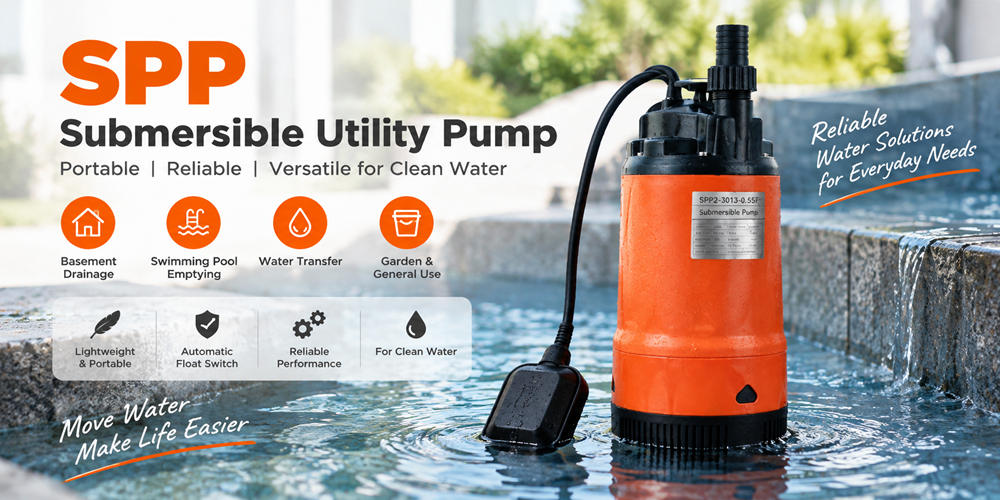
Not every submersible pump is designed simply to remove water from a flooded area.
In many household and garden applications, the real challenge is not drainage but pressure.
Water stored in a rainwater tank, underground reservoir or collection tank may be readily available, but gravity alone may not provide enough pressure to operate a garden hose, sprinkler or domestic water outlet effectively.
The Stream SPP2-30/3-0.55F Multistage Submersible Booster Pump is designed for these situations.
Instead of using a single drainage-style impeller, the pump uses multiple centrifugal stages to progressively add hydraulic energy to the water.
This multi-stage design allows the SPP2-30/3-0.55F to provide significantly higher head than a typical lightweight drainage pump while retaining the convenience of submerged operation and a lightweight plastic construction.
The result is a compact high-head submersible pump suitable for domestic water supply, rainwater harvesting, tank water transfer and garden irrigation.
The Stream SPP2-30/3-0.55F is a clean-water multistage submersible booster pump.
It is designed to operate while submerged directly inside a suitable water source, such as a storage tank, reservoir or rainwater collection tank.
Its main characteristics include:
Multistage centrifugal hydraulic design
High-head capability
Lightweight construction
Automatic float-switch operation
Clean-water pumping
Domestic water-supply capability
Rainwater reuse
Garden and irrigation applications
Stream officially positions the model for domestic water supply, drawing rainwater for gardens and irrigation systems.
A normal utility or drainage pump is usually designed to move a relatively large volume of water at modest pressure.
Its main goal is to empty a basement, pool, sump or tank as quickly and conveniently as possible.
The SPP2-30/3-0.55F has a different hydraulic objective.
It is designed to create useful water pressure.
Instead of focusing primarily on low residual water level or large drainage flow, the multi-stage hydraulic system progressively increases pressure so the water can be delivered through hoses and piping to a higher or more distant outlet.
| Feature | Single-Stage Drainage Pump | SPP2 Multistage Pump |
|---|---|---|
| Hydraulic Stages | One | Multiple |
| Primary Goal | Drain water | Generate higher pressure/head |
| Typical Application | Basements, pools, sumps | Tanks, irrigation, domestic water supply |
| Long Hose Runs | Limited by available head | Better suited where more head is required |
| Sprinklers | May not provide sufficient pressure | More suitable when hydraulic duty matches |
A multistage pump uses several impellers and diffusers arranged one after another.
Water first enters the inlet of the pump and reaches the first impeller.
The rotating impeller transfers mechanical energy from the motor to the water.
The water then passes through a diffuser, which helps convert velocity into pressure and guides the water toward the next hydraulic stage.
At the next stage, another impeller adds more energy.
This process repeats through the available stages.
Rather than relying on one large pressure increase, the pump builds head progressively across several stages.
A centrifugal impeller can add a certain amount of head to the pumped water.
When multiple stages are connected in series, the head produced by each stage is added to the next.
In simplified terms:
Total Pump Head ≈ Head from Stage 1 + Stage 2 + Stage 3 + ...
This is why multistage pumps can generate higher discharge pressure while maintaining a relatively compact pump diameter.
Head describes how much hydraulic energy a pump can provide.
A pump needs head to overcome:
Vertical elevation
Pipe friction
Long hoses
Valves and fittings
Sprinkler resistance
Required outlet pressure
This means a pump can have plenty of water available but still perform poorly if it cannot generate enough head.
Imagine a rainwater tank installed beside a house.
A conventional gravity outlet may provide enough water to fill a watering can, but pressure can become very weak when a long garden hose is connected.
If the hose then feeds a sprinkler, additional pressure is required.
A multistage submersible pump inside the tank can add the hydraulic energy needed to push water through the hose and toward the irrigation equipment.
This is one of the main reasons high-head submersible pumps are particularly useful in rainwater harvesting systems.
Collecting roof rainwater can reduce dependence on mains water for garden use.
However, storing rainwater and using it effectively are two different challenges.
A typical system may look like:
Roof → Gutter → Rainwater Tank → SPP2 Pump → Hose / Irrigation System
The SPP2 can remain inside the tank and deliver the collected water whenever irrigation is required.
Compared with a surface garden pump, placing the pump directly in the water provides several practical benefits.
A surface pump needs to draw water through a suction pipe.
Air leakage or poor priming on the suction side can prevent reliable operation.
A submerged pump already has water around its inlet, eliminating the long external suction line.
The pump is located inside the tank rather than occupying space beside it.
The surrounding water and tank can help reduce the amount of operating noise heard outside compared with an exposed surface pump.
The pump draws directly from the stored water without requiring an external foot valve and long suction pipe in a typical tank installation.
Stream also specifies domestic water supply as a primary application for the SPP2-30/3-0.55F.
Where a household stores clean water in a tank or reservoir, a submersible multistage pump can provide pressure to move that water toward suitable household outlets.
Possible applications include:
Water-storage tank supply
Garden taps
Outdoor washing
Utility water supply
Suitable household water-transfer systems
The complete domestic system should be designed according to the required pressure, flow, control method and local plumbing regulations.
Garden irrigation is one of the most natural applications for a high-head multistage submersible pump.
The pump can deliver stored water to:
Garden hoses
Sprinklers
Vegetable gardens
Flower beds
Greenhouses
Small irrigation zones
The available pressure at the final outlet will depend on the complete hydraulic system.
Sprinklers require both flow and pressure.
A pump may be able to move plenty of water but still fail to operate a sprinkler correctly if available head is too low.
This is where a multistage pump has an advantage over many basic drainage pumps.
The higher available head makes it more suitable for pressure-dependent irrigation equipment when the pump curve matches the sprinkler requirement.
Every meter of hose creates friction.
The longer the hose, the more pressure is lost before water reaches the outlet.
Small-diameter hoses create even greater friction losses.
A high-head pump provides additional pressure capacity to overcome these losses.
For best performance, avoid unnecessarily narrow hoses and excessive numbers of fittings.
Yes, a multistage pump can supply water to suitable drip irrigation systems when the system is properly designed.
However, many drip systems operate at relatively low pressure.
A pressure regulator may therefore be necessary to prevent excessive pressure at the emitters.
Filtration is also strongly recommended when using collected rainwater with drip irrigation.
The SPP2 is designed for clear water.
Rainwater collected from roofs can contain:
Leaves
Sand
Dust
Roof particles
Organic debris
Using an inlet screen, tank filter or other suitable rainwater filtration system helps protect both the pump and the downstream irrigation equipment.
The Stream SPP2-30/3-0.55F is intended for clean-water environments.
It should not be treated as a dirty-water drainage or sewage pump.
A multistage pump contains several relatively precise hydraulic components.
Sand and abrasive particles can wear impellers and diffusers, while larger debris can cause blockage.
In a single-stage drainage pump, water may pass through one relatively open hydraulic path.
A multistage pump moves the same water through several impellers and diffusers.
Abrasive contamination therefore has multiple opportunities to contact hydraulic surfaces.
For long service life, relatively clean water is important.
A major advantage of the SPP2 concept is that high-head capability does not require a heavy cast-iron body.
The lightweight plastic construction makes the pump easier to:
Carry
Lower into a tank
Remove for maintenance
Move between water sources
Store when not in use
For domestic and garden applications, portability can be just as important as hydraulic performance.
Engineering plastics are widely used in modern domestic water pumps.
For suitable clean-water applications, they can provide:
Low weight
Corrosion resistance
Complex molded hydraulic shapes
Economical manufacturing
The key is matching the material to the intended application rather than assuming a heavier pump is always a better pump.
The Stream SPP2-30/3-0.55F includes an automatic float switch.
The float moves with the water level inside the tank or reservoir.
When sufficient water is available, the switch allows pump operation.
As the water level falls, the float can stop the pump automatically.
Tank water levels can change substantially according to rainfall and consumption.
Without water-level control, a pump may continue operating after the tank is nearly empty.
The float switch provides a simple and reliable method of responding to water level.
It also helps reduce the risk associated with dry running.
| Model | SPP2-30/3-0.55F |
| Pump Type | Submersible Multistage Booster Pump |
| Motor Power | 0.55 kW |
| Hydraulic Design | Multistage Impellers |
| Control | Automatic Float Switch |
| Maximum Immersion Depth | 5 m |
| Liquid Temperature | 0–40°C |
| Liquid pH Range | 6.5–8.5 |
| Duty | Continuous Service S1 |
| Pumped Liquid | Clear Water |
Although both belong to Stream's utility-pump range, their hydraulic purposes are different.
| Feature | SPP2-30/3-0.55F | Standard SPP Drainage Pump |
|---|---|---|
| Main Purpose | Pressure boosting and water supply | Drainage |
| Hydraulic System | Multistage | Single-stage utility design |
| Primary Strength | High head | Portable water removal |
| Typical Application | Tank supply and irrigation | Pools, basements and general drainage |
Both a surface garden pump and a multistage submersible pump can supply irrigation water.
The difference is mainly where the pump is installed and how water enters it.
| Feature | SPP2 Submersible Pump | Surface Garden Pump |
|---|---|---|
| Installation | Inside water source | Outside water source |
| Suction Priming | Not required in normal submerged operation | Usually required or needs self-priming design |
| Suction Line | Not required externally | Required |
| Typical Installation | Tank or reservoir | Beside tank, pond or well |
The SPP2 should also not be confused with a conventional narrow-diameter deep-well borehole pump.
A deep-well pump is designed to operate inside a narrow well casing and can often be installed substantially deeper below the water surface.
The SPP2 is better suited to accessible tanks, reservoirs and suitable water sources where its specified maximum immersion depth of 5 m is sufficient.
For a very deep borehole, a dedicated deep-well pump should be selected.
One of the strongest applications is drawing collected rainwater from a tank and supplying it to garden irrigation.
The pump can provide pressure from stored clean water for suitable household and utility applications.
Small reservoirs containing clean water can provide irrigation supply where a submerged high-head pump is preferred.
The multistage design makes the pump particularly useful where hoses and irrigation devices require more pressure than a normal drainage pump can provide.
Stored water can be supplied to appropriate greenhouse watering systems, subject to the required flow and pressure.
Estimate how much water the irrigation or domestic application requires.
A single hose requires less flow than several sprinklers operating simultaneously.
Measure the difference in elevation between the water level and the highest outlet.
Long or narrow hoses create significant pressure loss.
Sprinklers, spray nozzles and other equipment may require a minimum pressure to operate correctly.
The final selection should be made using the pump performance curve rather than maximum head alone.
Maximum head normally occurs when pump flow approaches zero.
Maximum flow normally occurs at much lower head.
A real irrigation system operates somewhere between these two extremes.
This operating point is determined by the intersection of the pump curve and system resistance curve.
For this reason, maximum flow and maximum head should never be treated as simultaneous performance values.
A common reason for poor irrigation performance is an undersized hose.
Friction increases quickly as the inside diameter becomes smaller.
This means a pump capable of good pressure at its outlet may deliver much less pressure at the end of a long narrow hose.
Use an appropriately sized hose whenever possible.
Sediment naturally accumulates at the bottom of rainwater tanks and reservoirs.
Because the SPP2 is a clean-water multistage pump, it is good practice to avoid positioning the inlet directly inside heavy settled sludge or sand.
Periodic tank cleaning and inlet filtration can help reduce abrasive material entering the pump.
Stream specifies the SPP2-30/3-0.55F for continuous S1 service within its stated operating conditions.
S1 refers to operation under a continuous load long enough for the motor to reach thermal equilibrium.
This distinguishes the pump from products designed only for very short intermittent operating periods.
Correct submersion, water temperature and hydraulic conditions still need to be maintained.
Large debris and abrasive material can damage or block multistage hydraulic components.
Excessive friction can eliminate much of the pressure advantage provided by the multistage pump.
The float requires enough space to move freely with the water level.
The Stream product page specifies a maximum immersion depth of 5 m.
A 0.55 kW motor rating does not tell you whether the pump will satisfy a particular irrigation system.
Flow and head at the required operating point are more important.
Possible causes include excessive hose length, narrow pipe diameter, excessive elevation or a sprinkler requirement above the pump's available operating point.
Check the water level, float-switch position and electrical supply.
The water level may have fallen far enough for the float switch to stop operation.
Inspect filters, inlet passages, hoses and irrigation components for blockage or sediment.
It is a 0.55 kW clean-water multistage submersible booster pump designed for high-head domestic water supply, rainwater use and irrigation applications.
Multiple stages allow the pump to progressively add pressure to the water, producing higher head than a typical single-stage utility pump.
It can move water, but its main advantage is high-head water supply rather than low-level drainage. It is better understood as a submersible booster pump.
Yes. Rainwater drawing for garden use is one of the main applications listed by Stream.
It can supply suitable sprinkler and irrigation systems when the required flow and pressure fall within the pump's performance curve.
Yes. Domestic water supply is listed as an intended application, subject to correct system design and local plumbing requirements.
It includes an automatic float switch that responds to the water level.
The specified maximum immersion depth is 5 meters.
The specified liquid-temperature range is 0–40°C.
Stream specifies a liquid pH range of 6.5–8.5.
The product page specifies continuous S1 service within the stated working conditions.
It is designed for clear water. Dirty water containing leaves, sludge, sand or substantial suspended debris should be handled by a suitable dirty-water pump.
Its maximum specified immersion depth is 5 m, so a dedicated deep-well pump is more appropriate where substantially deeper installation is required.
It depends on the application. A multistage pump is advantageous when higher head or pressure is needed. A single-stage drainage pump can be more appropriate when the priority is simply moving large quantities of water at low to moderate head.
The lightweight construction makes the pump easier to lower into tanks, remove for maintenance and transport between applications while providing good corrosion resistance for suitable clean-water use.
The Stream SPP2-30/3-0.55F fills an important gap between a basic household drainage pump and a conventional high-pressure surface or deep-well pump.
It retains the simple installation and portability of a lightweight submersible utility pump while using multiple centrifugal stages to generate the higher head required for practical water supply and irrigation.
Placed directly inside a rainwater tank, reservoir or suitable clean-water storage tank, the pump eliminates the need for a long surface suction line and delivers water toward hoses, sprinklers and domestic utility outlets.
The automatic float switch provides water-level control, while the lightweight plastic construction makes installation and removal easier than with many heavier metal pumps.
With a 0.55 kW motor, multistage hydraulic design, 5 m maximum immersion depth, 0–40°C liquid-temperature range and continuous S1 duty, the SPP2-30/3-0.55F is designed as a practical high-head clean-water solution for homes, gardens and rainwater reuse systems.
For users who need more pressure than a conventional drainage pump can provide but still want a compact and portable submersible solution, the Stream SPP2-30/3-0.55F offers a particularly useful combination of high head, lightweight construction and convenient tank installation.
Address
No.17 XeDa Jimei Ind. Park, Xiqing Economic Development Area, Tianjin, China
Telephone
+86 13816508465
QUICK LINKS